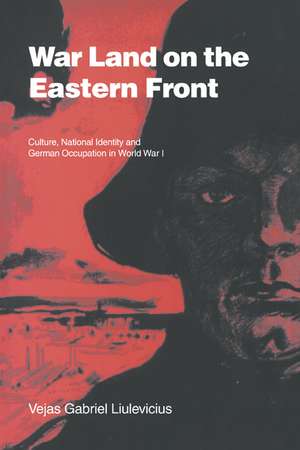
War Land on the Eastern Front
Autor Vejas Gabriel Liulevicius, Liulevicius Vejas Gabriel Editat de Jay Winteren Limba Engleză Paperback – sep 2005
În War Land on the Eastern Front, descoperim o analiză metodică a unei moșteniri adesea umbrite de evenimentele din vestul Europei: impactul ocupației germane în spațiul est-european în timpul Marelui Război. Structura volumului propune o progresie logică, pornind de la contactul inițial al soldaților cu 'pământul războiului', trecând prin faza de utopie militară și programele culturale (Kultur), până la criza finală și fenomenul Freikorps. Considerăm că această abordare 'anatomică' a ocupației oferă o claritate rară asupra modului în care ambițiile administrative s-au ciocnit cu realitățile de pe teren. Merită menționat că autorul, Vejas Gabriel Liulevicius, folosește o varietate impresionantă de surse neglijate anterior, integrând vocile ocupanților și ale ocupaților deopotrivă. Această lucrare se înscrie într-un parcurs academic coerent al autorului, continuând temele explorate în The German Myth of the East, unde acesta investiga fascinația și anxietatea germană față de răsărit. Dacă în The Art of Identity and Memory accentul cădea pe recuperarea experiențelor uitate, aici accentul este pus pe construcția unui stat militar și pe transformarea ideologică a spațiului. Ca alternativă la volumul World War I in Central and Eastern Europe de Judith Devlin pentru același nivel de rigoare istorică, lucrarea de față are avantajul unei focalizări specifice pe mentalitatea germană și pe modul în care 'lecțiile' Frontului de Est au fost ulterior radicalizate de regimul nazist. În timp ce alte titluri similare, precum Other Fronts, Other Wars?, oferă o perspectivă panoramică asupra diverselor teatre de operațiuni, Vejas Gabriel Liulevicius reușește să demonstreze legătura directă dintre politicile de ocupare din 1914-1918 și dezastrele de la mijlocul secolului al XX-lea.
Preț: 415.43 lei
Carte tipărită la comandă
Livrare economică 25 noiembrie-09 decembrie
Specificații
ISBN-10: 0521023904
Pagini: 320
Ilustrații: 5 maps
Dimensiuni: 152 x 229 x 19 mm
Greutate: 0.52 kg
Editura: Cambridge University Press
Locul publicării:Cambridge, United Kingdom
V-ar putea interesa
-
 The Pity of WarNiall Ferguson-18%Preț: 112.99 lei138.07 lei
 -
 The German Myth of the East: 1800 to the PresentVejas Gabriel Liulevicius-22%Preț: 362.94 lei466.68 lei
 -
 Mastering Modern European HistoryStuart Miller-22%Preț: 259.21 lei333.09 lei
 -
 Theories of European IntegrationBen RosamondPreț: 278.35 lei
 -
 The Unbound PrometheusDavid LandesPreț: 273.83 lei
 -
 Hellenist World Alex Roman Conq 2edM. M. AustinPreț: 345.54 lei
 -
 A Concise History of RomaniaKeith HitchinsPreț: 191.83 lei
 -
 After the Civil WarMichael RichardsPreț: 289.18 lei
 -
 DubrovnikRobin HarrisPreț: 196.40 lei
 -
 Byzantium in the Iconoclast Era, c. 680-850Leslie BrubakerPreț: 398.96 lei
 -
 July CrisisThomas OttePreț: 275.05 lei
 -
 Aristocracy and the Modern WorldEllis WassonPreț: 286.54 lei
 -
 Modern Italy, 1871 to the PresentMartin ClarkPreț: 440.49 lei
 -
 -14%Preț: 980.57 lei1140.20 lei
De ce să citești această carte
Recomandăm această carte cititorilor pasionați de istorie militară și socială care doresc să înțeleagă rădăcinile ideologice ale conflictelor din secolul XX. Este o resursă esențială pentru a vedea cum experiența Frontului de Est a modelat viziunea germană asupra spațiului vital, oferind o perspectivă documentată asupra modului în care ocupația militară transformă identitățile culturale și politice.
Despre autor
Vejas Gabriel Liulevicius este un istoric reputat, profesor la University of Tennessee, specializat în istoria modernă a Europei Centrale și de Est. Expertiza sa se concentrează pe intersecția dintre experiența de război, ideologie și construcția identitară. Prin lucrări precum The German Myth of the East și ediția germană a prezentului volum, Kriegsland im Osten, Liulevicius a contribuit fundamental la integrarea istoriei frontului răsăritean în discursul academic global, fiind recunoscut pentru capacitatea de a sintetiza surse de arhivă complexe în narațiuni istorice accesibile și riguroase.
Descriere scurtă
Cuprins
Recenzii
"Drawing on an imporessive array of German and Lithuanian archival sources, and displaying a real flair for the integration of cultural and political theory with empirical research, Liulevicius has written a brilliant, engrossing, deeply insightful history of a failed imperial enterprise in which the material and human costs to the occupied were outweighed only by the moral price paid by the occupiers." Aviel Roshwald, Central European History
"In a dense and well-crafted work, the author has written a book which rewards careful reading even by those familiar with the Eastern Front of the Great War. This is a thoroughly researched social and political study of the evolution of wartime German policy and a valuable addition to the scholarship of the era." Stand To
"The premise of this carefully researched, well-written monograph is that the experience of German soldiers on the eastern front in WW I decisively shaped Nazi policies and helps account for the atrocious behavior of its military and civilian personnel in the East during WW II.... Liulevicius's important book directs our attention to and illuminates important threads of continuity in modern German history." Choice
"a well-researched, scholarly work that does much to explain why Germans, during the rise of Nazism in the decades that followed the Great War, viewed eastern European peoples as uncivilized... This publication is a must acquisition for the researcher who may later explore the German home front of World War I." Jrnl of Slavic Military Studies
"Liulevicius is certainly right to point out that the Eastern Front has been neglected in the historical literature on the First World War, and from that point of view alone his book is a welcome addition." The International History Review
"All of this is superbly researched and analyzed ... this book makes a genuine contribution to the historiography on World War I." Historian
"This fine book examines German occupation policies in Lithuania during World War I and their legacy on the mind-set of German soldiers for whom the experience of war on the eastern front proved to have a profoundly disorienting impact." Slavic Review Winter 2001
"there can be no doubt that Liulevicius's study, arguably the first cultural history of the German occupation of eastern Europe in the First World War, is truly path-breaking." Canadian Journal of History