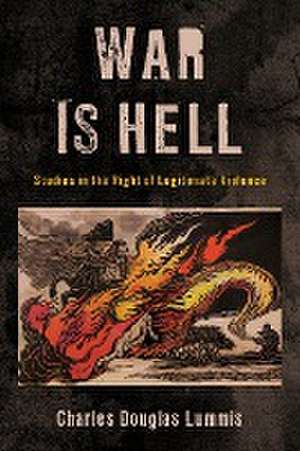
War Is Hell: Studies in the Right of Legitimate Violence: World Social Change
Autor Charles Douglas Lummisen Limba Engleză Paperback – 3 mar 2023
This book is a study of war - and by extension, peace - from the standpoint of political theory. For all those who think there is too much war, and to deal with that we need to search for new ways of thinking.
Din seria World Social Change
- 9%
 Preț: 187.06 lei
 - 15%
 Preț: 197.60 lei
 - 19%
 Preț: 315.63 lei
 - 23%
 Preț: 277.56 lei
 - 27%
 Preț: 403.78 lei
 - 19%
 Preț: 314.19 lei
 - 29%
 Preț: 357.22 lei
 - 24%
 Preț: 352.95 lei
 - 30%
 Preț: 355.87 lei
 -
 Preț: 336.01 lei
 - 24%
 Preț: 366.72 lei
 - 23%
 Preț: 230.29 lei
 - 27%
 Preț: 258.00 lei
 - 24%
 Preț: 255.02 lei
 -
 Preț: 219.35 lei
 - 23%
 Preț: 260.97 lei
 - 23%
 Preț: 260.97 lei
 - 20%
 Preț: 368.86 lei
 - 20%
 Preț: 372.55 lei
 - 20%
 Preț: 318.21 lei
Preț: 221.62 lei
Preț vechi: 293.60 lei
-25%
Puncte Express: 332
Carte tipărită la comandă
Livrare economică 07-21 decembrie
Livrare prin curier în România Termenul estimat este afișat lângă disponibilitate.
Transport gratuit de la 400.00 lei Plată online sau ramburs, în funcție de opțiunile comenzii.
Retur gratuit în 14 zile Comandă securizată și suport în română.
Specificații
ISBN-13: 9781538174210
ISBN-10: 1538174219
Pagini: 254
Dimensiuni: 148 x 228 x 18 mm
Greutate: 0.38 kg
Editura: Bloomsbury Publishing
Colecția Rowman & Littlefield
Seria World Social Change
Locul publicării:New York, United States
ISBN-10: 1538174219
Pagini: 254
Dimensiuni: 148 x 228 x 18 mm
Greutate: 0.38 kg
Editura: Bloomsbury Publishing
Colecția Rowman & Littlefield
Seria World Social Change
Locul publicării:New York, United States
V-ar putea interesa
-
 Philosophie Du CoeurLéonie DusseuilPreț: 168.75 lei
 -
 Doctrine de Saint-Simonnienne. Résumé Général de l'Exposition Faite En 1828-1829Barthélémy-Prosper EnfantinPreț: 83.08 lei
 -
 L'Être Et Le ConnaîtreH. EspinassetPreț: 231.24 lei
 -
 Idées sur la politique de Platon et d'AristoteGiuseppe FerrariPreț: 105.84 lei
 -
 La Matière Et l'ÉnergieÉmile FerrièrePreț: 253.97 lei
 -
 Preț: 89.42 lei
 -
 De la destination du savant et de l'homme de lettresJohann Gottlieb FichtePreț: 105.05 lei
 -
 L'Attitude Du Catholique Devant La Science (2e Éd.)George-Lespinasse FonsegrivePreț: 90.21 lei
 -
 Anti-ÉmileJohann Heinrich Samuel FormeyPreț: 150.75 lei
 -
 Leibniz, Descartes Et SpinozaLouis-Alexandre Foucher De CareilPreț: 161.92 lei
 -
 Dissertations sur la Recherche de la véritéSimon FoucherPreț: 150.15 lei
 -
 Aperçu d'Une Nouvelle Logique.Partie 1L. FoucouPreț: 90.38 lei
 -
 Aperçu d'Une Nouvelle Logique. Partie 3L. FoucouPreț: 97.92 lei
 -
 Esquisse d'Une Interprétation Du MondeAlfred FouilléePreț: 230.86 lei
 -
 Nietzsche Et l'ImmoralismeAlfred FouilléePreț: 175.16 lei
 -
 La Morale Pour Tous (4e Éd.)Adolphe FranckPreț: 135.31 lei
 -
 Les Grands ProblèmesAdolphe FrançoisPreț: 199.07 lei
 -
 Le Grand Catéchisme de la FemmeLouis FrankPreț: 112.99 lei
 -
 Corps Et Âme: Essais Sur La Philosophie de Saint ThomasJules GardairPreț: 206.55 lei
Cuprins
Preface/ Acknowledgements
Introduction: Hell
Chapter 1: Peace as The Original Position
The Original Position
The Right to Make Promises
The Peaceful Village
The Village (2): Enter the Robber Band
The Peace in Daily Life
notes
Chapter 2: The Violent State
The Oxymoronic State
The Magical State
Legitimate Violence: The Hypothesis
Legitimate Violence: The Grand Experiment
The Phenomenon of Violence
The State as Blob
Max Weber and the Evil Moment of the State
notes
Chapter 3: Godlike Violence
Why Gods Can't be Heroes
Holy War
The Gods vs God
The Innocent Warrior
Chapter 4: Distance and Distance Collapse
The Art of Distancing
Overcoming the Fear of Killing
What Drill Instructors Teach
Together in the Bomb Shelter
Nativity in the War Zone
Post-Traumatic Stress Disorder
The Enemy Most Dear to You
Heraclesian Syndrome
"Or Has the Blood of Those You've Slain Made You Mad?"
notes
Chapter 5: (Just) War is Hell, Part I
"Violence Pushed to its Utmost Bounds"
Introduction: Hell
Chapter 1: Peace as The Original Position
The Original Position
The Right to Make Promises
The Peaceful Village
The Village (2): Enter the Robber Band
The Peace in Daily Life
notes
Chapter 2: The Violent State
The Oxymoronic State
The Magical State
Legitimate Violence: The Hypothesis
Legitimate Violence: The Grand Experiment
The Phenomenon of Violence
The State as Blob
Max Weber and the Evil Moment of the State
notes
Chapter 3: Godlike Violence
Why Gods Can't be Heroes
Holy War
The Gods vs God
The Innocent Warrior
Chapter 4: Distance and Distance Collapse
The Art of Distancing
Overcoming the Fear of Killing
What Drill Instructors Teach
Together in the Bomb Shelter
Nativity in the War Zone
Post-Traumatic Stress Disorder
The Enemy Most Dear to You
Heraclesian Syndrome
"Or Has the Blood of Those You've Slain Made You Mad?"
notes
Chapter 5: (Just) War is Hell, Part I
"Violence Pushed to its Utmost Bounds"
Recenzii
Against the Hobbesian view that war is the original state of nature, Lummis argues in this provocative study of war that peace is the ordinary state of affairs for human beings, that violence is violence, and that the right of legitimate violence is "modern warfare's grand enabling clause" (p. xiii). Historically grounded discussions fill in this framework, with attention given to a variety of war-related topics: the role of religion, the meaning of just war, the dehumanization of enemies, the role that rape and pillage play in gendered warfare, and post-traumatic syndrome as a consequence of authorized killing. In conversation with Aquinas, Machiavelli, Weber, and Arendt, Lummis offers an in-depth discussion of Article 9 of the Japanese Constitution, which banned the right of belligerency, and then concludes with a discussion of Gandhi's vision of a radically different political configuration able to generate power and build community through nonviolent noncooperation. Lummis contends that the turn away from war requires collective action that withdraws consent to the right of belligerency. This well-researched, challenging, and original work should be of interest to students of history, international relations, political science, and ethics. Highly recommended. Advanced undergraduates through faculty.
War Is Hell is scholarly, well founded and illuminating. Very original and stimulating, which is characteristic of Doug Lummis.
Lummis' masterful combination of scholarship, grace, passion, and common sense gives us new ways of thinking about war and peace.
I've followed Charles Douglas Lummis' peace activism and anti-war analyses for years. "War is Hell" in the culmination of his exceptional experience and knowledge. From Dante and Hobbes to Arendt and Walzer, from the scorched earth of Atlanta to the ashes of Tokyo, this book takes us on an intellectual and political journey that energizes us to think tougher thoughts about building peace.
War Is Hell is scholarly, well founded and illuminating. Very original and stimulating, which is characteristic of Doug Lummis.
Lummis' masterful combination of scholarship, grace, passion, and common sense gives us new ways of thinking about war and peace.
I've followed Charles Douglas Lummis' peace activism and anti-war analyses for years. "War is Hell" in the culmination of his exceptional experience and knowledge. From Dante and Hobbes to Arendt and Walzer, from the scorched earth of Atlanta to the ashes of Tokyo, this book takes us on an intellectual and political journey that energizes us to think tougher thoughts about building peace.