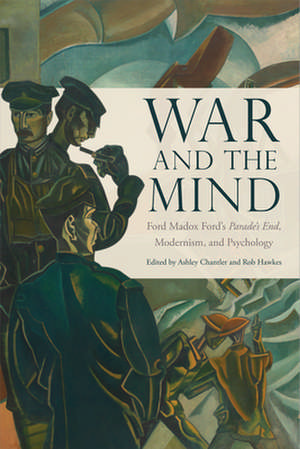
War and the Mind
Editat de Ashley Chantler, Rob Hawkesen Limba Engleză Hardback – 2 iun 2015
Bazându-ne pe arhivele critice recente și pe resursele oferite de Edinburgh University Press, analizăm War and the Mind, o lucrare esențială pentru înțelegerea modernismului literar prin prisma traumei. Considerăm acest volum, editat de Ashley Chantler și Rob Hawkes, drept prima investigație exhaustivă a dimensiunii psihologice din tetralogia Parade's End (Full Tetralogy). Observăm o trecere de la analiza pur literară spre o abordare interdisciplinară, unde estetica „Impresionismului literar” al lui Ford este confruntată direct cu realitățile clinice ale „shell shock-ului” și ale tulburărilor de memorie. Eseurile incluse aici nu se limitează la textul lui Ford, ci extind cadrul cercetării către figuri precum Virginia Woolf sau Rebecca West, oferind o perspectivă nuanțată asupra modului în care Marele Război a fracturat conștiința britanică. Volumul acoperă aceeași arie tematică precum Shell Shock and the Modernist Imagination, dar cu o abordare mai aplicată pe structura narativă a operei lui Ford, explorând modul în care trauma dictează forma romanului, nu doar conținutul acestuia. În contextul operei editorului, War and the Mind completează viziunea generală oferită în An Introduction to Ford Madox Ford, trecând de la o introducere contextuală la o analiză de profunzime a mecanismelor psihice descrise în capodopera sa. Structura este riguroasă, cele zece capitole integrând teorii semnate de Deleuze, Guattari și Freud pentru a ilumina concepte precum empatia și terapia prin scris. Această abordare face ca volumul să fie o resursă indispensabilă pentru studiile de gen și teoria traumei, oferind o nouă rigoare academică înțelegerii prozei moderniste.
Preț: 596.96 lei
Preț vechi: 796.57 lei
-25%
Carte disponibilă
Livrare economică 09-23 noiembrie
Specificații
ISBN-10: 0748694269
Pagini: 224
Dimensiuni: 152 x 236 x 18 mm
Greutate: 0.48 kg
Editura: EDINBURGH UNIVERSITY PRESS
V-ar putea interesa
-
 John FowlesJonathan NoakesPreț: 109.18 lei
 -
 After Yeats and Joyce: Reading Modern Irish LiteratureNeil Corcoran-20%Preț: 273.43 lei339.83 lei
 -
 -13%Preț: 301.50 lei346.30 lei
 -
 -17%Preț: 175.24 lei209.97 lei
 -
 Literature of the 1980s: After the WatershedJoseph Brooker-17%Preț: 174.15 lei209.68 lei
 -
 Modernist LiteratureRachel Potter-17%Preț: 172.87 lei208.86 lei
 -
 -22%Preț: 215.17 lei276.78 lei
 -
 IntermodernismKristin Bluemel-17%Preț: 180.72 lei216.52 lei
 -
 Djuna Barnes and Affective ModernismJulie Taylor-25%Preț: 597.38 lei793.88 lei
 -
 -17%Preț: 181.39 lei217.74 lei
 -
 Norman, D: Agatha ChristieDr Andrew NormanPreț: 89.16 lei
 -
 Isaac Rosenberg: The Making Of A Great War PoetJean Moorcroft Wilson-26%Preț: 90.30 lei121.68 lei
 -
 Arthur MillerChristopher BigsbyPreț: 170.62 lei
 -
 Branch-linesGuy CuthbertsonPreț: 110.26 lei
De ce să citești această carte
Recomandăm această carte cercetătorilor și studenților la litere interesați de intersecția dintre literatură și psihologie. Cititorul câștigă o înțelegere profundă a modului în care trauma de război a modelat tehnicile narative moderne. Este un instrument critic esențial pentru oricine dorește să exploreze Parade's End dincolo de contextul istoric, prin lentila medical humanities și a teoriilor contemporane despre memorie și represiune.