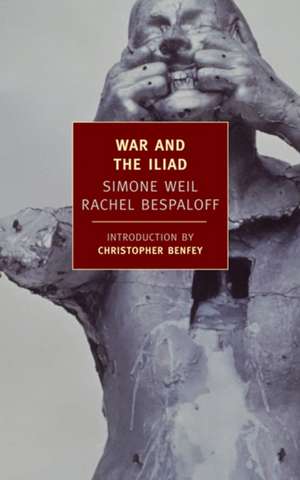
War and the Iliad
Autor Simone Weil, Rachel Bespaloff Traducere de Mary Mccarthyen Limba Engleză Paperback – 31 mar 2005
Remarcăm relevanța acestei ediții în cadrul studiilor de literatură clasică și filozofie politică, fiind o resursă esențială pentru înțelegerea modului în care textele antice pot fi utilizate ca instrumente de analiză pentru conflictele contemporane. Volumul War and the Iliad reunește pentru prima dată două perspective feminine divergente, dar complementare, asupra epopeii homerice, oferind un cadru de analiză ce transcende simpla critică literară. Notăm cu interes modul în care Simone Weil transformă The Iliad într-o meditație asupra forței ca entitate ce dezumanizează atât victima, cât și agresorul, un concept care a devenit piatră de temelie în interpretarea modernă a lui Homer. Comparabil cu lucrarea lui Charles H. Stocking, Homer's Iliad and the Problem of Force, în rigurozitatea cu care tratează conceptul de violență, acest volum se distinge prin contextul istoric imediat în care a fost scris. Dacă Stocking analizează forța din perspective filologice, Weil și Bespaloff o privesc ca pe o realitate existențială trăită în timpul celui de-al Doilea Război Mondial. În contextul operei sale, această lucrare se situează între activismul politic din The Need for Roots și căutarea spirituală din Waiting for God, marcând tranziția autoarei către o filozofie a compasiunii și a recunoașterii suferinței umane. Credem că structura acestui volum, care include și replica lui Rachel Bespaloff, oferă un echilibru necesar: dacă Weil vede în epopee un „poem al forței” ce distruge umanitatea, Bespaloff subliniază alegerile etice și drama existențială a personajelor. Stilul este dens, reflexiv, iar traducerea semnată de Mary McCarthy păstrează tensiunea intelectuală a originalului francez, transformând lectura într-un exercițiu de rezistență morală în fața brutalității istoriei.
Preț: 90.19 lei
Carte disponibilă
Livrare economică 29 octombrie-12 noiembrie
Specificații
ISBN-10: 1590171454
Pagini: 152
Dimensiuni: 127 x 205 x 9 mm
Greutate: 0.15 kg
Editura: NEW YORK REVIEW OF BOOKS
Locul publicării:United States
V-ar putea interesa
-
 The Company She KeepsMary McCarthyPreț: 106.97 lei
 -
 Cast A Cold EyeMary McCarthyPreț: 96.95 lei
 -
 Charmed LifeMcCarthyPreț: 146.30 lei
 -
 Gravity and GraceSimone WeilPreț: 171.61 lei
 -
 Lectures on PhilosophySimone WeilPreț: 158.50 lei
 -
 The World of OdysseusM. I. FinleyPreț: 101.64 lei
 -
 DanteErich AuerbachPreț: 119.21 lei
 -
 Preț: 121.87 lei
 -
 Preț: 277.94 lei
 -
 HetärenbriefeAlkiphronPreț: 102.64 lei
 -
 Froschmäusekrieg / BatrachomyomachiaThassilo Von SchefferPreț: 109.04 lei
 -
 Preț: 277.94 lei
 -
 PerserkriegeProkopPreț: 323.75 lei
 -
 Gastmahl des TrimalchioPetroniusPreț: 171.63 lei
 -
 Pompeianische WandinschriftenHieronymus GeistPreț: 191.50 lei
 -
 KinderzuchtPlutarchPreț: 191.18 lei
 -
 Über Liebe und EhePlutarchPreț: 193.51 lei
 -
 Antike AstronomieHeinrich BalssPreț: 276.88 lei
 -
 Preț: 192.20 lei
 -
 Buch VII-VIIIHermann BeckbyPreț: 398.33 lei
 -
 Buch IX-XIHermann Beckby-8%Preț: 407.91 lei443.39 lei
 -
 Buch I-VIHermann BeckbyPreț: 401.14 lei
 -
 Buch XII - XVIHermann Beckby-8%Preț: 506.03 lei550.03 lei
 -
 A Little Primer of Tu FuDavid HawkesPreț: 98.18 lei
De ce să citești această carte
Această carte este o resursă indispensabilă pentru studenții la litere, filozofie sau istorie, oferind o perspectivă unică asupra modului în care clasicii pot fi recitiți în momente de criză globală. Cititorul câștigă o înțelegere profundă a legăturii dintre puterea brută și condiția umană, fiind un ghid intelectual care transformă lectura The Iliad dintr-un exercițiu academic într-o necesitate morală pentru înțelegerea conflictelor de orice fel.
Despre autor
Simone Weil (1909–1943) a fost o figură singulară în peisajul intelectual al secolului XX, descrisă de Albert Camus drept „singurul spirit mare al timpului nostru”. Filozof, mistică și activistă politică, Weil a trăit cu o intensitate rară, alegând să lucreze în fabrici de mașini pentru a înțelege condiția muncitorului și implicându-se în Războiul Civil Spaniol. Deși majoritatea scrierilor sale, precum First and Last Notebooks, au fost publicate postum, influența sa asupra teologiei și filozofiei politice moderne rămâne imensă. Opera sa reflectă o preocupare constantă pentru obligațiile etice față de ceilalți și pentru relația dintre om și sacru.
Descriere scurtă
Simone Weil's The Iliad, or the Poem of Force is one of her most celebrated works--an inspired analysis of Homer's epic that presents a nightmare vision of combat as a machine in which all humanity is lost. First published on the eve of war in 1939, the essay has often been read as a pacifist manifesto. Rachel Bespaloff was a French contemporary of Weil's whose work similarly explored the complex relations between literature, religion, and philosophy. She composed her own distinctive discussion of the Iliad in the midst of World War II--calling it "her method of facing the war"--and, as Christopher Benfey argues in his introduction, the essay was very probably written in response to Weil. Bespaloff's account of the Iliad brings out Homer's novelistic approach to character and the existential drama of his characters' choices; it is marked, too, by a tragic awareness of how the Iliad speaks to times and places where there is no hope apart from war.
This edition brings together these two influential essays for the first time, accompanied by Benfey's scholarly introduction and an afterword by the great Austrian novelist Hermann Broch.
Notă biografică
Rachel Bespaloff (1895ߝ1949) was born to a Ukrainian Jewish family—her father was the Zionist theoretician Daniel Pasmanik—and raised in Geneva. Bespaloff intended to pursue a musical career, but after an encounter with the thinker Leo Shestov, she devoted herself to the study of philosophy. One of the first French readers of Heidegger, Bespaloff published essays in the 1930s about Kierkegaard, Gabriel Marcel, André Malraux, and Julien Green, among other philosophers and writers. In 1942, she left France for the United States, where she worked as a scriptwriter for the French Section of the Office of War Information before teaching French literature at Mount Holyoke. In 1949, Rachel Bespaloff committed suicide, leaving a note that said she was “too fatigued to carry on.”
Christopher Benfey is Mellon Professor of English at Mount Holyoke. His latest book, Red Brick, Black Mountain, White Clay, is now out in paperback. (March 2013)
Hermann Broch (1886-1951) was the author of The Sleepwalkers and The Death of Virgil, among other novels.
Mary McCarthy (1912-1989) was a novelist, essayist, and critic. Her political and social commentary, literary essays, and drama criticism appeared in magazines such as Partisan Review, The New Yorker, Harper’s, and The New York Review of Books, and were collected in On the Contrary (1961), Mary McCarthy’s Theatre Chronicles 1937-1962 (1963), The Writing on the Wall (1970), Ideas and the Novel (1980), and Occasional Prose (1985). Her novels include The Company She Keeps (1942), The Oasis (1949), The Groves of Academe (1952), A Charmed Life (1955), The Group (1963), Birds of America (1971), and Cannibals and Missionaries (1979). She was the author of three works of autobiography, Memories of a Catholic Girlhood (1957), How I Grew (1987), and the unfinished Intellectual Memoirs (1992), and two travel books about Italy, Venice Observed (1956) and The Stones of Florence (1959). Her essays on the Vietnam War were collected in The Seventeenth Degree (1974); her essays on Watergate were collected in The Mask of State (1974).
Recenzii
— Marina Warner, The Times Literary Supplement “Book of the Year”
"The publication of Simone Weil’s essay…[was] an event of great importance to those of us who read it. This is one of the most moving and original literary essays ever written."
— Elizabeth Hardwick
"In the early months of the Second World War two brilliant and despairing French women of Jewish background each wrote an essay on the Iliad. Weil’s 'The Iliad, or The Poem of Force', and Bespaloff’s 'On the Iliad' remain the twentieth century’s most beloved, tortured, and profound responses to the world’s greatest and most disturbing poem. Before the world ended, Mary McCarthy had translated both essays into English, and plans were soon made to publish them together in a book, but to no avail. Here, thanks to NYRB (one of the very few happy innovations in contemporary publishing), the two are finally between the same covers. This is an especially important service for Bespaloff’s essay, which has never been readily available as Weil’s."
— Benjamin Schwarz, The Atlantic Monthly