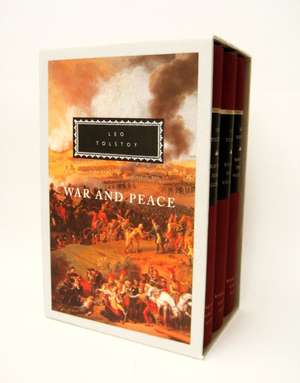
War and Peace
Autor Leo Tolstoy Traducere de Louise Maude, Alymer Maudeen Limba Engleză Hardback – 7 dec 1992
War and Peace broadly focuses on Napoleon's invasion of Russia in 1812 and follows three of the most well-known characters in literature: Pierre Bezukhov, the illegitimate son of a count who is fighting for his inheritance and yearning for spiritual fulfillment; Prince Andrei Bolkonsky, who leaves his family behind to fight in the war against Napoleon; and Natasha Rostov, the beautiful young daughter of a nobleman who intrigues both men.
As Napoleon's army invades, Tolstoy brilliantly follows characters from diverse backgrounds—peasants and nobility, civilians and soldiers—as they struggle with the problems unique to their era, their history, and their culture. And as the novel progresses, these characters transcend their specificity, becoming some of the most moving—and human—figures in world literature. Translated by Richard Pevear and Larissa Volokhonsky
(Book Jacket Status: Not Jacketed)
Three-Volume Boxed Set
| Toate formatele și edițiile | Preț | Express |
|---|---|---|
| Paperback (18) | 41.95 lei 3-5 săpt. | +32.55 lei 4-10 zile |
| WORDSWORTH EDITIONS LTD – iul 1993 | 41.95 lei 3-5 săpt. | +32.55 lei 4-10 zile |
| Oxford University Press – 14 oct 2010 | 84.07 lei 23-29 zile | +52.87 lei 4-10 zile |
| Penguin Books – 24 feb 2009 | 85.17 lei 24-35 zile | +54.82 lei 4-10 zile |
| Andrews McMeel Publishing – 27 oct 2022 | 93.81 lei 24-36 zile | |
| Little Brown – 28 aug 2025 | 95.17 lei 3-5 săpt. | +86.33 lei 4-10 zile |
| Vintage Publishing – 6 aug 2009 | 95.63 lei 24-35 zile | +59.93 lei 4-10 zile |
| Random House – 7 noi 2024 | 96.68 lei 3-5 săpt. | +39.24 lei 4-10 zile |
| BBC BOOKS – apr 2016 | 110.05 lei 24-35 zile | +54.12 lei 4-10 zile |
| Dover Publications – 13 sep 2017 | 124.53 lei 3-5 săpt. | |
| Random House – 9 iul 2002 | 136.27 lei 3-5 săpt. | |
| Knopf Doubleday Publishing Group – 2 dec 2008 | 155.89 lei 3-5 săpt. | +64.36 lei 4-10 zile |
| Penguin Publishing Group – dec 2006 | 189.98 lei 3-5 săpt. | |
| Mint Editions – 4 mai 2021 | 42.60 lei 6-8 săpt. | |
| – | 193.42 lei 3-5 săpt. | |
| Devoted Publishing – 23 dec 2016 | 264.87 lei 6-8 săpt. | |
| SC Active Business Development SRL – 13 apr 2017 | 283.46 lei 38-44 zile | |
| Throne Classics – 24 mai 2019 | 374.56 lei 38-44 zile | |
| Read & Co. Classics – 7 sep 2020 | 396.91 lei 6-8 săpt. | |
| Hardback (12) | 69.10 lei 3-5 săpt. | +72.36 lei 4-10 zile |
| OUP OXFORD – 28 sep 2017 | 120.19 lei 23-29 zile | +72.36 lei 4-10 zile |
| Penguin Books – 7 ian 2016 | 137.11 lei 24-35 zile | +115.59 lei 4-10 zile |
| Arcturus Publishing – 15 mar 2019 | 144.58 lei 3-5 săpt. | +89.69 lei 4-10 zile |
| Vintage Publishing – 8 noi 2007 | 194.86 lei 24-35 zile | |
| Little Brown – 2 ian 2020 | 198.40 lei 3-5 săpt. | +50.94 lei 4-10 zile |
| EVERYMAN – 29 oct 1992 | 372.83 lei 24-35 zile | +136.99 lei 4-10 zile |
| Knopf Doubleday Publishing Group – 7 dec 1992 | 423.15 lei 3-5 săpt. | |
| Mint Editions – 15 feb 2022 | 69.10 lei 3-5 săpt. | |
| BENEDICTION CLASSICS – 24 noi 2019 | 378.09 lei 6-8 săpt. | |
| BENEDICTION CLASSICS – 26 apr 2017 | 383.14 lei 6-8 săpt. | |
| Prince Classics – 14 apr 2019 | 413.12 lei 38-44 zile | |
| Benediction Classics – 5 feb 2016 | 451.27 lei 38-44 zile |
Preț: 423.15 lei
Preț vechi: 459.95 lei
-8%
Puncte Express: 635
Preț estimativ în valută:
74.83€ • 85.80$ • 64.67£
74.83€ • 85.80$ • 64.67£
Carte disponibilă
Livrare economică 07-21 aprilie
Specificații
ISBN-13: 9780679405733
ISBN-10: 0679405739
Pagini: 1736
Dimensiuni: 136 x 217 x 105 mm
Greutate: 1.93 kg
Editura: Knopf Doubleday Publishing Group
ISBN-10: 0679405739
Pagini: 1736
Dimensiuni: 136 x 217 x 105 mm
Greutate: 1.93 kg
Editura: Knopf Doubleday Publishing Group
V-ar putea interesa
-
 The Art of RhetoricAristotePreț: 28.16 lei
 -
 And Then There Were NoneAgatha ChristiePreț: 68.76 lei
 -
 The Essential Rumi - ReissueColeman BarksPreț: 105.54 lei
 -
 -20%Preț: 49.11 lei61.58 lei
 -
 On the Shortness of LifeLucius Annaeus Seneca-22%Preț: 42.02 lei53.76 lei
 -
 MeditationsMarcus Aurelius-21%Preț: 42.72 lei54.18 lei
 -
 On SuicideDavid Hume-22%Preț: 42.24 lei53.87 lei
 -
 Animal FarmGeorge Orwell-30%Preț: 46.96 lei66.90 lei
 -
 The Idea FactoryJon Gertner-44%Preț: 58.30 lei103.73 lei
 -
 Anna KareninaLeo Tolstoy-14%Preț: 62.80 lei73.39 lei
 -
 Preț: 97.19 lei
 -
 The Little Book of HyggeMeik Wiking-18%Preț: 86.36 lei105.38 lei
 -
 SteppenwolfHermann HessePreț: 67.87 lei
 -
 Godel, Escher, Bach: An Eternal Golden BraidDouglas Hofstadter-22%Preț: 113.34 lei144.49 lei
 -
 PoeticsAristotle-21%Preț: 18.69 lei23.72 lei
 -
 The Remains of the DayKazuo IshiguroPreț: 61.35 lei
 -
 The Name of the Wind: The legendary must-read fantasy masterpiecePatrick Rothfuss-25%Preț: 68.80 lei91.66 lei
 -
 Fantastically Great Women Who Changed The WorldKate Pankhurst-36%Preț: 35.79 lei55.86 lei
 -
 Revolt of the AngelsAnatole FrancePreț: 117.65 lei
 -
 -22%Preț: 121.71 lei155.13 lei
 -
 Some Assembly RequiredNeil ShubinPreț: 82.34 lei
 -
 Crime and PunishmentFyodor DostoevskyPreț: 37.65 lei
 -
 The Little PrinceAntoine De Saint-ExuperyPreț: 34.01 lei
 -
 Anna KareninaLeo TolstoyPreț: 40.37 lei
 -
 Beyond Good & EvilFriedrich Wilhelm NietzschePreț: 69.21 lei
Extras
WELL, PRINCE, Genoa and Lucca are now no more than private estates of the Bonaparte family. No, I warn you, that if you do not tell me we are at war, if you again allow yourself to palliate all the infamies and atrocities of this Antichrist (upon my word, I believe he is), I don’t know you in future, you are no longer my friend, no longer my faithful slave, as you say. There, how do you do, how do you do? I see I’m scaring you, sit down and talk to me.”
These words were uttered in July 1805 by Anna Pavlovna Scherer, a distinguished lady of the court, and confidential maid-of-honour to the Empress Marya Fyodorovna. It was her greeting to Prince Vassily, a man high in rank and office, who was the first to arrive at her soirée. Anna Pavlovna had been coughing for the last few days; she had an attack of la grippe, as she said—grippe was then a new word only used by a few people. In the notes she had sent round in the morning by a footman in red livery, she had written to all indiscriminately:
“If you have nothing better to do, count (or prince), and if the prospect of spending an evening with a poor invalid is not too alarming to you, I shall be charmed to see you at my house between 7 and 10. Annette Scherer.”
“Heavens! what a violent outburst!” the prince responded, not in the least disconcerted at such a reception. He was wearing an embroidered court uniform, stockings and slippers, and had stars on his breast, and a bright smile on his flat face.
He spoke in that elaborately choice French, in which our forefathers not only spoke but thought, and with those slow, patronising intonations peculiar to a man of importance who has grown old in court society. He went up to Anna Pavlovna, kissed her hand, presenting her with a view of his perfumed, shining bald head, and complacently settled himself on the sofa.
“First of all, tell me how you are, dear friend. Relieve a friend’s anxiety,” he said, with no change of his voice and tone, in which indifference, and even irony, was perceptible through the veil of courtesy and sympathy.
“How can one be well when one is in moral suffering? How can one help being worried in these times, if one has any feeling?” said Anna Pavlovna. “You’ll spend the whole evening with me, I hope?”
“And the fête at the English ambassador’s? To-day is Wednesday. I must put in an appearance there,” said the prince. “My daughter is coming to fetch me and take me there.”
“I thought to-day’s fête had been put off. I confess that all these festivities and fireworks are beginning to pall.”
“If they had known that it was your wish, the fête would have been put off,” said the prince, from habit, like a wound-up clock, saying things he did not even wish to be believed.
“Don’t tease me. Well, what has been decided in regard to the Novosiltsov dispatch? You know everything.”
“What is there to tell?” said the prince in a tired, listless tone. “What has been decided? It has been decided that Bonaparte has burnt his ships, and I think that we are about to burn ours.”
Prince Vassily always spoke languidly, like an actor repeating his part in an old play. Anna Pavlovna Scherer, in spite of her forty years, was on the contrary brimming over with excitement and impulsiveness. To be enthusiastic had become her pose in society, and at times even when she had, indeed, no inclination to be so, she was enthusiastic so as not to disappoint the expectations of those who knew her. The affected smile which played continually about Anna Pavlovna’s face, out of keeping as it was with her faded looks, expressed a spoilt child’s continual consciousness of a charming failing of which she had neither the wish nor the power to correct herself, which, indeed, she saw no need to correct.
These words were uttered in July 1805 by Anna Pavlovna Scherer, a distinguished lady of the court, and confidential maid-of-honour to the Empress Marya Fyodorovna. It was her greeting to Prince Vassily, a man high in rank and office, who was the first to arrive at her soirée. Anna Pavlovna had been coughing for the last few days; she had an attack of la grippe, as she said—grippe was then a new word only used by a few people. In the notes she had sent round in the morning by a footman in red livery, she had written to all indiscriminately:
“If you have nothing better to do, count (or prince), and if the prospect of spending an evening with a poor invalid is not too alarming to you, I shall be charmed to see you at my house between 7 and 10. Annette Scherer.”
“Heavens! what a violent outburst!” the prince responded, not in the least disconcerted at such a reception. He was wearing an embroidered court uniform, stockings and slippers, and had stars on his breast, and a bright smile on his flat face.
He spoke in that elaborately choice French, in which our forefathers not only spoke but thought, and with those slow, patronising intonations peculiar to a man of importance who has grown old in court society. He went up to Anna Pavlovna, kissed her hand, presenting her with a view of his perfumed, shining bald head, and complacently settled himself on the sofa.
“First of all, tell me how you are, dear friend. Relieve a friend’s anxiety,” he said, with no change of his voice and tone, in which indifference, and even irony, was perceptible through the veil of courtesy and sympathy.
“How can one be well when one is in moral suffering? How can one help being worried in these times, if one has any feeling?” said Anna Pavlovna. “You’ll spend the whole evening with me, I hope?”
“And the fête at the English ambassador’s? To-day is Wednesday. I must put in an appearance there,” said the prince. “My daughter is coming to fetch me and take me there.”
“I thought to-day’s fête had been put off. I confess that all these festivities and fireworks are beginning to pall.”
“If they had known that it was your wish, the fête would have been put off,” said the prince, from habit, like a wound-up clock, saying things he did not even wish to be believed.
“Don’t tease me. Well, what has been decided in regard to the Novosiltsov dispatch? You know everything.”
“What is there to tell?” said the prince in a tired, listless tone. “What has been decided? It has been decided that Bonaparte has burnt his ships, and I think that we are about to burn ours.”
Prince Vassily always spoke languidly, like an actor repeating his part in an old play. Anna Pavlovna Scherer, in spite of her forty years, was on the contrary brimming over with excitement and impulsiveness. To be enthusiastic had become her pose in society, and at times even when she had, indeed, no inclination to be so, she was enthusiastic so as not to disappoint the expectations of those who knew her. The affected smile which played continually about Anna Pavlovna’s face, out of keeping as it was with her faded looks, expressed a spoilt child’s continual consciousness of a charming failing of which she had neither the wish nor the power to correct herself, which, indeed, she saw no need to correct.
Recenzii
“There remains the greatest of all novelists—for what else can we call the author of War and Peace?” —Virginia Woolf
Textul de pe ultima copertă
Among the great novels of the world, 'War and Peace' has long held pride of place because it fulfills, in its seamless interweaving of the historical and the personal, and its genius in registering the entire scale of human life, all the promise latent in the art of fiction itself.
Descriere
Descriere de la o altă ediție sau format:
'If life could write, it would write like Tolstoy.' Isaac BabelTolstoy's epic masterpiece intertwines the lives of private and public individuals during the time of the Napoleonic wars and the French invasion of Russia. The fortunes of the Rostovs and the Bolkonskys, of Pierre, Natasha, and Andrei, are intimately connected with the national history that is played out in parallel with their lives. Balls and soirées alternate with councils of war and the machinations of statesmen and generals, scenes of violent battles with everyday human passions in a work whose extraordinary imaginative power has never been surpassed. The prodigious cast of characters, both great and small, seem to act and move as if connected by threads of destiny as the novel relentlessly questions ideas of free will, fate, and providence. Yet Tolstoy's portrayal of marital relations and scenes of domesticity is as truthful and poignant as the grand themes that underlie them.In this revised and updated version of the definitive and highly acclaimed Maude translation, Tolstoy's genius and the power of his prose are made newly available to the contemporary reader. ABOUT THE SERIES: For over 100 years Oxford World's Classics has made available the widest range of literature from around the globe. Each affordable volume reflects Oxford's commitment to scholarship, providing the most accurate text plus a wealth of other valuable features, including expert introductions by leading authorities, helpful notes to clarify the text, up-to-date bibliographies for further study, and much more.
'If life could write, it would write like Tolstoy.' Isaac BabelTolstoy's epic masterpiece intertwines the lives of private and public individuals during the time of the Napoleonic wars and the French invasion of Russia. The fortunes of the Rostovs and the Bolkonskys, of Pierre, Natasha, and Andrei, are intimately connected with the national history that is played out in parallel with their lives. Balls and soirées alternate with councils of war and the machinations of statesmen and generals, scenes of violent battles with everyday human passions in a work whose extraordinary imaginative power has never been surpassed. The prodigious cast of characters, both great and small, seem to act and move as if connected by threads of destiny as the novel relentlessly questions ideas of free will, fate, and providence. Yet Tolstoy's portrayal of marital relations and scenes of domesticity is as truthful and poignant as the grand themes that underlie them.In this revised and updated version of the definitive and highly acclaimed Maude translation, Tolstoy's genius and the power of his prose are made newly available to the contemporary reader. ABOUT THE SERIES: For over 100 years Oxford World's Classics has made available the widest range of literature from around the globe. Each affordable volume reflects Oxford's commitment to scholarship, providing the most accurate text plus a wealth of other valuable features, including expert introductions by leading authorities, helpful notes to clarify the text, up-to-date bibliographies for further study, and much more.
Notă biografică
Count Lev Nikolayevich Tolstoy (9 September [O.S. 28 August] 1828 - 20 November [O.S. 7 November] 1910), usually referred to in English as Leo Tolstoy, was a Russian writer who is regarded as one of the greatest authors of all time.[3] He received multiple nominations for the Nobel Prize in Literature every year from 1902 to 1906 and nominations for Nobel Peace Prize in 1901, 1902 and 1910 and the fact that he never won is a major Nobel prize controversy. Born to an aristocratic Russian family in 1828,[3] he is best known for the novels War and Peace (1869) and Anna Karenina (1877),[8] often cited as pinnacles of realist fiction.[3] He first achieved literary acclaim in his twenties with his semi-autobiographical trilogy, Childhood, Boyhood, and Youth (1852-1856), and Sevastopol Sketches (1855), based upon his experiences in the Crimean War. Tolstoy's fiction includes dozens of short stories and several novellas such as The Death of Ivan Ilyich (1886), Family Happiness (1859), and Hadji Murad (1912). He also wrote plays and numerous philosophical essays. In the 1870s Tolstoy experienced a profound moral crisis, followed by what he regarded as an equally profound spiritual awakening, as outlined in his non-fiction work A Confession (1882). His literal interpretation of the ethical teachings of Jesus, centering on the Sermon on the Mount, caused him to become a fervent Christian anarchist and pacifist.[3] Tolstoy's ideas on nonviolent resistance, expressed in such works as The Kingdom of God Is Within You (1894), had a profound impact on such pivotal 20th-century figures as Mahatma Gandhi[9] and Martin Luther King Jr.[10] Tolstoy also became a dedicated advocate of Georgism, the economic philosophy of Henry George, which he incorporated into his writing, particularly Resurrection (1899).