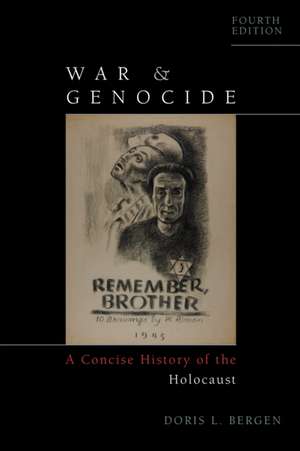
War and Genocide: A Concise History of the Holocaust
Autor Doris L. Bergenen Limba Engleză Paperback – 23 aug 2024
Preț: 208.62 lei
Preț vechi: 334.00 lei
-38%
Puncte Express: 313
Carte disponibilă
Livrare economică 02-16 noiembrie
Livrare express 17-23 octombrie pentru 166.99 lei
Livrare prin curier în România Termenul estimat este afișat lângă disponibilitate.
Transport gratuit de la 400.00 lei Plată online sau ramburs, în funcție de opțiunile comenzii.
Retur gratuit în 14 zile Comandă securizată și suport în română.
Specificații
ISBN-13: 9781538178065
ISBN-10: 1538178060
Pagini: 440
Ilustrații: 104 b/w photos; 10 maps;
Dimensiuni: 156 x 232 x 26 mm
Greutate: 0.52 kg
Ediția:4th edition
Editura: Bloomsbury Publishing
Colecția Rowman & Littlefield
Locul publicării:New York, United States
ISBN-10: 1538178060
Pagini: 440
Ilustrații: 104 b/w photos; 10 maps;
Dimensiuni: 156 x 232 x 26 mm
Greutate: 0.52 kg
Ediția:4th edition
Editura: Bloomsbury Publishing
Colecția Rowman & Littlefield
Locul publicării:New York, United States
Cuprins
Table of Contents
Acknowledgments
List of Illustrations and Photo Credits
List of Maps
Introduction Holocaust, War, and Genocide Themes and Problems
1 Dry Timber Preconditions
2 Leadership and Will Hitler, the National Socialist German Workers' Party, and Nazi Ideology
3 From Revolution to Routine Nazi Germany, 1933-1938
4 Open Aggression In Search of War, 1938-1939
5 Brutal Innovations War against Poland and Ghettoization of Jews, 1939-1940
6 Escalation and Expansion The Program to Kill People with Disabilities and the War in the West, 1939-1941
7 The War of Annihilation, 1941-1943
8 Flashover: The Peak Years of Killing Jews, 1942-1943
9 Death Throes and Killing Frenzies, 1944-1945
Conclusion: Legacies of Atrocity
Index
About the Author
Acknowledgments
List of Illustrations and Photo Credits
List of Maps
Introduction Holocaust, War, and Genocide Themes and Problems
1 Dry Timber Preconditions
2 Leadership and Will Hitler, the National Socialist German Workers' Party, and Nazi Ideology
3 From Revolution to Routine Nazi Germany, 1933-1938
4 Open Aggression In Search of War, 1938-1939
5 Brutal Innovations War against Poland and Ghettoization of Jews, 1939-1940
6 Escalation and Expansion The Program to Kill People with Disabilities and the War in the West, 1939-1941
7 The War of Annihilation, 1941-1943
8 Flashover: The Peak Years of Killing Jews, 1942-1943
9 Death Throes and Killing Frenzies, 1944-1945
Conclusion: Legacies of Atrocity
Index
About the Author
Recenzii
Doris Bergen's War and Genocide has long served as an excellent introduction to the history of the Holocaust. Clearly and engagingly written, the book combines sweeping historical analysis with insightful stories of how ordinary people experienced these terrible events. This new edition integrates up-to-date research in the field and includes expanded consideration of the Holocaust in comparison with other genocides.
Bergen's outstanding volume on the Holocaust has been made even better in this new edition. The emphasis on genocide as a process that must center on the complexity of humanity itself forms the core critical contribution of the book. To this, Bergen has added rich new materials and sources, including important visual material from Jewish victims and survivors. Her subtle but accessible text remains the model for approaching this difficult history.
Written by one of the field's leading scholars in a beautiful and easy to read style, this book is remarkably comprehensive, and impressively up-to-date on evolving scholarship. It covers all the important themes and trends in Holocaust history over the last forty years, as well as all of the geographic areas. The book also brings in personal stories of victims and survivors. It makes my class much richer and easier to teach; War and Genocide is beyond compare.
In this fourth edition of War and Genocide, Doris Bergen integrates new insights from scholarly research into the Holocaust, making it accessible to a wider readership, and showing how our understanding of this enormous event keeps evolving. In doing so, Bergen broadens the book's geographical scope to include the Middle East; draws revealing links between the Holocaust, colonialism, eugenics, racism, and modern forms of warfare; and gives voice to a spectrum of individual people. A brilliant educator, Bergen thoughtfully and clearly, guides readers to consider how events and individual fates are "similar to, distinct from, and connected to" each other as well as the place of the Holocaust within a broader global human history of genocide.
Bergen's outstanding volume on the Holocaust has been made even better in this new edition. The emphasis on genocide as a process that must center on the complexity of humanity itself forms the core critical contribution of the book. To this, Bergen has added rich new materials and sources, including important visual material from Jewish victims and survivors. Her subtle but accessible text remains the model for approaching this difficult history.
Written by one of the field's leading scholars in a beautiful and easy to read style, this book is remarkably comprehensive, and impressively up-to-date on evolving scholarship. It covers all the important themes and trends in Holocaust history over the last forty years, as well as all of the geographic areas. The book also brings in personal stories of victims and survivors. It makes my class much richer and easier to teach; War and Genocide is beyond compare.
In this fourth edition of War and Genocide, Doris Bergen integrates new insights from scholarly research into the Holocaust, making it accessible to a wider readership, and showing how our understanding of this enormous event keeps evolving. In doing so, Bergen broadens the book's geographical scope to include the Middle East; draws revealing links between the Holocaust, colonialism, eugenics, racism, and modern forms of warfare; and gives voice to a spectrum of individual people. A brilliant educator, Bergen thoughtfully and clearly, guides readers to consider how events and individual fates are "similar to, distinct from, and connected to" each other as well as the place of the Holocaust within a broader global human history of genocide.