
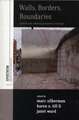
Walls, Borders, Boundaries: Spektrum: Publications of the German Studies Association, cartea 4
Editat de Marc Silberman, Karen E. Till, Janet Warden Limba Engleză Paperback – dec 2014
Din seria Spektrum: Publications of the German Studies Association
-
 Preț: 165.37 lei
-
 Preț: 255.72 lei
-
 Preț: 252.25 lei
-
 Preț: 269.13 lei
-
 Preț: 251.36 lei
-
 Preț: 155.60 lei
- 23%
 Preț: 762.97 lei
-
 Preț: 265.58 lei
-
 Preț: 267.12 lei
-
 Preț: 270.01 lei
-
 Preț: 270.50 lei
-
 Preț: 269.06 lei
-
 Preț: 268.60 lei
-
 Preț: 265.31 lei
-
 Preț: 310.26 lei
- 23%
 Preț: 777.49 lei
-
 Preț: 272.63 lei
-
 Preț: 235.52 lei
- 23%
 Preț: 762.13 lei
-
 Preț: 251.87 lei
- 23%
 Preț: 758.83 lei
- 18%
 Preț: 633.83 lei
-
 Preț: 201.11 lei
- 23%
 Preț: 777.60 lei
- 23%
 Preț: 759.14 lei
- 23%
 Preț: 776.91 lei
- 23%
 Preț: 775.87 lei
- 23%
 Preț: 774.07 lei
- 23%
 Preț: 762.23 lei
-
 Preț: 274.61 lei
-
 Preț: 268.21 lei
- 23%
 Preț: 760.83 lei
Preț: 266.43 lei
Puncte Express: 400
Carte tipărită la comandă
Livrare economică 08-22 decembrie
Livrare prin curier în România Termenul estimat este afișat lângă disponibilitate.
Transport gratuit de la 400.00 lei Plată online sau ramburs, în funcție de opțiunile comenzii.
Retur gratuit în 14 zile Comandă securizată și suport în română.
Specificații
ISBN-13: 9781782386865
ISBN-10: 1782386866
Pagini: 284
Ilustrații: 19 illustrations
Dimensiuni: 152 x 229 x 15 mm
Greutate: 0.42 kg
Editura: BERGHAHN BOOKS
Colecția Spektrum: Publications of the German Studies Association
Seria Spektrum: Publications of the German Studies Association
ISBN-10: 1782386866
Pagini: 284
Ilustrații: 19 illustrations
Dimensiuni: 152 x 229 x 15 mm
Greutate: 0.42 kg
Editura: BERGHAHN BOOKS
Colecția Spektrum: Publications of the German Studies Association
Seria Spektrum: Publications of the German Studies Association
V-ar putea interesa
-
 The Pakistan ParadoxChristrophe JaffrelotPreț: 318.94 lei
-
 Insecure GulfKristian Coates UlrichsenPreț: 204.76 lei
-
 Magnificent and Beggar LandRicardo Soares De OliveiraPreț: 445.63 lei
-
 Middle East Drugs BazaarPhilip RobinsPreț: 235.71 lei
-
 Famine in SomaliaDaniel MaxwellPreț: 284.91 lei
-
 Arab Migrant Communities in the GccZahra BabarPreț: 326.81 lei
-
 Preț: 334.21 lei
-
 Spy Secrets That Can Save Your LifeJason HansonPreț: 104.60 lei
-
 Weimar SurfacesJanet WardPreț: 286.59 lei
-
 Pattern Cutting and Making UpJanet Ward-8%Preț: 468.83 lei509.60 lei
-
 The New Berlin: Memory, Politics, PlaceKaren E. TillPreț: 214.21 lei
-
 Fascism in AmericaGavriel D. RosenfeldPreț: 218.53 lei
-
 Brecht On TheatreBertolt Brecht-23%Preț: 188.76 lei245.30 lei
-
 Collected Short Stories of Bertolt BrechtBertolt Brecht-22%Preț: 537.40 lei686.70 lei
-
 Sunrise and SunsetsJanet WardPreț: 104.64 lei
-
 Les Farfadets PolitiquesHertzleib-BPreț: 75.37 lei
-
 Preț: 82.11 lei
-
 Preț: 89.59 lei
-
 Preț: 75.14 lei
-
 Preț: 80.31 lei
-
 Preț: 82.51 lei
-
 Preț: 139.07 lei
-
 Preț: 87.53 lei
-
 Les Ministres Anciens Et Ceux de l'Époque Actuelle, Jugés d'Après Leurs OeuvresHenri-Alexis CahaissePreț: 82.68 lei
-
 Preț: 170.67 lei
Notă biografică
Janet Ward is Professor of History at the University of Oklahoma and author of Post-Wall Berlin: Borders, Space and Identity and Weimar Surfaces: Urban Visual Culture in 1920s Germany. Her current work includes a co-edited collection on (trans)nationalism and the German city, and a book project on urban destruction and reconstruction.
Cuprins
List of Illustrations
Acknowledgements
Introduction: Walls, Borders, Boundaries
Marc Silberman, Karen E. Till, and Janet Ward
PART I: CITY WALLS
Chapter 1. The Dialectics of Urban Form in Absolutist France
Yair Mintzker
Chapter 2. The Camp in the City, the City as Camp: Berlin's Other Guarded Walls
Olaf Briese
Chapter 3. "Threshold Resistance": Dani Karavan's Berlin Installation Grundgesetz
Eric Jarosinski
Chapter 4. Did Walls Really Come Down? Contemporary B/ordering Walls in Europe
Daniela Vicherat Mattar
PART II: BORDER ZONES
Chapter 5. Border Guarding as Social Practice: A Case Study of Czech Communist Governance and Hidden Transcripts
Muriel Blaive and Thomas Lindenberger
Chapter 6. A "Complicated Contrivance": West Berlin behind the Wall, 1971-1989
David Barclay
Chapter 7. Moving Borders and Competing Civilizing Missions: Germany, Poland, and Ukraine in the Context of the EU's Eastern Enlargement
Steffi Marung
PART III: MIGRATING BOUNDARIES
Chapter 8. Migrants, Mosques, and Minarets: Reworking the Boundaries of Liberal Democracy in Switzerland and Germany
Patricia Ehrkamp
Chapter 9. Not Our Kind: Generational Barriers Dividing Postwar Albanian Migrant Communities
Isa Blumi
Chapter 10. Invisible Migrants: Memory and German Nationhood in the Shadow of the Berlin Wall
Jeffrey Jurgens
Chapter 11. Crossing Boundaries in Cyprus: Landscapes of Memory in the Demilitarized Zone
Gülgün Kayim
Works Cited
Notes on Contributors
Index
Recenzii
"[A] revealing reflection and interpretation upon the development of post-World War II Europe. It offers a vision of imposed borders and boundaries that have become familiar yet remain disturbing; such a dichotomy is explored in various ways in the essays to make a provocative and fascinating book. The book is especially strong in the combination of the empirical and theoretical, treating borders and boundaries at many different levels from the purely physical to the social, cultural and political, as well as the symbolic. [It is]...a very welcome addition to the field." * Wendy Pullan,University of Cambridge "The volume is interdisciplinary and broadly conceptualized yet it focuses on some key aspects that give the volume sufficient focus and depth. The quality of the contributions (including the substantive introduction) is consistently high - [and] not merely a collection of pieces from various disciplines; instead many contributions speak to one another across individual disciplines, e.g., in a consideration of the ambivalent or contradictory effects of walls and boundaries - culturally, historically, and socially." * Friederike Eigler, Georgetown University