
Walden
Autor Henry David Thoreauen Limba Engleză Paperback – 18 iul 2017
Included in this book is "Civil Disobedience", Thoreau's famous essay which has influenced figures such as Gandhi, Leo Tolstoy, and Martin Luther King Jr.
Preț: 100.55 lei
Puncte Express: 151
Carte tipărită la comandă
Livrare economică 07-21 decembrie
Livrare prin curier în România Termenul estimat este afișat lângă disponibilitate.
Transport gratuit de la 400.00 lei Plată online sau ramburs, în funcție de opțiunile comenzii.
Retur gratuit în 14 zile Comandă securizată și suport în română.
Specificații
ISBN-13: 9781944393557
ISBN-10: 1944393552
Pagini: 342
Dimensiuni: 140 x 216 x 21 mm
Greutate: 0.48 kg
Editura: RiverRun Select
ISBN-10: 1944393552
Pagini: 342
Dimensiuni: 140 x 216 x 21 mm
Greutate: 0.48 kg
Editura: RiverRun Select
V-ar putea interesa
-
 Walden and Civil DisobedienceHenry David ThoreauPreț: 30.39 lei
 -
 Walden and Civil DisobedienceHenry David Thoreau-17%Preț: 60.21 lei72.56 lei
 -
 Great Ideas Where I Lived and What I Lived ForHenry Thoreau-20%Preț: 45.37 lei56.43 lei
 -
 Where I Lived, and What I Lived forHenry David ThoreauPreț: 73.17 lei
 -
 Henry David Thoreau: A Very Short IntroductionLawrence Buell-19%Preț: 57.39 lei71.06 lei
 -
 Henry David Thoreau: A LifeLaura Dassow WallsPreț: 155.91 lei
 -
 Walden: A Fully Annotated EditionHenry David ThoreauPreț: 203.32 lei
 -
 WaldenHenry David ThoreauPreț: 76.16 lei
 -
 Walden and Other Writings (The Norton Library)Henry David ThoreauPreț: 70.82 lei
 -
 Walden, Or, Life in the WoodsHenry David Thoreau-17%Preț: 39.06 lei47.32 lei
 -
 WalkingHenry David Thoreau-19%Preț: 29.12 lei35.82 lei
 -
 Walden and Other WritingsHenry David ThoreauPreț: 38.89 lei
 -
 Walden & Civil Disobedience (Masterpiece Library Edition)Henry David ThoreauPreț: 124.32 lei
 -
 The Illustrated Walden: or, Life in the WoodsHenry Thoreau DPreț: 142.07 lei
 -
 Walden and Civil Disobedience (Special Edition)Henry Thoreau D-31%Preț: 106.03 lei154.12 lei
 -
 Walden, and on the Duty of Civil DisobedienceHenry David ThoreauPreț: 68.17 lei
 -
 -20%Preț: 84.34 lei105.36 lei
 -
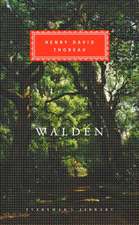 WaldenHenry Thoreau-17%Preț: 102.35 lei123.99 lei
Notă biografică
Henry David Thoreau (1817-1862) was an American naturalist, essayist, poet, and philosopher. He is best known for his book Walden and his essay "On the Duty of Civil Disobedience" (originally published as "Resistance to Civil Government"). Thoreau was a lifelong abolitionist, delivering lectures that attacked the fugitive slave law while praising the writings of Wendell Phillips and defending the abolitionist John Brown. Thoreau's philosophy of civil disobedience later influenced the political thoughts and actions of such notable figures as Leo Tolstoy, Mahatma Gandhi, and Martin Luther King Jr. His writings on natural history and philosophy anticipated modern-day environmentalism.
Descriere
Descriere de la o altă ediție sau format:
`The mass of men lead lives of quiet desperation' In 1845 Henry David Thoreau left his home town of Concord, Massachusetts to begin a new life alone, in a rough hut he built himself a mile and a half away on the north-west shore of Walden Pond. Walden is Thoreau's classic autobiographical account of this experiment in solitary living, his refusal to play by the rules of hard work and the accumulation of wealth and above all the freedom it gave him to adapt his living to the natural world around him. This new edition of Walden traces the sources of Thoreau's reading and thinking and considers the author in the context of his birthplace and his sense of its history - social, economic and natural. In addition, an ecological appendix provides modern identifications of the myriad plants and animals to which Thoreau gave increasingly close attention as he became acclimatized to his life in the woods by Walden Pond. ABOUT THE SERIES: For over 100 years Oxford World's Classics has made available the widest range of literature from around the globe. Each affordable volume reflects Oxford's commitment to scholarship, providing the most accurate text plus a wealth of other valuable features, including expert introductions by leading authorities, helpful notes to clarify the text, up-to-date bibliographies for further study, and much more.
`The mass of men lead lives of quiet desperation' In 1845 Henry David Thoreau left his home town of Concord, Massachusetts to begin a new life alone, in a rough hut he built himself a mile and a half away on the north-west shore of Walden Pond. Walden is Thoreau's classic autobiographical account of this experiment in solitary living, his refusal to play by the rules of hard work and the accumulation of wealth and above all the freedom it gave him to adapt his living to the natural world around him. This new edition of Walden traces the sources of Thoreau's reading and thinking and considers the author in the context of his birthplace and his sense of its history - social, economic and natural. In addition, an ecological appendix provides modern identifications of the myriad plants and animals to which Thoreau gave increasingly close attention as he became acclimatized to his life in the woods by Walden Pond. ABOUT THE SERIES: For over 100 years Oxford World's Classics has made available the widest range of literature from around the globe. Each affordable volume reflects Oxford's commitment to scholarship, providing the most accurate text plus a wealth of other valuable features, including expert introductions by leading authorities, helpful notes to clarify the text, up-to-date bibliographies for further study, and much more.
Cuprins
Introduction by
Bill McKibben
WALDEN
Economy
Where I Lived, and What I Lived For
Reading
Sounds
Solitude
Visitors
The Bean-Field
The Village
The Ponds
Baker Farm
Higher Laws
Brute Neighbors
House-Warming
Former Inhabitants; and Winter Visitors
Winter Animals
The Pond in Winter
Spring
Conclusion
Bill McKibben
WALDEN
Economy
Where I Lived, and What I Lived For
Reading
Sounds
Solitude
Visitors
The Bean-Field
The Village
The Ponds
Baker Farm
Higher Laws
Brute Neighbors
House-Warming
Former Inhabitants; and Winter Visitors
Winter Animals
The Pond in Winter
Spring
Conclusion
Textul de pe ultima copertă
By virtue of its casual, off-handedly brilliant wisdom and the easy splendor of its nature writing, Thoreau's account of his adventure in self-reliance on the shores of a pond in Massachusetts is one of the signposts by which the modern mind has located itself in an increasingly bewildering world.