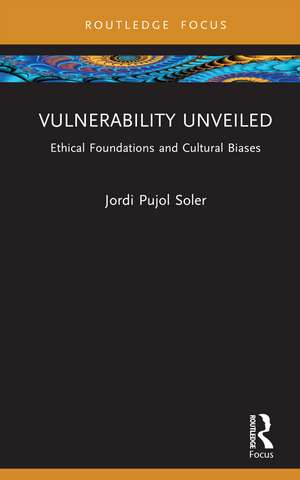
Vulnerability Unveiled: Ethical Foundations and Cultural Biases: Routledge Focus on Religion
Autor Jordi Pujol Soler, Carolina Montero Orphanopoulosen Limba Engleză Hardback – 24 noi 2026
Din seria Routledge Focus on Religion
-
 Preț: 213.45 lei
 -
 Preț: 213.58 lei
 -
 Preț: 188.19 lei
 - 15%
 Preț: 444.16 lei
 - 16%
 Preț: 159.44 lei
 -
 Preț: 219.85 lei
 -
 Preț: 441.03 lei
 -
 Preț: 226.80 lei
 -
 Preț: 188.57 lei
 -
 Preț: 187.22 lei
 -
 Preț: 177.66 lei
 -
 Preț: 70.25 lei
 - 15%
 Preț: 432.20 lei
 -
 Preț: 238.96 lei
 -
 Preț: 224.10 lei
 - 15%
 Preț: 432.92 lei
 - 15%
 Preț: 430.52 lei
 -
 Preț: 230.33 lei
 -
 Preț: 217.23 lei
 -
 Preț: 220.68 lei
 -
 Preț: 243.42 lei
 -
 Preț: 222.82 lei
 -
 Preț: 226.92 lei
 - 15%
 Preț: 446.75 lei
 -
 Preț: 188.31 lei
 - 15%
 Preț: 436.91 lei
 -
 Preț: 228.20 lei
 - 15%
 Preț: 478.13 lei
Preț: 466.31 lei
Preț vechi: 591.79 lei
-21% Precomandă
Puncte Express: 699
Carte nepublicată încă
Livrare prin curier în România Precomanda se expediază când titlul devine disponibil.
Transport gratuit pentru acest produs Plată online sau ramburs, în funcție de opțiunile comenzii.
Retur gratuit în 14 zile Comandă securizată și suport în română.
Doresc să fiu notificat când acest titlu va fi disponibil:
Se trimite...
Specificații
ISBN-13: 9781041387688
ISBN-10: 1041387687
Pagini: 168
Dimensiuni: 138 x 216 mm
Ediția:1
Editura: Taylor & Francis
Colecția Routledge
Seria Routledge Focus on Religion
Locul publicării:Oxford, United Kingdom
ISBN-10: 1041387687
Pagini: 168
Dimensiuni: 138 x 216 mm
Ediția:1
Editura: Taylor & Francis
Colecția Routledge
Seria Routledge Focus on Religion
Locul publicării:Oxford, United Kingdom
Public țintă
Academic and PostgraduateCuprins
Introduction PART ONE: ON VULNERABILITY 1. The Human Condition and the Ethical Turn Toward Vulnerability PART TWO: THE SOCIO-CULTURAL NARRATIVE ON VULNERABILITY 2. Antifragility and the Teleology of Toughness 3. The Misappropriation of Vulnerability: Victimhood Culture 4. Concept Creep: The Overextension of Vulnerability, Harm, and Risk 5. The Socio-Cultural Script of Vulnerability PART THREE: ORGANIZATIONAL VULNERABILITY 6. The Exercise of Authority as a Dynamic Network of Relationships 7. Organizational Behavior and Systemic Culture 8. Institutional Vulnerability: The Case Study of the Catholic Church 9. Institutional Vulnerability: The Case Study of the State as Caretaker 10. Conclusion Bibliography Index
Recenzii
Survivors have taught us that the protection of minors and vulnerable adults demands much more than procedures: it demands a true conversion of institutional culture. Pujol and Montero offer the ethical foundations for that conversion, illuminating why every institution of care must learn to recognize, listen to, and honor those who have been entrusted to it.
— H.E. Seán Cardinal O'Malley, O.F.M. Cap., Archbishop Emeritus of Boston; Founding President, Pontifical Commission for the Protection of Minors (2014–2025)
Vulnerability is no mere ethical concept among many, but "a constitutive horizon for reinterpreting the human condition and moral life," argue Fr. Jordi Pujol and Dr. Carolina Montero. Following MacIntyre's work on dependency, they avoid both denying and valorizing vulnerability, offering care and the hope of transformation as its remedy. Drawing on philosophy, sociology, and psychology, their theological framework confronts clerical abuse and state policy alike.
— Daniel Philpott, Professor of Political Science, University of Notre Dame, U.S.
This book advances an uncomfortable and necessary thesis: wherever vulnerability is denied or exploited, violence multiplies. Abuse is not an isolated accident but the foreseeable result of fragile institutions, cultures that prefer silence to truth, and unregulated power. Montero and Pujol do not stop at diagnosis: they offer a clear and demanding framework for naming risks, dismantling complicity, and confronting them with the radicality that human dignity demands.
— Patricia Espinosa, Psychiatrist and Member of the Pontifical Commission for the Protection of Minors, Vatican.
This work portrays our human finitude and fragility with a balanced perspective across psychological, social, institutional, and cultural dimensions. Moving beyond monolithic rigidity and reductionist fragmentation, the authors weave a portrait of humanity in which vulnerability and responsibility play an essential role in shaping our future.
— Javier de la Torre, Professor of Theology, Universidad Pontificia de Comillas, Madrid.
This groundbreaking work challenges the myths of self-sufficiency that have shaped philosophy, psychology, and law for centuries, presenting vulnerability instead as a foundational dimension of our shared humanity. From this broader perspective, it examines the Catholic Church's own legal engagement with vulnerability and the ongoing challenge of protecting the dignity and fragility of all God's children. Timely and compelling, it is essential reading for contemporary ecclesial thought.
— Msgr. John Paul Kimes, Professor of Canon Law, University of Notre Dame, U.S.
In an age where grievance and fear circulate as moral currency, and digital platforms turn every wound into a spectacle, this book reveals what has been obscured by public discourse: vulnerability is the basis of social relationships, not a pathology. Resisting both sentimentalism and cynicism, Pujol and Montero provide a vital framework for understanding how late-modern cultures misrepresent human fragility, presenting it as a key philosophical and sociological issue of our time.
— Guido Gili, Professor of Sociology, Pontifical Gregorian University, Rome
— H.E. Seán Cardinal O'Malley, O.F.M. Cap., Archbishop Emeritus of Boston; Founding President, Pontifical Commission for the Protection of Minors (2014–2025)
Vulnerability is no mere ethical concept among many, but "a constitutive horizon for reinterpreting the human condition and moral life," argue Fr. Jordi Pujol and Dr. Carolina Montero. Following MacIntyre's work on dependency, they avoid both denying and valorizing vulnerability, offering care and the hope of transformation as its remedy. Drawing on philosophy, sociology, and psychology, their theological framework confronts clerical abuse and state policy alike.
— Daniel Philpott, Professor of Political Science, University of Notre Dame, U.S.
This book advances an uncomfortable and necessary thesis: wherever vulnerability is denied or exploited, violence multiplies. Abuse is not an isolated accident but the foreseeable result of fragile institutions, cultures that prefer silence to truth, and unregulated power. Montero and Pujol do not stop at diagnosis: they offer a clear and demanding framework for naming risks, dismantling complicity, and confronting them with the radicality that human dignity demands.
— Patricia Espinosa, Psychiatrist and Member of the Pontifical Commission for the Protection of Minors, Vatican.
This work portrays our human finitude and fragility with a balanced perspective across psychological, social, institutional, and cultural dimensions. Moving beyond monolithic rigidity and reductionist fragmentation, the authors weave a portrait of humanity in which vulnerability and responsibility play an essential role in shaping our future.
— Javier de la Torre, Professor of Theology, Universidad Pontificia de Comillas, Madrid.
This groundbreaking work challenges the myths of self-sufficiency that have shaped philosophy, psychology, and law for centuries, presenting vulnerability instead as a foundational dimension of our shared humanity. From this broader perspective, it examines the Catholic Church's own legal engagement with vulnerability and the ongoing challenge of protecting the dignity and fragility of all God's children. Timely and compelling, it is essential reading for contemporary ecclesial thought.
— Msgr. John Paul Kimes, Professor of Canon Law, University of Notre Dame, U.S.
In an age where grievance and fear circulate as moral currency, and digital platforms turn every wound into a spectacle, this book reveals what has been obscured by public discourse: vulnerability is the basis of social relationships, not a pathology. Resisting both sentimentalism and cynicism, Pujol and Montero provide a vital framework for understanding how late-modern cultures misrepresent human fragility, presenting it as a key philosophical and sociological issue of our time.
— Guido Gili, Professor of Sociology, Pontifical Gregorian University, Rome
Notă biografică
Jordi Pujol Soler is a Full Professor in the School of Church Communications at the Pontifical University of Santa Croce, Rome.
Carolina Montero Orphanopoulos is a theological ethics researcher and Director of the Interdisciplinary Institute of Philosophical and Theological Studies at the Universidad Católica Silva Henríquez in Santiago, Chile.
Carolina Montero Orphanopoulos is a theological ethics researcher and Director of the Interdisciplinary Institute of Philosophical and Theological Studies at the Universidad Católica Silva Henríquez in Santiago, Chile.
Descriere
This book explores the moral, cultural, and institutional meanings of vulnerability in contemporary life. Vulnerability has become a word of remarkable reach and too often is framed as a problem to be solved, a deficit to be managed, or a category for those ‘in need’.