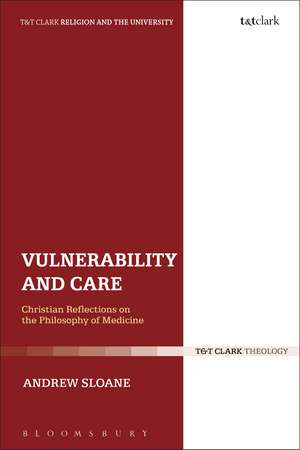
Vulnerability and Care: Christian Reflections on the Philosophy of Medicine: Religion and the University
Autor Dr Andrew Sloaneen Limba Engleză Hardback – 28 ian 2016
The book provides two main 'doorways' into a Christian philosophical theology of medicine. First it presents a brief description of the contexts in which medicine is practiced in the early 21st century, identifying key problems and challenges that medicine must address. It then turns to issues in contemporary bioethics, demonstrating how the debate is rooted in conflicting visions of the nature of medicine (and so human existence). This leads to a discussion of some of the philosophical and theological resources currently available for those who would reflect 'Christianly' on medicine. The heart of the book consists of an articulation of a Christian understanding of medicine as both a scholarly and a social practice, articulating the philosophical-theological framework which informs this perspective. It fleshes out features of medicine as an inherently moral practice, one informed by a Christian social vision and shaped by key theological commitments. The book closes by returning to the issues relating to the context of medicine and bioethics with which it opened, demonstrating how a Christian philosophical-theology of medicine informs and enriches those discussions.
Preț: 835.21 lei
Preț vechi: 1242.47 lei
-33%
Puncte Express: 1253
Carte tipărită la comandă
Livrare economică 17 noiembrie-01 decembrie
Livrare prin curier în România Termenul estimat este afișat lângă disponibilitate.
Transport gratuit pentru acest produs Plată online sau ramburs, în funcție de opțiunile comenzii.
Retur gratuit în 14 zile Comandă securizată și suport în română.
Specificații
ISBN-13: 9780567316776
ISBN-10: 0567316777
Pagini: 224
Dimensiuni: 156 x 234 x 14 mm
Greutate: 0.49 kg
Editura: Bloomsbury Publishing
Colecția T&T Clark
Seria Religion and the University
Locul publicării:London, United Kingdom
ISBN-10: 0567316777
Pagini: 224
Dimensiuni: 156 x 234 x 14 mm
Greutate: 0.49 kg
Editura: Bloomsbury Publishing
Colecția T&T Clark
Seria Religion and the University
Locul publicării:London, United Kingdom
V-ar putea interesa
-
 The Book of ForgivingArchbishop Desmond TutuPreț: 70.34 lei
 -
 Christ ActuallyJames CarrollPreț: 140.37 lei
 -
 -31%Preț: 1026.52 lei1494.02 lei
 -
 Lost ChurchAlan BillingsPreț: 98.60 lei
 -
 Simply Good NewsTom WrightPreț: 85.59 lei
 -
 Where on Earth is Heaven?Paula GooderPreț: 41.59 lei
 -
 What Do We Mean by 'God'?Keith WardPreț: 60.27 lei
 -
 The SPCK Dictionary of Theology and HermeneuticsAnthony ThiseltonPreț: 464.80 lei
 -
 Challenge of Jesus (Revised)WrightPreț: 112.49 lei
 -
 Preț: 158.84 lei
 -
 Totally Forgiving GodR T Kendall Ministries Inc.Preț: 93.10 lei
 -
 From Fear to LoveHarry WillsonPreț: 89.73 lei
 -
 Preț: 92.67 lei
 -
 Preț: 92.29 lei
 -
 Teaching Global Theologies: Power and PraxisPui-lan KWOKPreț: 300.17 lei
Cuprins
Acknowledgements
1. Introduction
2. Entering the world of medicine
3. Why bioethics needs a philosophy (and theology) of medicine
4. Perspectives on philosophy of medicine
5. Perspectives on theology of medicine
6. Finding the target: Messer's theology of health
7. A philosophical-theological framework for medicine
8. Human vulnerability and the goods of medicine
9. Re-engaging the world of medicine
Bibliography
Index
1. Introduction
2. Entering the world of medicine
3. Why bioethics needs a philosophy (and theology) of medicine
4. Perspectives on philosophy of medicine
5. Perspectives on theology of medicine
6. Finding the target: Messer's theology of health
7. A philosophical-theological framework for medicine
8. Human vulnerability and the goods of medicine
9. Re-engaging the world of medicine
Bibliography
Index
Recenzii
This reviewer encourages readers who are interested in pursuing medicine as a profession, bioethicists, theologians, or anyone just curious about an insider's view to read this work. The history, philosophies, and theologies discussed within, as well as the medical and bioethical questions raised, make Sloane's work well worth the time spent reading.
Andrew Sloane's Vulnerability and Care is a brave attempt to redefine our approach to one of civilisation's most enduring endeavours ... This is a thought-provoking book.
Modern medicine is sick and the scandals that have made it so have not been, for the most part, failures of technical competence but more fundamental failures of care. In this ground-breaking book, Andrew Sloane examines a wide range of topics from Ebola to euthanasia, from evidence-based medicine to organ donation through the lenses of theology and philosophy and comes to a radical conclusion. His central thesis is that the primary goal of medicine is not healing and alleviating suffering, at the expense of care for the vulnerable, but rather it is to care for the vulnerable including healing and alleviating suffering where possible. When we can't cure, we must still care, and Dr Sloane makes a powerful case for why we need to change the focus of the practice of medicine before it loses its soul completely.
Few would disagree with Andrew Sloane's claim that medicine is searching for a clear understanding of what it is about, but his contention that it is not primarily about health and healing and the alleviation of suffering is much more contentious. Through a careful and engaging analysis of some current medical issues, contemporary bioethics and the relevant philosophical and theological literature, he convincingly justifies both claims. His view is that medicine is not so much about health care but about health care. That it is first and foremost a moral practice (rather than a science) which recognises our human solidarity in weakness, frailty and finitude. A major challenge to the standard Christian and secular understandings of the nature of medicine.
Andrew Sloane brings a rich double background to this provocative and much needed work on the philosophy of medicine. He is trained in both medicine and theology. William James described philosophy as a particularly stubborn attempt to think clearly. The best theology is equally the result of such stubbornness. Clarity and careful reflection informed by both fields are much in evidence in this volume. So too is Sloane's concern for the vulnerable and their need of care informed by his Christian worldview that frames the discussion. Sloane believes that "medicine is searching for a clear understanding of what it is and what it is about." This volume is an important response to that search because it deals not just with descriptive questions but the normative ones of how medicine it to be thought about and what the proper ends of medical practices ought to be.
Andrew Sloane's Vulnerability and Care is a brave attempt to redefine our approach to one of civilisation's most enduring endeavours ... This is a thought-provoking book.
Modern medicine is sick and the scandals that have made it so have not been, for the most part, failures of technical competence but more fundamental failures of care. In this ground-breaking book, Andrew Sloane examines a wide range of topics from Ebola to euthanasia, from evidence-based medicine to organ donation through the lenses of theology and philosophy and comes to a radical conclusion. His central thesis is that the primary goal of medicine is not healing and alleviating suffering, at the expense of care for the vulnerable, but rather it is to care for the vulnerable including healing and alleviating suffering where possible. When we can't cure, we must still care, and Dr Sloane makes a powerful case for why we need to change the focus of the practice of medicine before it loses its soul completely.
Few would disagree with Andrew Sloane's claim that medicine is searching for a clear understanding of what it is about, but his contention that it is not primarily about health and healing and the alleviation of suffering is much more contentious. Through a careful and engaging analysis of some current medical issues, contemporary bioethics and the relevant philosophical and theological literature, he convincingly justifies both claims. His view is that medicine is not so much about health care but about health care. That it is first and foremost a moral practice (rather than a science) which recognises our human solidarity in weakness, frailty and finitude. A major challenge to the standard Christian and secular understandings of the nature of medicine.
Andrew Sloane brings a rich double background to this provocative and much needed work on the philosophy of medicine. He is trained in both medicine and theology. William James described philosophy as a particularly stubborn attempt to think clearly. The best theology is equally the result of such stubbornness. Clarity and careful reflection informed by both fields are much in evidence in this volume. So too is Sloane's concern for the vulnerable and their need of care informed by his Christian worldview that frames the discussion. Sloane believes that "medicine is searching for a clear understanding of what it is and what it is about." This volume is an important response to that search because it deals not just with descriptive questions but the normative ones of how medicine it to be thought about and what the proper ends of medical practices ought to be.