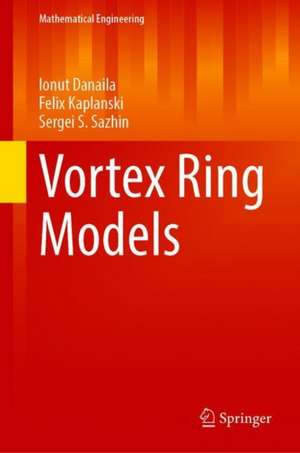
Vortex Ring Models: Mathematical Engineering
Autor Ionut Danaila, Felix Kaplanski, Sergei S. Sazhinen Limba Engleză Hardback – 17 apr 2021
Din seria Mathematical Engineering
- 18%
 Preț: 1074.85 lei
 - 18%
 Preț: 1071.32 lei
 - 17%
 Preț: 447.19 lei
 - 18%
 Preț: 1060.41 lei
 - 18%
 Preț: 1035.90 lei
 - 15%
 Preț: 666.56 lei
 - 18%
 Preț: 747.16 lei
 - 15%
 Preț: 662.91 lei
 - 18%
 Preț: 808.21 lei
 - 15%
 Preț: 667.64 lei
 -
 Preț: 401.12 lei
 - 18%
 Preț: 807.81 lei
 - 18%
 Preț: 1040.06 lei
 - 18%
 Preț: 950.43 lei
 - 15%
 Preț: 674.45 lei
 - 18%
 Preț: 1037.53 lei
 - 18%
 Preț: 755.34 lei
 -
 Preț: 413.84 lei
 - 18%
 Preț: 1232.28 lei
 - 15%
 Preț: 663.68 lei
 - 15%
 Preț: 670.71 lei
 -
 Preț: 393.24 lei
 - 18%
 Preț: 810.57 lei
 - 18%
 Preț: 1151.54 lei
 -
 Preț: 331.16 lei
 - 18%
 Preț: 749.98 lei
 - 18%
 Preț: 1153.02 lei
 - 15%
 Preț: 672.68 lei
 - 15%
 Preț: 666.97 lei
 - 18%
 Preț: 916.46 lei
 - 15%
 Preț: 665.43 lei
 - 15%
 Preț: 680.13 lei
 - 15%
 Preț: 595.50 lei
 - 18%
 Preț: 938.54 lei
 - 15%
 Preț: 673.77 lei
 - 15%
 Preț: 667.86 lei
 - 15%
 Preț: 673.31 lei
Preț: 812.62 lei
Preț vechi: 991.00 lei
-18%
Puncte Express: 1219
Carte disponibilă
Livrare economică 05-19 noiembrie
Livrare prin curier în România Termenul estimat este afișat lângă disponibilitate.
Transport gratuit pentru acest produs Plată online sau ramburs, în funcție de opțiunile comenzii.
Retur gratuit în 14 zile Comandă securizată și suport în română.
Specificații
ISBN-13: 9783030681494
ISBN-10: 3030681491
Pagini: 216
Ilustrații: XV, 197 p. 62 illus., 52 illus. in color.
Dimensiuni: 160 x 241 x 17 mm
Greutate: 0.48 kg
Ediția:1st ed. 2021
Editura: Springer
Colecția Mathematical Engineering
Seria Mathematical Engineering
Locul publicării:Cham, Switzerland
ISBN-10: 3030681491
Pagini: 216
Ilustrații: XV, 197 p. 62 illus., 52 illus. in color.
Dimensiuni: 160 x 241 x 17 mm
Greutate: 0.48 kg
Ediția:1st ed. 2021
Editura: Springer
Colecția Mathematical Engineering
Seria Mathematical Engineering
Locul publicării:Cham, Switzerland
Cuprins
The vortex ring problem.- Steady inviscid vortex rings.- Viscous vortex rings.- Viscous vortex rings with elliptical cores.- Confined vortex rings.- Formation number of vortex rings.- Applications of the models.
Recenzii
“The book can be recommended to researchers with an interest in vortex rings or axisymmetric flows. The presentation is self-contained, with all of the mathematics required given in the text or appendices so that workers new to the field can use the book as a starting point for their research. … The connection between mathematical, physical, and engineering applications is well motivated and should allow a reader to apply the presented methods to their problems quite readily.” (Michael J. Carley, Mathematical Reviews, September, 2022)
Textul de pe ultima copertă
This book offers a guide to understanding models of vortex rings, starting from classical ones (circular vortex filament, Hill and Norbury-Fraenkel inviscid models) to very recent models incorporating viscous effects and realistic shapes of the vortex core. Unconfined and confined viscous vortex rings are described by closed formulae for vorticity, stream function, translational velocity, energy, impulse and circulation. Models are applied to predict the formation number of optimal vortex rings and to describe two-phase vortex ring-like structures generated in internal combustion engines. The book provides a detailed presentation of analytical developments of models, backed up by illustrations and systematic comparisons with results of direct numerical simulations. The book is useful for graduate students in applied mathematics, engineering and physical sciences. It is a useful reference for researchers and practising engineers interested in modelling flows with vortex rings.
Caracteristici
Presents the first systematic mathematical descriptions of the new viscous vortex ring models and their verifications Maintains a close link between the mathematical and engineering application of the models Provides a clear description of the models at a level acceptable to the engineering community
Notă biografică
Ionut Danaila is Professor of Applied Mathematics at the University of Rouen Normandy, Laboratoire de mathématiques Raphaël Salem, and former member of Laboratoire Jacques-Louis Lions, Sorbonne Université. He is co-author of two textbooks (in French) on scientific computing and one research monograph (on vortex ring models) for researchers and graduate students. His main research interests are in numerical analysis and modern scientific computing. He developed several numerical codes for applications in fluid mechanics, quantum physics and thermal sciences. Over the last decade, he headed two fundamental research projects on the mathematical modelling and high-performance simulation of quantum systems (Bose-Einstein condensates and superfluid helium). Pascal Joly, now retired, was Research Scientist at Laboratoire Jacques-Louis Lions, Sorbonne Université and Centre national de la recherche scientifique (CNRS). His main research interests concern efficient algorithms in scientific computing (such as solving large sparse linear systems of equations), coding finite element methods for various industrial applications and exploring the wavelets theory in signal processing. He taught courses on numerical methods in various engineering schools and he is former deputy director of the Master of Sciences and Technology of the Université Pierre et Marie Curie for applied Mathematics. Sidi-Mahmoud Kaber is Associate Professor of Applied Mathematics at Laboratoire Jacques-Louis Lions, Sorbonne Université. He is co-author of three textbooks in French and one in English on numerical analysis. His main research interests include approximation of singular functions and numerical schemes for parallel computing. He is very engaged in using programming and software in mathematics education. Marie Postel is Associate Professor of Applied Mathematics at Laboratoire Jacques-Louis Lions, Sorbonne Université. She is co-author of two textbooks (in French) on numerical methods. Her research interests are currently mathematical modeling of biological systems, along with the numerical simulation and calibration of model using experimental data. She has designed several adaptive methods in scientific computing for PDEs using multiresolution analysis. She is currently the head of a master program in engineering mathematics, and teaches numerical methods for ODEs, PDEs and optimization at undergraduate and graduate level.