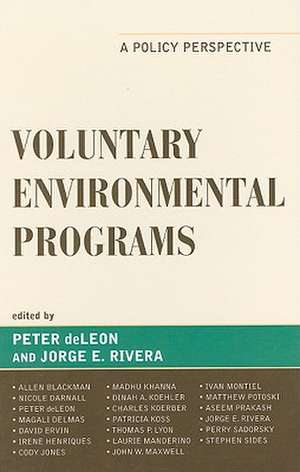
Voluntary Environmental Programs: A Policy Perspective: Studies in Public Policy
Editat de Peter deLeon, Jorge E. Rivera Contribuţii de Allen Blackman, Aseem Prakash, Charles Koerber, Cody Jones, Darnell, David Ervin, Dinah A. Koehler, Irene Henriques, Ivan Montiel, John W. Maxwell, Jorge Riviera, Laurie Manderino, Madhu Khanna, Magali Delmas, Matthew Potoski, Patricia Koss, Perry Sadorsky, Peter de Leon, Thomas P. Lyon, Sidesen Limba Engleză Hardback – 3 dec 2009
Voluntary Environmental Programs (VEP) provides an overview of current research on VEPs, looking at issues such as what motivates firms to participate, how a VEP structure affects a company's efficiency and credibility with stakeholders, and who monitors compliance of participants. This current work examines how a firm's environmental performance over time compares with VEP commitments. This book also discusses the particular considerations for VEPs in developing countries, where information flows and regulatory oversight capacities differ from the U.S.




Preț: 724.25 lei
Preț vechi: 1062.36 lei
-32%
Puncte Express: 1086
Carte tipărită la comandă
Livrare economică 30 noiembrie-14 decembrie
Livrare prin curier în România Termenul estimat este afișat lângă disponibilitate.
Transport gratuit pentru acest produs Plată online sau ramburs, în funcție de opțiunile comenzii.
Retur gratuit în 14 zile Comandă securizată și suport în română.
Specificații
ISBN-13: 9780739133224
ISBN-10: 0739133225
Pagini: 308
Dimensiuni: 150 x 230 x 24 mm
Greutate: 0.57 kg
Editura: Bloomsbury Publishing
Colecția Lexington Books
Seria Studies in Public Policy
Locul publicării:New York, United States
ISBN-10: 0739133225
Pagini: 308
Dimensiuni: 150 x 230 x 24 mm
Greutate: 0.57 kg
Editura: Bloomsbury Publishing
Colecția Lexington Books
Seria Studies in Public Policy
Locul publicării:New York, United States
Cuprins
Chapter 1. Voluntary Environmental Programs: An Introduction
Chapter 2. The Effectiveness of Voluntary Environmental Programs-A Policy at a Crossroads?
Chapter 3. Environmental Public Voluntary Programs Reconsidered
Chapter 4. Voluntary Environmental Management: Motivations and Policy Implications
Chapter 5. Collective Action Through Voluntary Environmental Programs: A Club Theory Approach
Chapter 6. The Diffusion Voluntary International Standards: Responsible Care, ISO 9000 and ISO 14001 in the Chemical Industry
Chapter 7. Is Greener Whiter Yet? The Sustainable Slopes Program After Five Years
Chapter 8. Assessing the Performance of Voluntary Environmental Programs: Does Certification Matter?
Chapter 9. Can Voluntary Environmental Regulation Work in Developing Countries: Lessons from Case Studies
Chapter 10. Voluntary Environmental Programs: A Canadian Perspective
Chapter 11. Concluding Opinion, Voluntary Environmental Programs: Are Carrots Without Sticks Enough for Effective EnvironmentalProtection Policy?
Chapter 2. The Effectiveness of Voluntary Environmental Programs-A Policy at a Crossroads?
Chapter 3. Environmental Public Voluntary Programs Reconsidered
Chapter 4. Voluntary Environmental Management: Motivations and Policy Implications
Chapter 5. Collective Action Through Voluntary Environmental Programs: A Club Theory Approach
Chapter 6. The Diffusion Voluntary International Standards: Responsible Care, ISO 9000 and ISO 14001 in the Chemical Industry
Chapter 7. Is Greener Whiter Yet? The Sustainable Slopes Program After Five Years
Chapter 8. Assessing the Performance of Voluntary Environmental Programs: Does Certification Matter?
Chapter 9. Can Voluntary Environmental Regulation Work in Developing Countries: Lessons from Case Studies
Chapter 10. Voluntary Environmental Programs: A Canadian Perspective
Chapter 11. Concluding Opinion, Voluntary Environmental Programs: Are Carrots Without Sticks Enough for Effective EnvironmentalProtection Policy?
Recenzii
This book is a very useful compilation of essays by many of the scholars who have devoted most serious attention and research to the evaluation of voluntary environmental programs. It will be valuable to anyone interested in doing research on them, as well as to anyone interested in knowing what we have learned about these policy tools and what they have and have not accomplished.
The editors and authors of Voluntary Environmental Programs offer a clear-eyed, evidence-based assessment of one of the most important developments in environmental policy and management over the past quarter century. The contributors' theoretical approaches and well-researched cases are bound together by a policy perspective, and the results go far beyond the optimistic and at times Pollyannaish assessments of voluntary environmental programs (VEPs) presented in the past. Importantly, the contributors thoroughly examine governmental roles and responsibilities-a significant improvement over studies that linger too long on the 'volunteer' in VEPs.
The editors and authors of Voluntary Environmental Programs offer a clear-eyed, evidence-based assessment of one of the most important developments in environmental policy and management over the past quarter century. The contributors' theoretical approaches and well-researched cases are bound together by a policy perspective, and the results go far beyond the optimistic and at times Pollyannaish assessments of voluntary environmental programs (VEPs) presented in the past. Importantly, the contributors thoroughly examine governmental roles and responsibilities-a significant improvement over studies that linger too long on the 'volunteer' in VEPs.