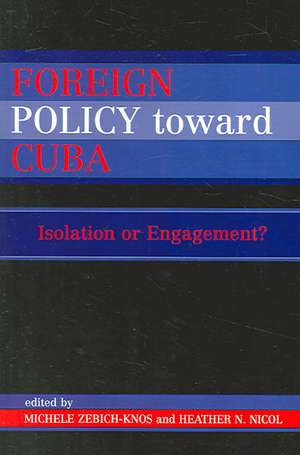
Foreign Policy Toward Cuba: Isolation or Engagement?: Studies in Public Policy
Editat de Michele Zebich-Knos, Heather Nicol Contribuţii de Sahadeo Basdeo, Jan Knippers Black, Sung-Chang Chun, Douglas Friedman, Hugh Gladwin, Cedric Grant, Guillermo J. Grenier, Brett Heindl, Dr. or Prof. John M. Kirk, Hal Klepak, Soraya Castro Marino, Peter McKenna, Renee G. Scherlen, Lana Wylieen Limba Engleză Paperback – 9 sep 2005
Preț: 336.56 lei
Preț vechi: 469.23 lei
-28%
Puncte Express: 505
Carte tipărită la comandă
Livrare economică 06-20 iunie
Specificații
ISBN-13: 9780739112410
ISBN-10: 0739112414
Pagini: 285
Dimensiuni: 153 x 227 x 24 mm
Greutate: 0.43 kg
Editura: Bloomsbury Publishing
Colecția Lexington Books
Seria Studies in Public Policy
Locul publicării:New York, United States
ISBN-10: 0739112414
Pagini: 285
Dimensiuni: 153 x 227 x 24 mm
Greutate: 0.43 kg
Editura: Bloomsbury Publishing
Colecția Lexington Books
Seria Studies in Public Policy
Locul publicării:New York, United States
V-ar putea interesa
-
 ISISJ. M. BergerPreț: 102.92 lei
 -
 -20%Preț: 60.82 lei75.89 lei
 -
 Jeremy ThorpeMichael Bloch-25%Preț: 79.11 lei105.58 lei
 -
 Global Political TheoryDavid HeldPreț: 153.17 lei
 -
 More HumanSteve Hilton-20%Preț: 83.31 lei103.72 lei
Cuprins
Chapter 1 Isolate or Engage?: Divergent Approaches to Foreign Policy Toward Cuba
Chapter 2 U.S. Policy toward Cuba: Trends and Transformation During the George W. Bush Administration
Chapter 3 The US-Cuba Standoff: A Double Con?
Chapter 4 Canada-Cuba Relations: Old Wine in New Bottles?
Chapter 5 From Reasonable Steadiness to "from Crisis to Crisis": Mexico-Cuba Relations in the Post-Cold War Era
Chapter 6 Cuba-CARICOM Relations Since 1972: Challenge and Change in Regional Cooperation
Chapter 7 Carribean Community and Cuba Relations: Thirty Years Revisited
Chapter 8 The Exile Ideology: Popular Culture and Boundary Maintenance in the Cuban Enclave
Chapter 9 From Miami With Love: Transnational Political Activism in the Cuban Exile Community
Chapter 10 The Cuba-United States Conflict: Notes for Reflection of the War Against Terrorism
Chapter 11 Civil Society in Contemporary Cuba: U.S. Policy and the Cuban Reality
Chapter 12 "Venceremos!" Castro's Discourse on Cuba's Foreign Policy
Chapter 13 A Clash of Perspectives?: Some Conclusions About the "Cuba Problem"
Chapter 2 U.S. Policy toward Cuba: Trends and Transformation During the George W. Bush Administration
Chapter 3 The US-Cuba Standoff: A Double Con?
Chapter 4 Canada-Cuba Relations: Old Wine in New Bottles?
Chapter 5 From Reasonable Steadiness to "from Crisis to Crisis": Mexico-Cuba Relations in the Post-Cold War Era
Chapter 6 Cuba-CARICOM Relations Since 1972: Challenge and Change in Regional Cooperation
Chapter 7 Carribean Community and Cuba Relations: Thirty Years Revisited
Chapter 8 The Exile Ideology: Popular Culture and Boundary Maintenance in the Cuban Enclave
Chapter 9 From Miami With Love: Transnational Political Activism in the Cuban Exile Community
Chapter 10 The Cuba-United States Conflict: Notes for Reflection of the War Against Terrorism
Chapter 11 Civil Society in Contemporary Cuba: U.S. Policy and the Cuban Reality
Chapter 12 "Venceremos!" Castro's Discourse on Cuba's Foreign Policy
Chapter 13 A Clash of Perspectives?: Some Conclusions About the "Cuba Problem"
Recenzii
Since Castro's revolution, the United States has tried to overthrow, isolate, or undermine Cuba, while Canada, Mexico, and the Caribbean have preferred engagement. Michele Zebich-Knos and Heather Nicol have assembled a superb group of scholars to describe the domestic causes and evaluate the international effects of these different approaches. This is an important book that takes a new approach to an old problem and emerges with a curious conclusion: neither confrontation nor engagement has worked.
The editors have assembled an extremely qualified group of scholars in the rich field of Cuban studies. Their treatments are balanced and authoritative and go beyond the Havana-Washington axis to cover the whole hemisphere. No other source provides such an exhaustive account of how Cuban-U.S. relations became and remain so contentious.
Much of it is useful, perceptive and timely, and the best of the contributions are very good, justifying the whole publication.
I highly recommend Foreign Policy toward Cuba: Isolation or Engagement? It should be required reading for anyone interested in foreign policy, international relations, Latin American studies, and politics in general.
This is a wonderful exploration of the myriad facets of an increasingly important question. The book is comprehensive, well-written, and a useful resource for policy-makers and students.
The editors have assembled an extremely qualified group of scholars in the rich field of Cuban studies. Their treatments are balanced and authoritative and go beyond the Havana-Washington axis to cover the whole hemisphere. No other source provides such an exhaustive account of how Cuban-U.S. relations became and remain so contentious.
Much of it is useful, perceptive and timely, and the best of the contributions are very good, justifying the whole publication.
I highly recommend Foreign Policy toward Cuba: Isolation or Engagement? It should be required reading for anyone interested in foreign policy, international relations, Latin American studies, and politics in general.
This is a wonderful exploration of the myriad facets of an increasingly important question. The book is comprehensive, well-written, and a useful resource for policy-makers and students.