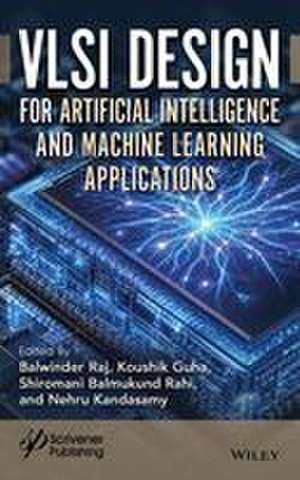
VLSI Design for Artificial Intelligence and Machine Learning Applications
Editat de Balwinder Raj, Koushik Guha, Nehru Kandasamy, Shiromani Balmukund Rahien Limba Engleză Hardback – 12 oct 2026
Very large-scale integration (VLSI) is the interdisciplinary science of utilizing advanced semiconductor technology to create various functions of a computer system. By combining VLSI technology, a very powerful computer architecture is possible to overcome the problems at different design stages. AI techniques such as knowledge-based and expert systems first define the problem and then choose the best solution from a range of possible approaches.
This book comprehensively covers nanomaterials, semiconductor devices, and modeling and simulation techniques used to address the challenges of low-power VLSI chip design. It explores process variability, device sizing, power supply scaling, conventional and emerging materials, leakage mitigation techniques, and critical design tradeoffs. The book presents state-of-the-art research in nanomaterials and semiconductor technologies alongside practical design considerations for low-power VLSI circuits, making it an essential resource for scientists, researchers, and postgraduate students interested in AI hardware, semiconductor devices, modeling, and simulation.
Preț: 1207.41 lei
Preț vechi: 1568.06 lei
-23% Precomandă
Puncte Express: 1811
Carte nepublicată încă
Livrare prin curier în România Precomanda se expediază când titlul devine disponibil.
Transport gratuit pentru acest produs Plată online sau ramburs, în funcție de opțiunile comenzii.
Retur gratuit în 14 zile Comandă securizată și suport în română.
Doresc să fiu notificat când acest titlu va fi disponibil:
Se trimite...
Specificații
Notă biografică
Balwinder Raj, PhD is an Associate Professor at the National Institute of Technology Jalandhar, India, with more than 15 years of teaching, research, and administrative experience. He has authored and co-authored eight books, 15 book chapters, and more than 150 research papers. His research interests include nanoscale semiconductor device modeling, nanoelectronics, hardware security, sensors, circuit design, and FinFET-based memory design.
Koushik Guha, PhD is an Associate Professor and Head of the Department of Electronics and Communication Engineering at the National Institute of Technology, Silchar, India. He has published more than 200 journal and conference papers, authored over 35 book chapters, and two books. His research interests include MEMS, RF MEMS, BIO-MEMS, smart sensors for IoT, and VLSI circuit design and optimization.
Shiromani Balmukund Rahi, PhD is an Assistant Professor in the School of Information and Communication Technology at Gautam Buddha University, Greater Noida, India. He has published 25 research articles, two conference proceedings, 25 book chapters, and seven books. His research focuses on low-power VLSI design, quantum-dot cellular automata, non-volatile memory devices, logic-in-memory computing, and neuromorphic computing.
Nehru Kandasamy, PhD is a Professor in the Department of Electronics and Communication Engineering at the Madanapalle Institute of Technology and Science, India. He has published numerous peer-reviewed articles and serves as a reviewer for more than 15 journals. His research interests include low-power VLSI design, quantum-dot cellular automata, non-volatile memory devices, logic-in-memory computing, and neuromorphic computing.
Koushik Guha, PhD is an Associate Professor and Head of the Department of Electronics and Communication Engineering at the National Institute of Technology, Silchar, India. He has published more than 200 journal and conference papers, authored over 35 book chapters, and two books. His research interests include MEMS, RF MEMS, BIO-MEMS, smart sensors for IoT, and VLSI circuit design and optimization.
Shiromani Balmukund Rahi, PhD is an Assistant Professor in the School of Information and Communication Technology at Gautam Buddha University, Greater Noida, India. He has published 25 research articles, two conference proceedings, 25 book chapters, and seven books. His research focuses on low-power VLSI design, quantum-dot cellular automata, non-volatile memory devices, logic-in-memory computing, and neuromorphic computing.
Nehru Kandasamy, PhD is a Professor in the Department of Electronics and Communication Engineering at the Madanapalle Institute of Technology and Science, India. He has published numerous peer-reviewed articles and serves as a reviewer for more than 15 journals. His research interests include low-power VLSI design, quantum-dot cellular automata, non-volatile memory devices, logic-in-memory computing, and neuromorphic computing.
Cuprins
Preface xxiii
1 2D Nanomaterials for VLSI Devices 1
Sukanya Ghosh
1.1 Introduction 2
1.2 Recent Progress in 2D Nanomaterials 6
1.3 Optimizing FETs toward Theoretical Performance Limits 9
1.4 2D Materials in Heterogeneously Integrated VLSI Devices 12
1.5 2D Material Sensors 19
1.6 Conclusion and Future Scope 23
2 Nano-MOSFETs, Double-Gate MOSFET, FinFET, and TFET 31
R.G. Abaszade, A. Singh, S. Arya, G. Koushik, S.I. Yusifov and E.A. Khanmamadova
2.1 Introduction 32
2.2 The Possibilities of Using Nanomaterials in Nanoelements 33
2.3 Nano-MOSFETs 34
2.4 Double-Gate MOSFET 37
2.5 FinFET 39
2.6 TFET 45
2.7 Conclusion 52
3 Nanowire, Nanotube FET, and CNTFET 67
R.G. Abaszade, A. Singh, S. Arya, G. Koushik and E.A. Khanmamadova
3.1 Introduction 68
3.2 Nanostructured Materials 69
3.3 Nanowire Applications in Electronic Devices 72
3.4 Nanotube FETs and Applications 76
3.5 CNTFETs and Applications 78
3.6 Conclusion 82
4 Dielectric Modulated Extended Source DG-TFET-Based Label-Free Biosensor: Design and Analysis 97
Nidhish Tiwari, Bharat Choudhary and Rajesh Saha
4.1 Introduction 98
4.2 Review on FET as Biosensor Application 99
4.3 Device Architecture and Simulation Deck 102
4.4 Results and Discussion 104
4.5 Conclusion 112
5 Gate-All-Around Transistors Transforming Future-Generation VLSI Scaling 123
P. Vimala, A. Sharon Geege, T.S. Arun Samuel and N. Mohan Kumar
5.1 Introduction 124
5.2 Industry Roadmap on GAA FETs 125
5.3 Comparison of GAA FETs Over MOSFET 128
5.4 Gate-All-Around Devices: Design Architecture 130
5.5 Horizontal Gate-All-Around Field-Effect Transistors 131
5.6 Vertical Gate-All-Around Field-Effect Transistors 133
5.7 Comparison of Lateral and Vertical GAA-FETs 137
5.8 Challenges and Opportunities of GAA FETs in VLSI 142
5.9 Applications 144
5.10 Conclusion and Research Scopes 145
6 Optimization of Gate-All-Around Field-Effect Transistors Design Using Genetic Algorithm 159
Chinmayee Dutta, Ananya Dastidar, Kanhu Charan Bhuyan and Dillip Kumar Sahoo
6.1 Introduction 160
6.2 Structural Description of Gate-All-Around Field-Effect Transistor 162
6.3 Fabrication Description of GAAFET 165
6.4 Operational Principle of GAAFET 167
6.5 Genetic Algorithm-Based Optimization of GAAFET Parameters 177
6.6 Application of Gate-All-Around (GAA) FET and Its Comparison to Other Devices 180viii Contents
6.7 Summary 184
7 Bandgap Reference Circuits for AI Hardware: Challenges, Design Trade-Offs, and Optimization Strategies 189
Mayank Kumar Singh, Rajasekhar Nagulapalli, Devarshi Mrinal Das and Mahendra Sakare
7.1 Introduction 190
7.2 Fundamentals of Bandgap Reference Circuits 194
7.3 Evolution and Technological Advancements 200
7.4 Design Procedure of BGR Circuits 200
7.5 Challenges and Open Issues 207
7.6 Future Research Directions 207
7.7 Conclusion 209
8 High-Speed Continuous-Time Linear Equalizers for AI and Machine Learning Hardware: Design, Optimization, and Linearity Enhancement 223
Puneet Singh, Rahul Walia, Rajasekhar Nagulapalli and Mahendra Sakare
8.1 Introduction 224
8.2 Channel Impairments and Consideration 226Contents ix
8.3 Continuous-Time Linear Equalizers 229
8.4 Linearity-Improved CTLE Architecture and Circuit Design 234
8.5 Simulation Results and Discussion 238
8.6 Conclusion 243
9 Negative-Capacitance FET 253
Katuri Yeshwanth, Sanket Saxena, Suman Lata Tripathi and Balwinder Raj
9.1 Introduction 254
9.2 Simulated Device Architecture 262
9.3 Simulated Device Architecture 264
9.4 Simulation Result 267
9.5 Electrostatic Behavior in NC-FETs 270
9.6 Comparison of NMOS and NC-FET 276
9.7 Conclusion 277
10 Adoption of Artificial Intelligence and Machine Learning Technique for Advanced Systems Design 289
Vidhya S. G., Afsha Firdose, Siddartha B. K., Manu Y. M., Dhruva M. S. and Nishchitha T. S.
10.1 Introduction 290
10.2 The Impact of Artificial Intelligence (AI) and Machine Learning (ML) on System Design 298
10.3 Basic Concepts in Artificial Intelligence (AI) and System Design 305
10.4 Selected Popular Applications of Artificial Intelligence (AI) Based-Driven System 310
11 A Comparative Study on Credit Card Fraud Ensnaring through Machine Learning 323
Sangram Panigrahi, Sushree Bibhuprada B. Priyadarshini, Pritam Pradhan, Adyasha Upasana, Jyoti Ranjan Sahoo, B. S. Byomkesh and Sanjoy Mondal
11.1 Introduction 324
11.2 Literature Review 331
11.3 Machine Learning Classifiers 333Contents xi
11.4 Credit-Card Fraud Detection System (CFDS) 337
11.5 Performance Evaluation 340
11.6 Summary 341
12 AI-Driven VLSI: Revolutionizing Semiconductor Design and Optimization 345
M. Bharathi, G. Sandhyakumari, N. Ashok Kumar, N. Padmaja, Krithikaa Mohanarangam, V. Jalaja and Yasha Jyothi M. Shirur
12.1 Introduction 346
12.2 Role of AI in VLSI Design and Optimization 350\
12.3 Artificial Intelligence (AI) Applications in Electronic Design Automation (EDA) with Case Study 352
12.4 Enhancing Power, Performance, and Area (PPA) Using AI 357
12.5 AI in FPGA and ASIC Design 358
12.6 Artificial Intelligence (AI) Driven Automation in VLSI Physical Design 359
12.7 Artificial Intelligence (AI) for Testing and Verification in VLSI 362
12.8 Challenges in AI-Driven VLSI Design 368
12.9 Future Directions 369
12.10 Conclusion 370
13 Performance Assessment of On-Chip Interconnects Using Neural Network Techniques 383
N. Ashok Kumar, M. Bharathi, P. Nagarajan, Shaik Javid Basha, N. Geetha Rani and N. Praveen Kumar
13.1 Introduction 384
13.2 Network-on-Chip Architecture 391
13.3 NN Operations on GPU 399
13.4 Tile-Level Thermal Budget Constraint 406
13.5 Heterogeneity of Applications and Tasks 408
13.6 NoC Topology 408
13.7 Scalability 412
14 AI/ML-Based Approaches to VLSI Design Methodologies 427
Jami Venkata Suman, Kolluru Anuhya, Kalisetti Purushotham Prasad, A. Swetha Priya, Omprakash Gurrapu and G.T. Chandra Sekhar
14.1 Introduction 428
14.2 Research Method 432
14.3 Result and Discussion 435
14.4 Conclusion 447
14.5 Future Scope 448
15 In-Memory Computing Using Memristors 459
G. H. V. S. M. Soma Sai, P. Ramakrishna, Kala S. and Nalesh S.
15.1 Introduction to Memristors 460
15.2 Emergence of Memristors 461
15.3 Memristor Device Physics and Fabrication 462
15.4 Key Developments and Applications 462
15.5 Existing Memristor Model 462
15.6 Memristor-Based Logic Families 464
15.7 Memristor-Based Computing Architectures 464
15.8 IMPLY Logic 465
15.9 IMPLY-Based Circuits 467
15.10 Adders 470
15.11 Design of Logic Gates 476
15.12 Multiplier 479
15.13 Reliability Challenges in IMPLY-Based In-Memory Computing with Memristors 481
15.14 Challenges Hindering Memristor Commercialization 482
15.15 Emerging Opportunities in Memristor Technology 483
15.16 Summary 483
16 Design of Voice of Care Using Personalized Voice Technology for Emotional Support and Digital Well-Being 489
Selvakumar V. S., J. Saranya, Dinesh K. and Gayathri S. R.
16.1 Introduction 490
16.2 Literature Review 492
16.3 System Architecture and Implementation 494
16.4 Methodology 506
16.5 Results 511
16.6 Future Enhancements 514
16.7 Conclusion 515
17 Revolutionizing Agricultural Logistics Using Automated Sorting System 527
Selvakumar V. S., Saranya J., Archana D. and Harini N.
17.1 Introduction 528
17.2 Literature Survey 529
17.3 Proposed Solution and System Overview 530
17.4 System Architecture 533
17.5 Methodology 539
17.6 Results and Discussion 543
17.7 Conclusion 546Contents xvii
17.8 Future Work 549
18 VLSI Circuits and Systems for Smart Agriculture: Innovations and Applications 559
M. Bharathi, Madhurima V., N. Ashok Kumar, Saleha Tabassum, G. Sandhyakumari, Yasha Jyothi M. Shirur and Krithikaa Mohanarangam
18.1 Introduction 560
18.2 Low-Power VLSI Circuits for Smart Agriculture 564
18.3 Energy-Efficient Sensor Nodes 565
18.4 Low-Power Microcontrollers and Processors 566
18.5 Power Management Techniques for Remote Agriculture Applications 567
18.6 VLSI-Based Sensor Systems for Agriculture Applications 567
18.7 Wireless Communication and IoT Integration in Agriculture 570
18.8 VLSI Solutions Based on Cloud Computing and Edge Computing 571
18.9 Precision Agriculture using VLSI Circuits 573
18.10 VLSI Circuits for Greenhouse and Controlled Environment Agriculture 575
18.11 Conclusion 577
19 Fundamentals of Memristors: Principles, Characteristics, and Emerging Applications 589
Rajib Sutradhar, Himangshu Jyoti Gogoi, Kuldeep Gogoi, Bijoy Barman, P. Puspa Devi and Dipjyoti Das
19.1 Introduction 590
19.2 Materials for Memristors 600
19.3 Memristor Characterization 605
19.4 Multiscale Simulation of Resistive Switching: Bridging Materials, Devices, and Systems 616
19.5 Future Scope and Challenges 620
19.6 Conclusion 621
20 ZnO Nanotube-Based Biosensors for the Detection of DNA Bases: A Comparative Study on Cytosine and Thymine Sensing 635
Indranil Maity and Siddhartha Bhattacharya
20.1 Introduction 636
20.2 Computational Methodology 638
20.3 Results and Discussion 639
20.4 Comparative Analysis on Type-1 and Type-2 Systems 654
20.5 Application of Artificial Intelligence (AI) and Machine Learning (ML) in Bio-Sensors 655
20.6 Conclusion 657
21 Impact of Artificial Intelligence and Machine Learning on the Design of Systems and the Future 663
Neha Tyagi
21.1 Introduction 664
21.2 Defining Applications of Artificial Intelligence and Machine Learning 665
21.3 The Necessity of Artificial Intelligence (AI) and Machine Learning (ML) in Modern System Design 666
21.4 Objectives 668
21.5 Historical Context and Evolution 671
21.6 Traditional System Design Approaches 675
21.7 The Transformation Brought by Artificial Intelligence (AI) and Machine Learning (ML) 676
21.8 Case Study for AI-Driven System Evolution in E-Commerce 678
21.9 The Role of Data in Artificial Intelligence (AI) Driven System Design 679
21.10 Challenges in AI-Driven System Design 682
21.11 Future Outlook 684
21.12 Conclusion 686
22 Non-Volatile Memory Devices for Neuromorphic Computing 695
Debasis Das
22.1 Introduction 696
22.2 Understanding the Neuro-Synaptic Behavior 699
22.3 Implementing Neuromorphic Hardware Using eNVM Devices 703
22.4 Resistive Memory Device 708
22.5 Spintronics Devices 712
22.6 Conclusion 720
References 720
23 Cross-Voter Detection Using Zynq 7000 SoC Kit 727
Arun Kumar Manoharan, Nagarjuna Telagam, Nehru Kandasamy, Menakadevi Nanjundan and Balwinder Raj
23.1 Introduction 728
23.2 Cross-Voting Detection Algorithms 730
23.3 FPGA-Based Cross-Voting Detection 731
23.4 Zynq 7000 FPGA Applications 734
23.5 Edge Computing in Elections 735
23.6 System Model 738
23.7 Algorithm 742
23.8 Working Mechanism 742xxii Contents
23.9 Working on the Zynq Board 743
23.10 Results and Discussions 745
23.11 Conclusion 747
Bibliography 748
Index 761
1 2D Nanomaterials for VLSI Devices 1
Sukanya Ghosh
1.1 Introduction 2
1.2 Recent Progress in 2D Nanomaterials 6
1.3 Optimizing FETs toward Theoretical Performance Limits 9
1.4 2D Materials in Heterogeneously Integrated VLSI Devices 12
1.5 2D Material Sensors 19
1.6 Conclusion and Future Scope 23
2 Nano-MOSFETs, Double-Gate MOSFET, FinFET, and TFET 31
R.G. Abaszade, A. Singh, S. Arya, G. Koushik, S.I. Yusifov and E.A. Khanmamadova
2.1 Introduction 32
2.2 The Possibilities of Using Nanomaterials in Nanoelements 33
2.3 Nano-MOSFETs 34
2.4 Double-Gate MOSFET 37
2.5 FinFET 39
2.6 TFET 45
2.7 Conclusion 52
3 Nanowire, Nanotube FET, and CNTFET 67
R.G. Abaszade, A. Singh, S. Arya, G. Koushik and E.A. Khanmamadova
3.1 Introduction 68
3.2 Nanostructured Materials 69
3.3 Nanowire Applications in Electronic Devices 72
3.4 Nanotube FETs and Applications 76
3.5 CNTFETs and Applications 78
3.6 Conclusion 82
4 Dielectric Modulated Extended Source DG-TFET-Based Label-Free Biosensor: Design and Analysis 97
Nidhish Tiwari, Bharat Choudhary and Rajesh Saha
4.1 Introduction 98
4.2 Review on FET as Biosensor Application 99
4.3 Device Architecture and Simulation Deck 102
4.4 Results and Discussion 104
4.5 Conclusion 112
5 Gate-All-Around Transistors Transforming Future-Generation VLSI Scaling 123
P. Vimala, A. Sharon Geege, T.S. Arun Samuel and N. Mohan Kumar
5.1 Introduction 124
5.2 Industry Roadmap on GAA FETs 125
5.3 Comparison of GAA FETs Over MOSFET 128
5.4 Gate-All-Around Devices: Design Architecture 130
5.5 Horizontal Gate-All-Around Field-Effect Transistors 131
5.6 Vertical Gate-All-Around Field-Effect Transistors 133
5.7 Comparison of Lateral and Vertical GAA-FETs 137
5.8 Challenges and Opportunities of GAA FETs in VLSI 142
5.9 Applications 144
5.10 Conclusion and Research Scopes 145
6 Optimization of Gate-All-Around Field-Effect Transistors Design Using Genetic Algorithm 159
Chinmayee Dutta, Ananya Dastidar, Kanhu Charan Bhuyan and Dillip Kumar Sahoo
6.1 Introduction 160
6.2 Structural Description of Gate-All-Around Field-Effect Transistor 162
6.3 Fabrication Description of GAAFET 165
6.4 Operational Principle of GAAFET 167
6.5 Genetic Algorithm-Based Optimization of GAAFET Parameters 177
6.6 Application of Gate-All-Around (GAA) FET and Its Comparison to Other Devices 180viii Contents
6.7 Summary 184
7 Bandgap Reference Circuits for AI Hardware: Challenges, Design Trade-Offs, and Optimization Strategies 189
Mayank Kumar Singh, Rajasekhar Nagulapalli, Devarshi Mrinal Das and Mahendra Sakare
7.1 Introduction 190
7.2 Fundamentals of Bandgap Reference Circuits 194
7.3 Evolution and Technological Advancements 200
7.4 Design Procedure of BGR Circuits 200
7.5 Challenges and Open Issues 207
7.6 Future Research Directions 207
7.7 Conclusion 209
8 High-Speed Continuous-Time Linear Equalizers for AI and Machine Learning Hardware: Design, Optimization, and Linearity Enhancement 223
Puneet Singh, Rahul Walia, Rajasekhar Nagulapalli and Mahendra Sakare
8.1 Introduction 224
8.2 Channel Impairments and Consideration 226Contents ix
8.3 Continuous-Time Linear Equalizers 229
8.4 Linearity-Improved CTLE Architecture and Circuit Design 234
8.5 Simulation Results and Discussion 238
8.6 Conclusion 243
9 Negative-Capacitance FET 253
Katuri Yeshwanth, Sanket Saxena, Suman Lata Tripathi and Balwinder Raj
9.1 Introduction 254
9.2 Simulated Device Architecture 262
9.3 Simulated Device Architecture 264
9.4 Simulation Result 267
9.5 Electrostatic Behavior in NC-FETs 270
9.6 Comparison of NMOS and NC-FET 276
9.7 Conclusion 277
10 Adoption of Artificial Intelligence and Machine Learning Technique for Advanced Systems Design 289
Vidhya S. G., Afsha Firdose, Siddartha B. K., Manu Y. M., Dhruva M. S. and Nishchitha T. S.
10.1 Introduction 290
10.2 The Impact of Artificial Intelligence (AI) and Machine Learning (ML) on System Design 298
10.3 Basic Concepts in Artificial Intelligence (AI) and System Design 305
10.4 Selected Popular Applications of Artificial Intelligence (AI) Based-Driven System 310
11 A Comparative Study on Credit Card Fraud Ensnaring through Machine Learning 323
Sangram Panigrahi, Sushree Bibhuprada B. Priyadarshini, Pritam Pradhan, Adyasha Upasana, Jyoti Ranjan Sahoo, B. S. Byomkesh and Sanjoy Mondal
11.1 Introduction 324
11.2 Literature Review 331
11.3 Machine Learning Classifiers 333Contents xi
11.4 Credit-Card Fraud Detection System (CFDS) 337
11.5 Performance Evaluation 340
11.6 Summary 341
12 AI-Driven VLSI: Revolutionizing Semiconductor Design and Optimization 345
M. Bharathi, G. Sandhyakumari, N. Ashok Kumar, N. Padmaja, Krithikaa Mohanarangam, V. Jalaja and Yasha Jyothi M. Shirur
12.1 Introduction 346
12.2 Role of AI in VLSI Design and Optimization 350\
12.3 Artificial Intelligence (AI) Applications in Electronic Design Automation (EDA) with Case Study 352
12.4 Enhancing Power, Performance, and Area (PPA) Using AI 357
12.5 AI in FPGA and ASIC Design 358
12.6 Artificial Intelligence (AI) Driven Automation in VLSI Physical Design 359
12.7 Artificial Intelligence (AI) for Testing and Verification in VLSI 362
12.8 Challenges in AI-Driven VLSI Design 368
12.9 Future Directions 369
12.10 Conclusion 370
13 Performance Assessment of On-Chip Interconnects Using Neural Network Techniques 383
N. Ashok Kumar, M. Bharathi, P. Nagarajan, Shaik Javid Basha, N. Geetha Rani and N. Praveen Kumar
13.1 Introduction 384
13.2 Network-on-Chip Architecture 391
13.3 NN Operations on GPU 399
13.4 Tile-Level Thermal Budget Constraint 406
13.5 Heterogeneity of Applications and Tasks 408
13.6 NoC Topology 408
13.7 Scalability 412
14 AI/ML-Based Approaches to VLSI Design Methodologies 427
Jami Venkata Suman, Kolluru Anuhya, Kalisetti Purushotham Prasad, A. Swetha Priya, Omprakash Gurrapu and G.T. Chandra Sekhar
14.1 Introduction 428
14.2 Research Method 432
14.3 Result and Discussion 435
14.4 Conclusion 447
14.5 Future Scope 448
15 In-Memory Computing Using Memristors 459
G. H. V. S. M. Soma Sai, P. Ramakrishna, Kala S. and Nalesh S.
15.1 Introduction to Memristors 460
15.2 Emergence of Memristors 461
15.3 Memristor Device Physics and Fabrication 462
15.4 Key Developments and Applications 462
15.5 Existing Memristor Model 462
15.6 Memristor-Based Logic Families 464
15.7 Memristor-Based Computing Architectures 464
15.8 IMPLY Logic 465
15.9 IMPLY-Based Circuits 467
15.10 Adders 470
15.11 Design of Logic Gates 476
15.12 Multiplier 479
15.13 Reliability Challenges in IMPLY-Based In-Memory Computing with Memristors 481
15.14 Challenges Hindering Memristor Commercialization 482
15.15 Emerging Opportunities in Memristor Technology 483
15.16 Summary 483
16 Design of Voice of Care Using Personalized Voice Technology for Emotional Support and Digital Well-Being 489
Selvakumar V. S., J. Saranya, Dinesh K. and Gayathri S. R.
16.1 Introduction 490
16.2 Literature Review 492
16.3 System Architecture and Implementation 494
16.4 Methodology 506
16.5 Results 511
16.6 Future Enhancements 514
16.7 Conclusion 515
17 Revolutionizing Agricultural Logistics Using Automated Sorting System 527
Selvakumar V. S., Saranya J., Archana D. and Harini N.
17.1 Introduction 528
17.2 Literature Survey 529
17.3 Proposed Solution and System Overview 530
17.4 System Architecture 533
17.5 Methodology 539
17.6 Results and Discussion 543
17.7 Conclusion 546Contents xvii
17.8 Future Work 549
18 VLSI Circuits and Systems for Smart Agriculture: Innovations and Applications 559
M. Bharathi, Madhurima V., N. Ashok Kumar, Saleha Tabassum, G. Sandhyakumari, Yasha Jyothi M. Shirur and Krithikaa Mohanarangam
18.1 Introduction 560
18.2 Low-Power VLSI Circuits for Smart Agriculture 564
18.3 Energy-Efficient Sensor Nodes 565
18.4 Low-Power Microcontrollers and Processors 566
18.5 Power Management Techniques for Remote Agriculture Applications 567
18.6 VLSI-Based Sensor Systems for Agriculture Applications 567
18.7 Wireless Communication and IoT Integration in Agriculture 570
18.8 VLSI Solutions Based on Cloud Computing and Edge Computing 571
18.9 Precision Agriculture using VLSI Circuits 573
18.10 VLSI Circuits for Greenhouse and Controlled Environment Agriculture 575
18.11 Conclusion 577
19 Fundamentals of Memristors: Principles, Characteristics, and Emerging Applications 589
Rajib Sutradhar, Himangshu Jyoti Gogoi, Kuldeep Gogoi, Bijoy Barman, P. Puspa Devi and Dipjyoti Das
19.1 Introduction 590
19.2 Materials for Memristors 600
19.3 Memristor Characterization 605
19.4 Multiscale Simulation of Resistive Switching: Bridging Materials, Devices, and Systems 616
19.5 Future Scope and Challenges 620
19.6 Conclusion 621
20 ZnO Nanotube-Based Biosensors for the Detection of DNA Bases: A Comparative Study on Cytosine and Thymine Sensing 635
Indranil Maity and Siddhartha Bhattacharya
20.1 Introduction 636
20.2 Computational Methodology 638
20.3 Results and Discussion 639
20.4 Comparative Analysis on Type-1 and Type-2 Systems 654
20.5 Application of Artificial Intelligence (AI) and Machine Learning (ML) in Bio-Sensors 655
20.6 Conclusion 657
21 Impact of Artificial Intelligence and Machine Learning on the Design of Systems and the Future 663
Neha Tyagi
21.1 Introduction 664
21.2 Defining Applications of Artificial Intelligence and Machine Learning 665
21.3 The Necessity of Artificial Intelligence (AI) and Machine Learning (ML) in Modern System Design 666
21.4 Objectives 668
21.5 Historical Context and Evolution 671
21.6 Traditional System Design Approaches 675
21.7 The Transformation Brought by Artificial Intelligence (AI) and Machine Learning (ML) 676
21.8 Case Study for AI-Driven System Evolution in E-Commerce 678
21.9 The Role of Data in Artificial Intelligence (AI) Driven System Design 679
21.10 Challenges in AI-Driven System Design 682
21.11 Future Outlook 684
21.12 Conclusion 686
22 Non-Volatile Memory Devices for Neuromorphic Computing 695
Debasis Das
22.1 Introduction 696
22.2 Understanding the Neuro-Synaptic Behavior 699
22.3 Implementing Neuromorphic Hardware Using eNVM Devices 703
22.4 Resistive Memory Device 708
22.5 Spintronics Devices 712
22.6 Conclusion 720
References 720
23 Cross-Voter Detection Using Zynq 7000 SoC Kit 727
Arun Kumar Manoharan, Nagarjuna Telagam, Nehru Kandasamy, Menakadevi Nanjundan and Balwinder Raj
23.1 Introduction 728
23.2 Cross-Voting Detection Algorithms 730
23.3 FPGA-Based Cross-Voting Detection 731
23.4 Zynq 7000 FPGA Applications 734
23.5 Edge Computing in Elections 735
23.6 System Model 738
23.7 Algorithm 742
23.8 Working Mechanism 742xxii Contents
23.9 Working on the Zynq Board 743
23.10 Results and Discussions 745
23.11 Conclusion 747
Bibliography 748
Index 761