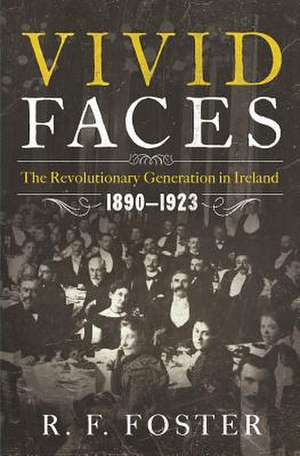
Vivid Faces
Autor R. F. Fosteren Limba Engleză Hardback – 26 ian 2015
Subliniem autoritatea incontestabilă a lui R. F. Foster, profesor la Oxford și unul dintre cei mai respectați istorici ai Irlandei moderne. După ce a semnat biografia de referință a lui Yeats, Foster revine asupra perioadei revoluționare cu o perspectivă care umanizează radical evenimentele din 1916. În Vivid Faces, cercetarea sa se fundamentează pe o arhivă impresionantă de documente private — jurnale și scrisori — care scot la lumină motivațiile intime ale generației ce a proclamat independența Irlandei. Remarcăm modul în care Foster reușește să integreze istoria politică în cea a vieții cotidiene. Spre deosebire de abordările care se concentrează strict pe tactici de gherilă sau negocieri diplomatice, autorul urmărește „fețele vii” ale revoluției: tineri care citeau Freud, frecventau galerii de artă modernă și militau pentru feminism sau socialism. Această lucrare acoperă aceeași arie tematică precum Handbook of the Irish Revival de Declan Kiberd, însă acolo unde Kiberd oferă o antologie de scrieri politice și culturale, Foster propune o narațiune istorică integrată, mult mai axată pe evoluția psihologică a participanților. Această abordare continuă direcția începută în lucrările sale anterioare, precum Words Alone sau cele două volume ale biografiei W. B. Yeats: A Life II. Dacă în acele volume Foster analiza simbioza dintre literatură și contextul istoric prin prisma marelui poet, în Vivid Faces el extinde acest cadru asupra întregii clase intelectuale și burgheze care a respins valorile tradiționale ale Bisericii și ale Imperiului Britanic. Rezultatul este un portret colectiv nuanțat, ce transformă rebeliunea dintr-un act de stradă într-o transformare profundă a conștiinței naționale.
Preț: 188.98 lei
Carte disponibilă
Livrare economică 17 noiembrie-01 decembrie
Specificații
ISBN-10: 0393082792
Pagini: 480
Dimensiuni: 161 x 241 x 43 mm
Greutate: 0.88 kg
Editura: W. W. Norton & Company
V-ar putea interesa
-
 Queen AnneAnne SomersetPreț: 122.11 lei
 -
 Luck and the IrishR. F. Foster-32%Preț: 63.19 lei92.47 lei
 -
 Singled OutVirginia NicholsonPreț: 133.11 lei
 -
 The Lost RevolutionBrian HanleyPreț: 142.24 lei
 -
 ReprobatesJohn StubbsPreț: 133.21 lei
 -
 Rebels: Voices from the Easter RisingFearghal McGarryPreț: 92.11 lei
 -
 Citizen SailorsGlyn Prysor-17%Preț: 90.56 lei109.56 lei
 -
 -19%Preț: 198.93 lei244.41 lei
 -
 A People of One Book: The Bible and the VictoriansTimothy Larsen-15%Preț: 293.03 lei345.89 lei
 -
 The Great ExplosionBrian DillonPreț: 115.32 lei
 -
 Masters of the PostDuncan Campbell-SmithPreț: 201.80 lei
 -
 Preț: 112.41 lei
 -
 How to be a TudorRuth Goodman-19%Preț: 75.79 lei93.55 lei
 -
 She-WolvesHelen CastorPreț: 95.18 lei
 -
 Queen Elizabeth IISarah Bradford-17%Preț: 65.62 lei79.46 lei
 -
 -26%Preț: 68.90 lei93.62 lei
 -
 The Balfour Declaration: The Origins of the Arab-Israeli ConflictJonathan Schneer-26%Preț: 91.52 lei123.05 lei
 -
 Foster, R. F.R. F. FosterPreț: 295.70 lei
 -
 Preț: 175.34 lei
 -
 -25%Preț: 76.51 lei102.02 lei
 -
 -18%Preț: 77.24 lei94.42 lei
 -
 Preț: 361.73 lei
De ce să citești această carte
Recomandăm această carte cititorilor pasionați de istorie europeană care doresc să înțeleagă rădăcinile umane ale independenței Irlandei. Veți câștiga o perspectivă inedită asupra modului în care arta, feminismul și ideile radicale au fuzionat pentru a motiva o generație întreagă. Este o lectură esențială pentru a vedea dincolo de mitul eroic, direct în mintea și inima celor care au trăit transformările din 1916.
Despre autor
R. F. Foster, născut în Waterford, Irlanda, este profesor emerit de istorie irlandeză (catedra Carroll Builders) la Hertford College, Oxford. Este recunoscut la nivel internațional pentru volumul „Modern Ireland”, considerat textul standard pentru studiul istoriei irlandeze contemporane. Expertiza sa vastă în secolul al XIX-lea și începutul secolului XX este dublată de o sensibilitate literară remarcabilă, demonstrată în biografia autorizată a lui W. B. Yeats, lucrare care a redefinit înțelegerea poetului în contextul politic al epocii sale. Activitatea sa academică îmbină rigoarea documentară cu o scriitură elegantă, accesibilă publicului larg.
Descriere scurtă
In this highly original history, acclaimed scholar R. F. Foster explores the human dimension of this pivotal event. He focuses on the ordinary men and women, Yeats's "vivid faces," who rose "from counter or desk among grey / Eighteenth-century houses" and took to the streets. A generation made, not born, they rejected the inherited ways of the Church, their bourgeois families, and British rule. They found inspiration in the ideals of socialism and feminism, in new approaches to love, art, and belief.
Drawing on fresh sources, including personal letters and diaries, Foster summons his characters to life. We meet Rosamond Jacob, who escaped provincial Waterford for bustling Dublin. On a jaunt through the city she might visit a modern art gallery, buy cigarettes, or read a radical feminist newspaper. She could practice the Irish language, attend a lecture on Freud, or flirt with a man who would later be executed for his radical activity. These became the roots of a rich life of activism in Irish and women's causes.
Vivid Faces shows how Rosamond and her peers were galvanized to action by a vertiginous sense of transformation: as one confided to his diary, "I am changing and things around me change." Politics had fused with the intimacies of love and belief, making the Rising an event not only of the streets but also of the hearts and minds of a generation.
Notă biografică
Recenzii
This book . . . reveals a rich and assorted cast of characters with a diversity of views and preoccupations - feminism, socialism, religious diversity, sexual liberalism, the works . . . The beauty of Vivid Faces is that it is squarely based on the testimonies of the characters themselves - letters, diaries, articles, books and later memories - and shows them as they were, not in the light of what they became, especially those revolutionaries sanctified in the selective historical memory of the Irish Republic . . . There are very funny accounts here of how summer schools in the Irish-speaking west of Ireland were an opportunity for unchaperoned young people enthusiastically to pair off . . . There can be few better accounts of [these] people . . . than this book. Foster writes with unconcealed delight about the foibles of these wonderful individuals as well as their achievements . . . There will be any number of accounts of the Easter Rising and its genesis in the run up to the centenary, but few will be as enjoyable as this
Foster has managed to produce the most complete and plausible exploration of the roots of the 1916 Rebellion and the power it subsequently exerted over the public imagination. As the centenary approaches, his book will be essential reading for anyone who wishes to follow the argument about the Irish revolutionary generation
A significant accomplishment that makes a serious case for the concept of 'generations' in exploring the origins of the Rising . . . Through personal diaries, letters and journals, [Foster] allows us to see how these young people lived. What follows is a portrait of an Ireland that bears little resemblance to the country that emerged after 1922 . . . Foster's book, in unmatchable prose, is a must-read
Powerful and absorbing . . . [Foster] draws on decades of engagement with cultural history to bring an original, lively and learned analysis to a fascinating generation . . . Judicious and empathetic, with no attempt to hide his admiration for their idealism, he does not fall into the trap of assessing them acerbically through the lens of the present but allows their own words to breathe. Much of his account is riveting and skilfully woven together, with the analysis enlivened by Foster's customary sparkling prose . . . [he] does a lot to balance male-dominated accounts of the period . . . Crucially, this is not a book built on reductive hindsight; instead it gives us a deep and textured awareness of that "enclosed, self-referencing, hectic world" where the thinkers lived, worked, reflected and dreamed
Roy Foster . . . has achieved what few have managed: an account of the Irish revolution that captures its quixotic ardour without succumbing to it . . . Vivid Faces is a wonderful book about revolution - both the specific and the general. I read it in the aftermath of Scotland's abortive revolution by referendum and found Foster's analysis painfully wise
Written by a master-historian, this superbly orchestrated group portrait of Ireland's 'revolutionary generation' from 1890 to 1923 shows how the independence movement drew its ideas, tactics and personnel not from peasant outsiders but metropolitan, middle-class insiders . . . Foster highlights refreshing new perspectives
Extraordinary personal journeys outlined in Foster's richly detailed evocation of a period of Irish history in which idealism, bohemianism and artistic creativity went with a resurgence of militant nationalism and what Foster calls 'the cult of the gun' . . . Foster's exhaustively researched history delineates the various streams of cultural and social radicalism that converged in the two decades leading up to the Irish revolution
Sometimes a history book prompts one to reflect on the past and present alike. R F Foster, professor of Irish history at Oxford University, has just published such a text . . . Foster writes so compellingly
Written with a stern sense of authority, but simultaneously leaving room for suggestion, interpretation, debate and nuance, Vivid Faces is an immensely important analysis of Irish history that will be used again and again as a reference point for generations to come: continuing a much-needed healthy debate about what exactly Irish Republicanism stands for?
It is a relief to read such a study, which takes for granted that the world is incorrigibly plural, and which immerses itself in the stuff of passionate human histories
The book itself is a valuable collection of a broad range of views of participants that publishers dared not mention for decades. It dissects the propaganda to provide an insightful look at the real contemporary thinking . . . invaluable historical record
Generous, humane and stylish