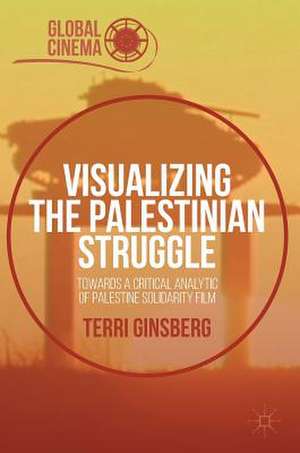
Visualizing the Palestinian Struggle: Global Cinema
Autor Terri Ginsbergen Limba Engleză Hardback – 4 noi 2016



Preț: 601.50 lei
Preț vechi: 707.65 lei
-15%
Puncte Express: 902
Carte tipărită la comandă
Livrare economică 04-18 decembrie
Livrare prin curier în România Termenul estimat este afișat lângă disponibilitate.
Transport gratuit pentru acest produs Plată online sau ramburs, în funcție de opțiunile comenzii.
Retur gratuit în 14 zile Comandă securizată și suport în română.
Specificații
ISBN-13: 9783319397764
ISBN-10: 3319397761
Pagini: 172
Ilustrații: XI, 157 p. 8 illus.
Dimensiuni: 153 x 216 x 15 mm
Greutate: 0.3 kg
Ediția:1st edition 2016
Editura: Springer International Publishing
Colecția Global Cinema
Seria Global Cinema
Locul publicării:Cham, Switzerland
ISBN-10: 3319397761
Pagini: 172
Ilustrații: XI, 157 p. 8 illus.
Dimensiuni: 153 x 216 x 15 mm
Greutate: 0.3 kg
Ediția:1st edition 2016
Editura: Springer International Publishing
Colecția Global Cinema
Seria Global Cinema
Locul publicării:Cham, Switzerland
V-ar putea interesa
-
 Fifty Years Of Carry OnRichard Webber-47%Preț: 64.15 lei120.66 lei
 -
 Jacobean DramaProfessor Pascale Aebischer-16%Preț: 191.55 lei226.73 lei
 -
 The Complete Star Wars(r) EncyclopediaStephen J Sansweet-9%Preț: 949.77 lei1043.71 lei
 -
 Contemporary Cinema of Africa and the DiasporaAnjali PrabhuPreț: 330.77 lei
 -
 Quota QuickiesSteve Chibnall-11%Preț: 255.99 lei287.80 lei
 -
 Night and the CityAndrew Pulver-36%Preț: 67.39 lei105.44 lei
 -
 Sweet Smell of SuccessJames Naremore-36%Preț: 67.74 lei105.76 lei
 -
 Dark Places - The Haunted House in FilmBarry CurtisPreț: 128.76 lei
Cuprins
Introduction – Modalities of Solidarity.- Chapter One – After Al-Aqsa.- Chapter Two – Revisiting Prior Commitments.- Chapter Three – Distant Neighbors.- Conclusion – A Time for Change.
Recenzii
“Visualizing Palestine is a groundbreaking resource on films of Palestine solidarity. The book presents a valuable teaching tool at the undergraduate and graduate levels. It would make essential reading for the study of Palestine cinema for its simultaneous analysis of marginal films and their critique of the hegemonic systems that silence them. To use any part of this book would be an affirmative act of solidarity.” (Samirah Alkassim, Arab Studies Quarterly, Vol. 43 (2), 2021)
Notă biografică
Terri Ginsberg is Assistant Professor of Film at The American University in Cairo. She is co-author of Historical Dictionary of Middle Eastern Cinema; author of Holocaust Film: The Political Aesthetics of Ideology; and co-editor of Perspectives on German Cinema and A Companion to German Cinema.
Textul de pe ultima copertă
This book offers a much-needed focus on Palestine solidarity films, supplying a critical theoretical framework whose intellectual thrust is rooted in the challenges facing scholars censored for attempting to rectify and reverse the silencing of a subject matter about which much of the world would remain uninformed without cinematic and televisual mediation. Its innovative focus on Palestine solidarity films spans a selected array of works which began to emerge during the 1970s, made by directors located outside Palestine/Israel who professed support for Palestinian liberation. Visualizing the Palestinian Struggle analyzes Palestinian solidarity films hailing from countries such as Canada, the United Kingdom, Egypt, Iran, Palestine/Israel, Mexico, and the United States. Visualizing the Palestinian Struggle is an effort to insist, constructively, upon a rectification and reversal of the glaring and disproportionate minimization and distortion of discourse critical of Zionism and Israeli policy in the cinematic and televisual public sphere.
Caracteristici
Creates a theory of solidarity film applicable to and beyond the Palestinian case Offers new points of analysis on the Palestinian–Israeli conflict and its political spectrum from film studies, cultural studies, and political studies lenses alike Includes allegorical “interludes” focusing on films made by Palestinians themselves in Palestine