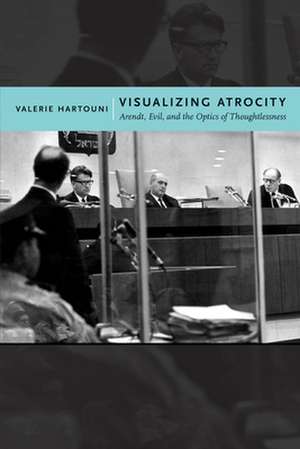
Visualizing Atrocity
Autor Valerie Hartounien Limba Engleză Paperback – 20 aug 2012
Preț: 243.21 lei
Puncte Express: 365
Carte tipărită la comandă
Livrare economică 04-18 iulie
Specificații
ISBN-13: 9780814769768
ISBN-10: 0814769764
Pagini: 205
Dimensiuni: 156 x 227 x 17 mm
Greutate: 0.33 kg
Editura: NEW YORK UNIVERSITY PRESS
ISBN-10: 0814769764
Pagini: 205
Dimensiuni: 156 x 227 x 17 mm
Greutate: 0.33 kg
Editura: NEW YORK UNIVERSITY PRESS
V-ar putea interesa
-
 -9%Preț: 252.97 lei278.51 lei
 -
 A Hero's Many FacesT. Schult-9%Preț: 704.04 lei773.67 lei
 -
 Preț: 103.25 lei
 -
 Treblinka SurvivorMark S. SmithPreț: 113.85 lei
 -
 -27%Preț: 1630.08 lei2232.99 lei
 -
 DisenchantmentCatherine D ChatterleyPreț: 134.78 lei
 -
 A Time to SpeakHelen LewisPreț: 68.31 lei
 -
 -23%Preț: 723.13 lei939.14 lei
 -
 The Woman without a NumberIby KnillPreț: 119.47 lei
 -
 Mrs Mahoneys Secret WarClaudia StrachanPreț: 89.42 lei
 -
 -25%Preț: 186.66 lei250.37 lei
 -
 Treblinka: A Survivor's MemoryChil Rajchman-29%Preț: 64.12 lei90.59 lei
 -
 Allies in AuschwitzDuncan LittlePreț: 70.16 lei
Recenzii
A compelling and broad-reaching manuscript that will be of great interest not only to scholars of Arendt and Eichmann, but to those who want to think more generally about the interrelationship of political judgment and visual culture. Judith Butler, University of California, Berkeley A beautifully written and brilliantly argued intervention into the project of intellectual history that breaks new ground in its complex reframing of the key questions of morality and justice in our times. Marita Sturken, NYU
"A compelling and broad-reaching manuscript that will be of great interest not only to scholars of Arendt and Eichmann, but to those who want to think more generally about the interrelationship of political judgment and visual culture." Judith Butler, University of California, Berkeley "A beautifully written and brilliantly argued intervention into the project of intellectual history that breaks new ground in its complex reframing of the key questions of morality and justice in our times." Marita Sturken, NYU
"A compelling and broad-reaching manuscript that will be of great interest not only to scholars of Arendt and Eichmann, but to those who want to think more generally about the interrelationship of political judgment and visual culture." Judith Butler, University of California, Berkeley "A beautifully written and brilliantly argued intervention into the project of intellectual history that breaks new ground in its complex reframing of the key questions of morality and justice in our times." Marita Sturken, NYU
Descriere
Re-assesses the myths that have come to shape and limit our understanding of the Nazi genocide as well as totalitarianisms broader, constitutive, and recurrent features
Notă biografică
Normal 0 MicrosoftInternetExplorer4 st1\: *{behavior: url(#ieooui) } /* Style Definitions */ table.MsoNormalTable {mso-style-name: "Table Normal"; mso-tstyle-rowband-size:0; mso-tstyle-colband-size:0; mso-style-noshow: yes; mso-style-parent: ""; mso-padding-alt:0pt 5.4pt 0pt 5.4pt; mso-para-margin:0pt; mso-para-margin-bottom: .0001pt; mso-pagination: widow-orphan; font-size:10.0pt; font-family: "Times New Roman";} Valerie Hartouni is Professor of Communication at the University of California, San Diego, and author of Cultural Conceptions: On Reproductive Technologies and the Remaking of Life.