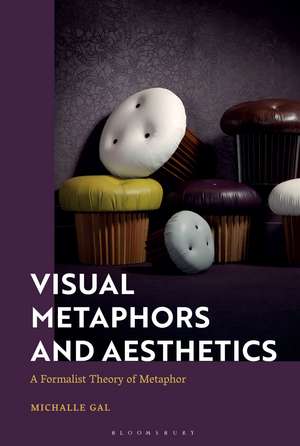
Visual Metaphors and Aesthetics: A Formalist Theory of Metaphor
Autor Michalle Galen Limba Engleză Paperback – 28 dec 2023
This focus on the external visual world allows Gal to employ visual theories to capture the essence of metaphor. She looks beyond conceptual or semantic mechanism, and returns to theories of Arnheim and Gombrich and the current evolution of ideas about the visual or material and embodied cognition. Proposing to see visual metaphors in their basic form, she uses a new externalist terminology of ontology, visuality, composition, affordance, construction, and emergence.
Setting out a new theory that takes into account that humans are visual no less than cognitive creatures, Visual Metaphors and Aesthetics lays the foundation for a new vocabulary to talk about metaphors.
Preț: 197.98 lei
Preț vechi: 279.18 lei
-29%
Puncte Express: 297
Carte tipărită la comandă
Livrare economică 23 noiembrie-07 decembrie
Livrare prin curier în România Termenul estimat este afișat lângă disponibilitate.
Transport gratuit de la 400.00 lei Plată online sau ramburs, în funcție de opțiunile comenzii.
Retur gratuit în 14 zile Comandă securizată și suport în română.
Specificații
ISBN-13: 9781350326705
ISBN-10: 1350326704
Pagini: 222
Ilustrații: 17 bw illus
Dimensiuni: 158 x 236 x 22 mm
Greutate: 0.34 kg
Editura: Bloomsbury Publishing
Colecția Bloomsbury Academic
Locul publicării:London, United Kingdom
ISBN-10: 1350326704
Pagini: 222
Ilustrații: 17 bw illus
Dimensiuni: 158 x 236 x 22 mm
Greutate: 0.34 kg
Editura: Bloomsbury Publishing
Colecția Bloomsbury Academic
Locul publicării:London, United Kingdom
V-ar putea interesa
-
 The Sublime, Terror and Human DifferenceChristine BattersbyPreț: 410.44 lei
 -
 Beauty In JapanSamuel H. Wainwright-18%Preț: 1423.52 lei1736.00 lei
 -
 NoveltyDonald A. Crosby-32%Preț: 522.98 lei768.03 lei
 -
 -34%Preț: 538.49 lei816.34 lei
 -
 -28%Preț: 273.62 lei378.60 lei
 -
 Neoplatonic AestheticsLiana De Girolami CheneyPreț: 455.17 lei
 -
 Aesthetics & the Philosophy of SpiritJohn Shannon HendrixPreț: 472.56 lei
 -
 Architecture and PsychoanalysisJohn Shannon HendrixPreț: 469.95 lei
 -
 -25%Preț: 249.23 lei331.48 lei
 -
 Preț: 65.43 lei
 -
 Aesthetic Afterlives: Irony, Literary Modernity and the Ends of BeautyDr Andrew EasthamPreț: 285.69 lei
 -
 Against Transmission: Media Philosophy and the Engineering of TimeDr Timothy Barker-25%Preț: 251.78 lei335.96 lei
 -
 Aesthetics in PerformanceAngela Hobart-23%Preț: 760.74 lei987.97 lei
 -
 Awakening BeautyAnthony NapoleonPreț: 151.43 lei
 -
 Seeing the Invisible: On KandinskyMichel Henry-39%Preț: 672.55 lei1103.10 lei
 -
 AestheticismMichalle GalPreț: 446.11 lei
 -
 Language, Image and SilenceOnno ZijlstraPreț: 440.08 lei
 -
 -Die Musik Faengt Im Menschen An-: Theoretisch - PraktischChristoph Khittl-27%Preț: 791.65 lei1084.46 lei
 -
 Aesthetics and NeuroscienceZoï Kapoula-15%Preț: 725.88 lei853.98 lei
 -
 Preț: 395.89 lei
 -
 -23%Preț: 458.21 lei595.07 lei
 -
 Preț: 311.85 lei
 -
 Essays in Literary AestheticsRanjan K. GhoshPreț: 364.31 lei
Cuprins
Introduction
1. The Visual Dimension of Metaphors
2. Semantic Theories of Metaphor
3. Cognitivist Theories of Metaphor: a conceptual turn
4. The Advent of the Visual Perspective of Metaphors
5. Metaphors After the Linguistic Turn of Aesthetics
6. Paradigmatic Metaphors
7. Visuality, Paraphrase and Syntactic Productivity
8. Visuality of Language: formalist account
9. Metaphor: A Definition
Bibliography
Index
1. The Visual Dimension of Metaphors
2. Semantic Theories of Metaphor
3. Cognitivist Theories of Metaphor: a conceptual turn
4. The Advent of the Visual Perspective of Metaphors
5. Metaphors After the Linguistic Turn of Aesthetics
6. Paradigmatic Metaphors
7. Visuality, Paraphrase and Syntactic Productivity
8. Visuality of Language: formalist account
9. Metaphor: A Definition
Bibliography
Index
Recenzii
Visual Metaphors and Aesthetics presents a groundbreaking re-evaluation of visual metaphorical discourse, offering fresh insights into its aesthetic and formalist dimensions from an externalism perspective.
Visual Metaphors and Aesthetics is incredibly audacious, which should encourage researchers to take an interest in reading this book.
Gal pulls this off with ease through smart and elegant writing, building up her theory point by point, chapter by chapter. Irrespective of which metaphor theory we follow, the result is a highly engaging and stimulating read that will undoubtedly spark countless debates on the nature of metaphor in the long run. What is certain is that Gal's thought-provoking-might I even suggest provocative-book offers a fresh and original insight on metaphor, substantially expanding the perspective for metaphor scholars working in any discipline.
Michalle Gal's Visual Metaphors and Aesthetics: A Formalist Theory of Metaphor is a major accomplishment. It takes seriously the imagistic, material, and imaginative dimensions of metaphor, and it shows that language use is shot through with painterly ambitions. This is a theory of metaphor by a philosopher of art for philosophers of art, and it is most welcome.
Human thinking is primordially tactile and visual, and on the visual level from the very beginning imbued with metaphors. On the linguistic level the ubiquity of metaphors of course meets the eye, but it is only when looking at their visual origins that an explanation of how they function can be given. Michalle Gal provides this explanation in an outstandingly informed and informative, creative and lucid way. A must read for anyone for whom the iconic turn is more than a metaphor.
Michalle Gal draws on recent developments in visual culture, and on the work of a number of under-appreciated thinkers-Arnheim, Aldrich, and Gombrich, among them-to offer a resourceful, spirited defense of an ambitious new theory of metaphor. Her rich book promises to unsettle widespread assumptions about metaphor as well as the history of philosophical aesthetics.
This important work is well researched, well organized, and well written.
Visual Metaphors and Aesthetics is incredibly audacious, which should encourage researchers to take an interest in reading this book.
Gal pulls this off with ease through smart and elegant writing, building up her theory point by point, chapter by chapter. Irrespective of which metaphor theory we follow, the result is a highly engaging and stimulating read that will undoubtedly spark countless debates on the nature of metaphor in the long run. What is certain is that Gal's thought-provoking-might I even suggest provocative-book offers a fresh and original insight on metaphor, substantially expanding the perspective for metaphor scholars working in any discipline.
Michalle Gal's Visual Metaphors and Aesthetics: A Formalist Theory of Metaphor is a major accomplishment. It takes seriously the imagistic, material, and imaginative dimensions of metaphor, and it shows that language use is shot through with painterly ambitions. This is a theory of metaphor by a philosopher of art for philosophers of art, and it is most welcome.
Human thinking is primordially tactile and visual, and on the visual level from the very beginning imbued with metaphors. On the linguistic level the ubiquity of metaphors of course meets the eye, but it is only when looking at their visual origins that an explanation of how they function can be given. Michalle Gal provides this explanation in an outstandingly informed and informative, creative and lucid way. A must read for anyone for whom the iconic turn is more than a metaphor.
Michalle Gal draws on recent developments in visual culture, and on the work of a number of under-appreciated thinkers-Arnheim, Aldrich, and Gombrich, among them-to offer a resourceful, spirited defense of an ambitious new theory of metaphor. Her rich book promises to unsettle widespread assumptions about metaphor as well as the history of philosophical aesthetics.
This important work is well researched, well organized, and well written.