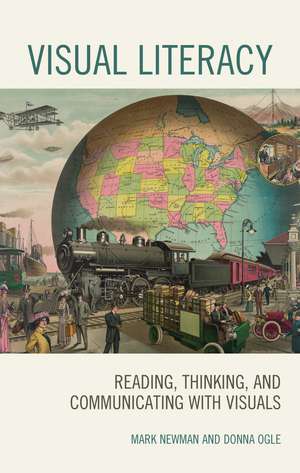
Visual Literacy: Reading, Thinking, and Communicating with Visuals
Autor Mark Newman, Donna Ogleen Limba Engleză Paperback – 25 oct 2019
Preț: 313.35 lei
Preț vechi: 388.32 lei
-19%
Puncte Express: 470
Carte tipărită la comandă
Livrare economică 16-30 noiembrie
Livrare prin curier în România Termenul estimat este afișat lângă disponibilitate.
Transport gratuit de la 400.00 lei Plată online sau ramburs, în funcție de opțiunile comenzii.
Retur gratuit în 14 zile Comandă securizată și suport în română.
Specificații
ISBN-13: 9781475840117
ISBN-10: 147584011X
Pagini: 216
Ilustrații: 50 b/w illustrations; 7 tables
Dimensiuni: 148 x 226 x 16 mm
Greutate: 0.3 kg
Editura: Bloomsbury Publishing
Colecția Rowman & Littlefield
Locul publicării:New York, United States
ISBN-10: 147584011X
Pagini: 216
Ilustrații: 50 b/w illustrations; 7 tables
Dimensiuni: 148 x 226 x 16 mm
Greutate: 0.3 kg
Editura: Bloomsbury Publishing
Colecția Rowman & Littlefield
Locul publicării:New York, United States
V-ar putea interesa
-
 Preț: 225.16 lei
 -
 -8%Preț: 464.96 lei505.38 lei
 -
 -25%Preț: 285.37 lei380.22 lei
 -
 SpanishPublishing, LindquistPreț: 107.49 lei
 -
 Russian LanguageArtemiy BelyaevPreț: 81.34 lei
 -
 Preț: 130.11 lei
 -
 Chinese BlockbusterRemillard, Gilbert C.Preț: 173.79 lei
 -
 Livro de Vocabulario FrancesLanguages, PinhokPreț: 99.84 lei
 -
 Livro de Vocabulario AlemaoLanguages, PinhokPreț: 99.84 lei
 -
 Textiles Gestalten an Stationen 9-10Christian HenningPreț: 193.51 lei
 -
 Englisch üben Klasse 8Christine JungPreț: 196.75 lei
 -
 Mathe an Stationen 5 GymnasiumTanja ZimmermannPreț: 194.92 lei
 -
 Mit 33 originellen Schreibanlässen durch das JahrBärbel KleinPreț: 192.47 lei
 -
 Mathematik im Alltag - 5./6. Klasse SoPädMelanie DietzPreț: 219.91 lei
 -
 Komm mit nach BethlehemBarbara PetersPreț: 167.29 lei
Cuprins
Acknowledgments
Introduction
Chapter One: Understanding Visual Literacy
Chapter Two: Understanding Visuals
Chapter Three: Working with Visuals as Texts
Chapter Four: Combining the Visual and Verbal
Chapter Five: Visuals as Learning Aids
Chapter Six: Creating Visuals
Chapter Seven: Visual literacy and English Language Learners
Chapter Eight: Visual Literacy for Students with Special Needs
Bibliography
About the Authors
Introduction
Chapter One: Understanding Visual Literacy
Chapter Two: Understanding Visuals
Chapter Three: Working with Visuals as Texts
Chapter Four: Combining the Visual and Verbal
Chapter Five: Visuals as Learning Aids
Chapter Six: Creating Visuals
Chapter Seven: Visual literacy and English Language Learners
Chapter Eight: Visual Literacy for Students with Special Needs
Bibliography
About the Authors
Recenzii
Highly Recommended: [Newman and Ogle] connect their passion for the humanities with research on language and literacy to provide a comprehensive examination of visual literacy. They outline visual literacy from its foundation to strategies for content by providing examples from research and classroom instruction. Teachers are connected to the study of visuals to improve students' ability to read and understand the meaning of visual documents. Visual learning resources, including graphic organizers and web-based tools such as apps, are highlighted for their ability to increase inquiry-based learning in the content areas, especially science and history. Through multimodal presentations, the authors argue, students can create their own messages and texts and develop a deep, analytical level of thinking. The final chapter explores the three principles of the universal design for learning framework (UDL); they reinforce the need for visuals in scaffolding learning and designing curriculum that engages all learners. This great resource is not only for teachers looking to strengthen visual literacy pedagogy but also for all individuals looking to build this competency for themselves.
Newman and Ogle's new book on Visual Literacy is just what the field has been missing for many years. It explores the vast subject area of visual literacy then clearly breaks down information to important and concise areas of study. The text would serve a variety of audiences well from educators, students, diverse populations as well as the general public. Due to our never ending input of visual images this text has current applications in many settings. The narrative is approachable for many readers. It informs all audiences in step by step analysis and information. I highly recommend this important book.
Visual images can convey powerful messages, often including cultural values and persuasive elements. Students have to be taught to analyze, understand, and critique the visual information that surrounds them every day. Failing to do so places them at risk for school failure, and even manipulation, in our highly visual and complex world. Ogle and Newman provide a path for teachers that guides efforts to broaden students' literacy learning to include the vast array visual content.
Newman and Ogle's new book on Visual Literacy is just what the field has been missing for many years. It explores the vast subject area of visual literacy then clearly breaks down information to important and concise areas of study. The text would serve a variety of audiences well from educators, students, diverse populations as well as the general public. Due to our never ending input of visual images this text has current applications in many settings. The narrative is approachable for many readers. It informs all audiences in step by step analysis and information. I highly recommend this important book.
Visual images can convey powerful messages, often including cultural values and persuasive elements. Students have to be taught to analyze, understand, and critique the visual information that surrounds them every day. Failing to do so places them at risk for school failure, and even manipulation, in our highly visual and complex world. Ogle and Newman provide a path for teachers that guides efforts to broaden students' literacy learning to include the vast array visual content.