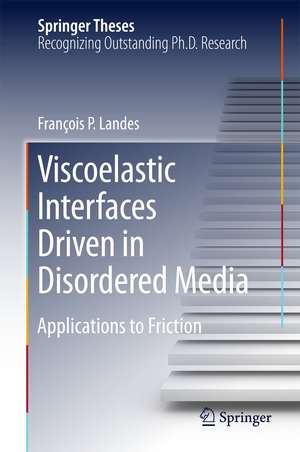
Viscoelastic Interfaces Driven in Disordered Media: Springer Theses
Autor François P. Landesen Limba Engleză Hardback – 21 iul 2015
Din seria Springer Theses
- 15%
 Preț: 663.23 lei
 - 15%
 Preț: 661.49 lei
 - 15%
 Preț: 660.04 lei
 - 18%
 Preț: 1438.89 lei
 -
 Preț: 397.39 lei
 - 18%
 Preț: 1150.06 lei
 - 18%
 Preț: 1261.12 lei
 - 15%
 Preț: 665.20 lei
 -
 Preț: 404.91 lei
 -
 Preț: 401.44 lei
 - 18%
 Preț: 1151.50 lei
 -
 Preț: 410.46 lei
 - 18%
 Preț: 1034.72 lei
 - 18%
 Preț: 977.51 lei
 - 18%
 Preț: 1144.10 lei
 - 15%
 Preț: 663.23 lei
 - 18%
 Preț: 1031.60 lei
 - 15%
 Preț: 638.81 lei
 - 18%
 Preț: 978.49 lei
 -
 Preț: 398.83 lei
 - 15%
 Preț: 667.93 lei
 -
 Preț: 399.72 lei
 - 15%
 Preț: 658.80 lei
 - 15%
 Preț: 663.97 lei
 - 15%
 Preț: 664.46 lei
 - 18%
 Preț: 1263.02 lei
 - 15%
 Preț: 663.48 lei
 - 18%
 Preț: 1035.90 lei
 - 18%
 Preț: 1273.75 lei
 - 18%
 Preț: 1152.69 lei
 - 15%
 Preț: 661.99 lei
 - 18%
 Preț: 1152.90 lei
 - 18%
 Preț: 1264.69 lei
 - 18%
 Preț: 1038.03 lei
 - 18%
 Preț: 1036.63 lei
 - 18%
 Preț: 1156.95 lei
 - 18%
 Preț: 1036.70 lei
 - 18%
 Preț: 979.42 lei
 - 15%
 Preț: 642.59 lei
 - 15%
 Preț: 665.96 lei
 - 18%
 Preț: 976.57 lei
 - 18%
 Preț: 1443.18 lei
 -
 Preț: 401.44 lei
 -
 Preț: 399.14 lei
 - 18%
 Preț: 1034.98 lei
 - 18%
 Preț: 1148.15 lei
 - 15%
 Preț: 658.33 lei
 - 15%
 Preț: 662.51 lei
 - 15%
 Preț: 659.03 lei
 - 15%
 Preț: 659.78 lei
Preț: 665.43 lei
Preț vechi: 782.86 lei
-15%
Puncte Express: 998
Carte tipărită la comandă
Livrare economică 05-19 decembrie
Livrare prin curier în România Termenul estimat este afișat lângă disponibilitate.
Transport gratuit pentru acest produs Plată online sau ramburs, în funcție de opțiunile comenzii.
Retur gratuit în 14 zile Comandă securizată și suport în română.
Specificații
ISBN-13: 9783319200217
ISBN-10: 3319200216
Pagini: 220
Ilustrații: XIII, 206 p. 79 illus., 37 illus. in color.
Dimensiuni: 160 x 241 x 18 mm
Greutate: 0.45 kg
Ediția:1st edition 2016
Editura: Springer
Colecția Springer Theses
Seria Springer Theses
Locul publicării:Cham, Switzerland
ISBN-10: 3319200216
Pagini: 220
Ilustrații: XIII, 206 p. 79 illus., 37 illus. in color.
Dimensiuni: 160 x 241 x 18 mm
Greutate: 0.45 kg
Ediția:1st edition 2016
Editura: Springer
Colecția Springer Theses
Seria Springer Theses
Locul publicării:Cham, Switzerland
V-ar putea interesa
-
 Complexity: A Very Short IntroductionJohn H. Holland-20%Preț: 56.65 lei70.82 lei
 -
 Nonlinear SystemsShankar Sastry-15%Preț: 682.48 lei802.92 lei
 -
 Preț: 325.10 lei
 -
 Pattern Formation and Dynamics in Nonequilibrium SystemsMichael Cross-14%Preț: 828.27 lei963.10 lei
 -
 Preț: 354.78 lei
 -
 Preț: 454.49 lei
 -
 Toward Analytical Chaos in NonAlbert C J Luo-9%Preț: 838.76 lei921.71 lei
 -
 Mathematical Methods in Biology and NeurobiologyJürgen Jost-15%Preț: 488.29 lei574.46 lei
 -
 Isospectral TransformationsLeonid BunimovichPreț: 402.24 lei
 -
 Henri Poincaré, 1912-2012Bertrand Duplantier-18%Preț: 812.88 lei991.31 lei
 -
 Dynamics of Quasi-Stable Dissipative SystemsIgor ChueshovPreț: 397.95 lei
 -
 Preț: 346.73 lei
Public țintă
ResearchCuprins
Introduction to Friction.- Application of Friction to Seismic Faults.- Elastic Interfaces Driven in Disordered Media.- Viscoelastic Interfaces Driven in Disordered Media.- Directed Percolation: a Non-Markovian Variant.- General Perspectives.
Textul de pe ultima copertă
This book offers an in-depth study of two well-known models of “avalanche” dynamics, modified minimally by the inclusion of relaxation. Many complex systems respond to continuous inputs of energy by accumulation of stress over time, interrupted by sudden energy releases called avalanches. The first model studied is the viscoelastic interface driven over disorder, which is shown to display the fundamental features of friction. In the mean-field limit, the friction force derived semi-analytically is compatible with laboratory experiments (displaying both velocity weakening and contact aging). In two dimensions, large-scale numerical simulations are in good agreement with the basic features of real earthquakes (Gutenberg-Richter Law, aftershock migration). The second model is a non-Markovian variant of Directed Percolation, in which we observe that the universality class is only partly modified by relaxation, a promising finding with respect to our first model.
Caracteristici
Nominated as an outstanding PhD thesis by the Université Paris-Sud, France Gives a pedagogical introduction to solid friction and fault dynamics, aimed at the needs of statistical physicists Reveals the crucial role of the interplay between disorder and relaxation in modeling solid friction and seismic faults Includes supplementary material: sn.pub/extras