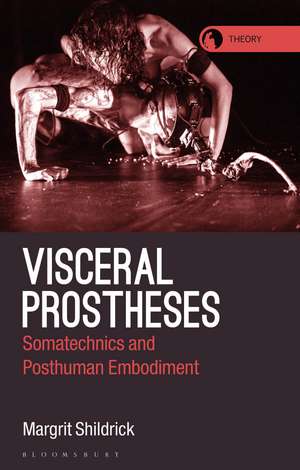
Visceral Prostheses: Somatechnics and Posthuman Embodiment: Theory in the New Humanities
Autor Professor Margrit Shildricken Limba Engleză Paperback – 19 oct 2023
Focusing on prostheses, Margrit Shildrick broadens our understanding of both what prostheses are and what they might mean for human embodiment. As well as rehabilitation devices used by disabled people to replace or augment impaired parts of the body, Shildrick introduces visceral organic prostheses, which involve any cellular material that cannot be identified with the self, from organ transplantation to the physiological processes of microchimerism and the microbiome. Beyond origin narratives that concentrate on 'host' and 'guest' and 'self' and 'other', she examines the transformative possibilities that prostheses offer as they extend the nature of the embodied self beyond genetic singularity.
Building on cutting-edge interdisciplinary research in critical disability studies, transplantation studies, and bioscience, Visceral Prostheses argues that bodies with prostheses in whatever form should no longer be understood as irregular forms of normative embodiment, but as limit cases of a common experience. In doing so, it challenges the western understanding of the singular self and welcomes a new understanding of the human.
The ebook editions of this book are available open access under a CC BY-NC-ND 4.0 licence on bloomsburycollections.com.
Din seria Theory in the New Humanities
- 23%
 Preț: 207.71 lei
 - 15%
 Preț: 166.00 lei
 - 19%
 Preț: 163.68 lei
 - 26%
 Preț: 200.36 lei
 - 18%
 Preț: 217.27 lei
 - 46%
 Preț: 229.93 lei
 - 20%
 Preț: 168.45 lei
 - 28%
 Preț: 209.30 lei
 - 27%
 Preț: 214.46 lei
 - 14%
 Preț: 162.03 lei
 - 22%
 Preț: 157.73 lei
 - 14%
 Preț: 162.38 lei
 - 31%
 Preț: 574.24 lei
 - 32%
 Preț: 568.32 lei
 - nou
 Preț: 128.07 lei
Preț: 211.87 lei
Preț vechi: 293.67 lei
-28%
Puncte Express: 318
Carte tipărită la comandă
Livrare economică 30 noiembrie-14 decembrie
Livrare prin curier în România Termenul estimat este afișat lângă disponibilitate.
Transport gratuit de la 400.00 lei Plată online sau ramburs, în funcție de opțiunile comenzii.
Retur gratuit în 14 zile Comandă securizată și suport în română.
Specificații
ISBN-13: 9781350224940
ISBN-10: 1350224944
Pagini: 272
Dimensiuni: 154 x 232 x 18 mm
Greutate: 0.42 kg
Editura: Bloomsbury Publishing
Colecția Bloomsbury Academic
Seria Theory in the New Humanities
Locul publicării:London, United Kingdom
ISBN-10: 1350224944
Pagini: 272
Dimensiuni: 154 x 232 x 18 mm
Greutate: 0.42 kg
Editura: Bloomsbury Publishing
Colecția Bloomsbury Academic
Seria Theory in the New Humanities
Locul publicării:London, United Kingdom
Cuprins
Acknowledgments
Introduction
Part 1: From Mechanical To Visceral Prostheses
Chapter 1: Disability
Chapter 2: Organ And Tissue Transplantation
Chapter 3: Microchimerism And The Microbiome
Part 2: Some Case Studies
Chapter 4: Dementia
Chapter 5: Stem Cell Transplant
Chapter 6: Surrogacy
Part 3: Towards Posthuman Embodiment
Chapter 7: Life And Death
Chapter 8: The Ethics Of A New Imaginary
Conclusion
References
Index
Introduction
Part 1: From Mechanical To Visceral Prostheses
Chapter 1: Disability
Chapter 2: Organ And Tissue Transplantation
Chapter 3: Microchimerism And The Microbiome
Part 2: Some Case Studies
Chapter 4: Dementia
Chapter 5: Stem Cell Transplant
Chapter 6: Surrogacy
Part 3: Towards Posthuman Embodiment
Chapter 7: Life And Death
Chapter 8: The Ethics Of A New Imaginary
Conclusion
References
Index
Recenzii
Margrit Shildrick is an important and original thinker whose work brilliantly brings together bioethics, feminist and queer theories, and critical disability studies. In Visceral Prostheses, Shildrick extends her thinking on posthuman embodiment into new territories, including the microbiome and microchimerism. Her analyses of various case studies of prostheses as both external and internal to corporeality takes feminist thought in new directions.
A fascinating reconceptualization of the notion of prosthesis through the lens of critical disability studies that views a range of contemporary medical interventions involving live but non-self materials as visceral prostheses requiring a reconceptualization of the human body as open to creative expansion. To frame stem cell transplants, heart and liver transplants, or even fecal transplants as prosthetics is reframes our conventional understanding of prosthetics as remedying a lack. Instead, these are all seen as journeys into a new realm of problematized and extended selfhood. For those engaged in critical disability studies, this reconfiguration of prosthesis is exciting. And for scholars engaged in studying biomedical innovations, the foundational role played by critical disability studies in this analysis of new biomedical strategies promises to reorient medicine in productive ways.
A fascinating reconceptualization of the notion of prosthesis through the lens of critical disability studies that views a range of contemporary medical interventions involving live but non-self materials as visceral prostheses requiring a reconceptualization of the human body as open to creative expansion. To frame stem cell transplants, heart and liver transplants, or even fecal transplants as prosthetics is reframes our conventional understanding of prosthetics as remedying a lack. Instead, these are all seen as journeys into a new realm of problematized and extended selfhood. For those engaged in critical disability studies, this reconfiguration of prosthesis is exciting. And for scholars engaged in studying biomedical innovations, the foundational role played by critical disability studies in this analysis of new biomedical strategies promises to reorient medicine in productive ways.