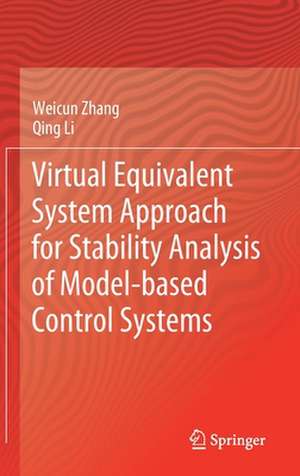
Virtual Equivalent System Approach for Stability Analysis of Model-based Control Systems
Autor Weicun Zhang, Qing Lien Limba Engleză Hardback – 6 iun 2020
Preț: 663.45 lei
Preț vechi: 780.53 lei
-15%
Puncte Express: 995
Carte tipărită la comandă
Livrare economică 02-16 decembrie
Livrare prin curier în România Termenul estimat este afișat lângă disponibilitate.
Transport gratuit pentru acest produs Plată online sau ramburs, în funcție de opțiunile comenzii.
Retur gratuit în 14 zile Comandă securizată și suport în română.
Specificații
ISBN-13: 9789811555374
ISBN-10: 9811555370
Pagini: 184
Ilustrații: XIII, 168 p. 100 illus., 15 illus. in color.
Dimensiuni: 160 x 241 x 16 mm
Greutate: 0.4 kg
Ediția:1st ed. 2021
Editura: Springer
Locul publicării:Singapore, Singapore
ISBN-10: 9811555370
Pagini: 184
Ilustrații: XIII, 168 p. 100 illus., 15 illus. in color.
Dimensiuni: 160 x 241 x 16 mm
Greutate: 0.4 kg
Ediția:1st ed. 2021
Editura: Springer
Locul publicării:Singapore, Singapore
V-ar putea interesa
-
 -9%Preț: 892.78 lei981.08 lei
-
 Discrete Control SystemsYoshifumi Okuyama-15%Preț: 667.86 lei785.72 lei
-
 -18%Preț: 987.18 lei1203.87 lei
-
 Control of Linear Parameter Varying Systems with ApplicationsJavad Mohammadpour-18%Preț: 931.77 lei1136.31 lei
-
 Controls and ArtAmy Laviers-15%Preț: 666.74 lei784.40 lei
-
 Control and Estimation Methods over Communication NetworksMagdi S. Mahmoud-18%Preț: 997.97 lei1217.04 lei
-
 Optimization and Optimal Control in Automotive SystemsHarald Waschl-15%Preț: 648.72 lei763.19 lei
-
 Advances in Modelling and Control of Non-integer-Order SystemsKrzysztof J. Latawiec-18%Preț: 985.70 lei1202.07 lei
-
 CONTROLO'2014 - Proceedings of the 11th Portuguese Conference on Automatic ControlAntónio Paulo Moreira-26%Preț: 1711.10 lei2317.86 lei
-
 Coordination Control of Distributed SystemsJan H. van Schuppen-15%Preț: 652.98 lei768.21 lei
-
 -15%Preț: 670.71 lei789.07 lei
-
 Hybrid Dynamical SystemsMohamed Djemaï-15%Preț: 648.92 lei763.44 lei
-
 Modeling and Control of Greenhouse Crop GrowthFrancisco Rodríguez-18%Preț: 927.53 lei1131.13 lei
-
 Conceptual Modeling - ER 2008Qing Li-20%Preț: 349.72 lei437.15 lei
-
 Advances in Web Based Learning - ICWL 2009Marc Spaniol-20%Preț: 345.45 lei431.82 lei
-
 Advances in Web-based Learning - ICWL 2012Elvira Popescu-20%Preț: 338.85 lei423.56 lei
-
 Web EngineeringFlorian Daniel-20%Preț: 334.84 lei418.56 lei
-
 SPC and Continuous ImprovementMal Owen-15%Preț: 632.96 lei744.65 lei
-
 -20%Preț: 1039.32 lei1299.14 lei
-
 -20%Preț: 1351.79 lei1689.74 lei
-
 -20%Preț: 1356.66 lei1695.82 lei
-
 -20%Preț: 1300.68 lei1625.85 lei
-
 The 8th International Conference on Robotic, Vision, Signal Processing & Power ApplicationsHarsa Amylia Mat Sakim-18%Preț: 1281.25 lei1562.50 lei
Cuprins
Motivation and Contents of the Monograph.-Stability and Convergence Analysis of Self-Tuning Control Systems.- Further Results On Stability and Convergence of Self-Tuning Control Systems.- Stable Weighted Multiple Model Adaptive Control: Continuous-Time Plant.- Stable Weighted Multiple Model Adaptive Control: Discrete-Time Stochastic Plant.- Further Results on Stable Weighted Multiple Model Adaptive Control: Discrete-Time Stochastic Plant.- Stability of Continuous-Time T-S Model Based Fuzzy Control Systems.- Appendix A Lemma and proofs for Chapter 2.- Appendix B Lemma and Proofs for Chapter 4.- Appendix C Lemma and proofs for Chapter 6.- Appendix D Lemma and proofs for Chapter 7.
Notă biografică
Jiqiang Wang is Associate Professor of Systems Control at Nanjing University of Aeronautics and Astronautics. He obtained his Ph.D. from Sheffield University, UK, in 2009. His research interests are in the general area of complex systems modelling, control and health management, with particular application to active control and energy harvesting, smart structures and turbine power systems. Specifically, he developed systematically a geometric design methodology for active control and energy harvesting towards performance limit; he initiated and proposed model-based nonlinear control of gas turbine power systems. He has been involved around 30 research projects from various sources as PIs & Co-PIs. He has published over 100 papers in international journals and conferences, with 8 filed patents and further 16 patents in review.
He is Sectary to Society of Artificial Intelligence Simulation Technology, Chinese Simulation Federation; Committee Member of Society of Intelligent Aerospace Systems, Chinese Association for Artificial Intelligence; Committee Member of Centre for Innovation in Aerospace Technology, NUAA Society for Science and Technology.
Weicun Zhang is Associate Professor at the School of Automation and Electrical Engineering, University of Science and Technology Beijing. He obtained his Ph.D. degree in Control Theory and Applications from Tsinghua University in 1993. His research interest covers adaptive control, multiple model adaptive control, intelligent control, their applications, etc.
Zhongzhi Hu is Professor at the Institute of Aeroengine Research, Tsinghua University. He obtained his Ph.D. degree in Control Theory from British Columbia University, Canada, in 1996. His research interest covers airworthiness certification, intelligent aeroengine control and aeroengine health management systems.
Textul de pe ultima copertă
This book puts forward the concept of a virtual equivalent system (VES) based on theoretical analysis and simulation results. The new concept will facilitate the development of a unified framework for analyzing the stability and convergence of self-tuning control (STC) systems, and potentially, of all adaptive control systems. The book then shows that a time-varying STC system can be converted into a time-invariant system using a certain nonlinear compensation signal, which reduces the complexity and difficulty of stability and convergence analysis. In closing, the VES concept and methodology are used to assess the stability of multiple model adaptive control (MMAC) systems and T-S model-based fuzzy control systems.
Caracteristici
Presents a unified analysis tool to help understand and assess the stability, convergence, and robustness of STC systems Provides a transfer-function block diagram-based interpretation to aid in comprehension Combines theory and analysis with simulation-based verification