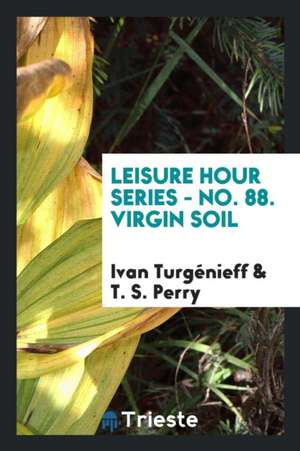
Virgin Soil
Autor Ivan Sergeevich Turgeneven Limba Engleză Paperback – 16 mai 2018
The novel centres on a depiction of some of the young people in late nineteenth century Russia who decided to reject the standard cultural mores of their time, join the Populist movement, and 'go amongst the people', living the lives of simple workers and peasants rather than lives of affectation and luxury. The novel has a number of central characters around whom the action revolves. It explores, for instance, the life of Alexey Dmitrievich Nezhdanov, the illegitimate son of an aristocrat, who seeks to radicalise the peasantry and involve them in political action. He is given a job as tutor to Kolya, the nine-year-old son of Sipyagin, a local politician, and goes to live on his country estate. Whilst working there he becomes attracted to Marianna, the niece of the family.
Another central character is Vasily Solomin, who manages a local factory and is also a Populist, though one with less optimism about the potential of the movement to effect fundamental socio-economic change.
Preț: 149.65 lei
Puncte Express: 224
Comandă specială
Livrare economică 03-09 noiembrie
Livrare prin curier în România Termenul estimat este afișat lângă disponibilitate.
Transport gratuit de la 400.00 lei Plată online sau ramburs, în funcție de opțiunile comenzii.
Retur gratuit în 14 zile Comandă securizată și suport în română.
Specificații
ISBN-13: 9780649729876
ISBN-10: 0649729870
Pagini: 330
Dimensiuni: 156 x 234 x 18 mm
Greutate: 0.46 kg
Editura: LIGHTNING SOURCE INC
ISBN-10: 0649729870
Pagini: 330
Dimensiuni: 156 x 234 x 18 mm
Greutate: 0.46 kg
Editura: LIGHTNING SOURCE INC
V-ar putea interesa
-
 El Libro de Las Maravillas del MundoJuan De MandevillePreț: 106.59 lei
 -
 La Divina Comedia 1304-1321Dante AligihieriPreț: 104.05 lei
 -
 Balsamo, the MagicianDumas AlexandrePreț: 48.95 lei
 -
 The Communist Threat in the Taiwan AreaJohn Foster Dulles Dwight D. EisenhowerPreț: 42.00 lei
 -
 Edge of the JungleWilliam BeebePreț: 45.15 lei
 -
 The Memoirs of Napoleon 1797 - Volume XIIILouis Antoine Fauvelet de BourriennePreț: 89.42 lei
 -
 For the Temple a Tale of the Fall of JerusalemG. a. HentyPreț: 58.94 lei
 -
 Preț: 42.62 lei
 -
 The Young CastellanGeorge Manville FennPreț: 51.32 lei
 -
 Saturday's ChildNorris, Kathleen ThompsonPreț: 61.94 lei
 -
 From the Ball-Room to HellThomas A. FaulknerPreț: 42.62 lei
 -
 Julienne Petit, Ou Le Voleur Et La GrisetteMarie AycardPreț: 191.87 lei
 -
 Idées Et Les Hommes, Essais de CritiqueAndre BeaunierPreț: 192.46 lei
 -
 Pascaline un dossier judiciaireParseval-DeschênesPreț: 169.36 lei
 -
 La roche d'enferMarie-Marguerite-Henriette-Amé de SarsPreț: 191.71 lei
 -
 Le mariage de RenéeMarthe LachèsePreț: 191.71 lei
 -
 Preț: 277.48 lei
 -
 La Ville aux oiseaux Tome 1Paul FévalPreț: 170.17 lei
Notă biografică
Ivan Sergeyevich Turgenev (1818-1883) was born into a wealthy family of the Russian landed gentry and educated in Moscow, St. Petersburg, and Berlin. He made his name as a writer with A Sportsman’s Sketches, an unvarnished picture of Russian country life that is said to have influenced Tsar Alexander II’s decision to liberate the serfs. In later years, Turgenev lived in Europe, returning only rarely to his native country. He was the author of poems, stories, plays, and six novels, the most celebrated of which include Fathers and Sons, Rudin, and On the Eve.
Charlotte Hobson divides her time between translating and writing. She is the author of Black Earth City.
Constance Garnett (1861–1946) was an English translator of nineteenth-century Russian literature, and introduced Tolstoy, Dostoevsky and Chekhov on a wide basis to the English speaking public.
Charlotte Hobson divides her time between translating and writing. She is the author of Black Earth City.
Constance Garnett (1861–1946) was an English translator of nineteenth-century Russian literature, and introduced Tolstoy, Dostoevsky and Chekhov on a wide basis to the English speaking public.
Recenzii
Every class of society, every type of character, every degree of fortune, every phase of manners, passes through his hands; his imagination claims its property equally, in town and country, among rich and poor, among wise people and idiots, dilettanti and peasants, the tragic and the joyous, the probable and the grotesque. He has an eye for all our passions and a deeply sympathetic sense of the wonderful complexity of our souls.
— Henry James
Turgenev’s Russia is but a canvas on which the incomparable artist of humanity lays his colours and his forms in the great light and free air of the world….All his creations, fortunate and unfortunate, oppressed and oppressors, are human beings, not strange beasts in a menagerie or damned souls knocking themselves out in the stuffy darkness of mystical contradictions. They are human beings, fit to live, fit to suffer, fit to struggle, fit to win, fit to lose, in the endless and inspiring game of pursuing from day to day the ever-receding future.
— Joseph Conrad
— Henry James
Turgenev’s Russia is but a canvas on which the incomparable artist of humanity lays his colours and his forms in the great light and free air of the world….All his creations, fortunate and unfortunate, oppressed and oppressors, are human beings, not strange beasts in a menagerie or damned souls knocking themselves out in the stuffy darkness of mystical contradictions. They are human beings, fit to live, fit to suffer, fit to struggle, fit to win, fit to lose, in the endless and inspiring game of pursuing from day to day the ever-receding future.
— Joseph Conrad