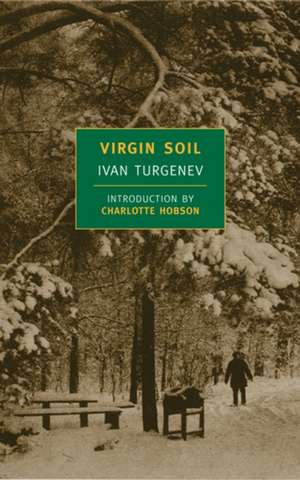
Virgin Soil
Autor Ivan Turgenev Traducere de Constance Garnetten Limba Engleză Paperback – 31 aug 2000
Preț: 117.79 lei
Puncte Express: 177
Carte disponibilă
Livrare economică 14-28 decembrie
Livrare prin curier în România Termenul estimat este afișat lângă disponibilitate.
Transport gratuit de la 400.00 lei Plată online sau ramburs, în funcție de opțiunile comenzii.
Retur gratuit în 14 zile Comandă securizată și suport în română.
Specificații
ISBN-13: 9780940322455
ISBN-10: 0940322455
Pagini: 368
Dimensiuni: 126 x 195 x 25 mm
Greutate: 0.37 kg
Ediția:Revised edition
Editura: NEW YORK REVIEW OF BOOKS
Locul publicării:United States
V-ar putea interesa
-
 El Libro de Las Maravillas del MundoJuan De MandevillePreț: 106.59 lei
-
 La Divina Comedia 1304-1321Dante AligihieriPreț: 104.05 lei
-
 Balsamo, the MagicianDumas AlexandrePreț: 48.95 lei
-
 The Communist Threat in the Taiwan AreaJohn Foster Dulles Dwight D. EisenhowerPreț: 42.00 lei
-
 Edge of the JungleWilliam BeebePreț: 45.15 lei
-
 For the Temple a Tale of the Fall of JerusalemG. a. HentyPreț: 58.94 lei
-
 Preț: 42.62 lei
-
 The Young CastellanGeorge Manville FennPreț: 51.32 lei
-
 Saturday's ChildNorris, Kathleen ThompsonPreț: 61.94 lei
-
 From the Ball-Room to HellThomas A. FaulknerPreț: 42.62 lei
-
 Julienne Petit, Ou Le Voleur Et La GrisetteMarie AycardPreț: 199.61 lei
-
 Idées Et Les Hommes, Essais de CritiqueAndre BeaunierPreț: 200.23 lei
-
 Pascaline Un Dossier JudiciaireParseval-DeschênesPreț: 178.71 lei
-
 La Roche d'EnferMarie-Marguerite-Henriette-Amé de SarsPreț: 198.28 lei
-
 Le Mariage de RenéeMarthe LachèsePreț: 199.43 lei
-
 Preț: 288.64 lei
-
 La Ville Aux Oiseaux Tome 1Paul FévalPreț: 176.97 lei
-
 Preț: 99.31 lei
Notă biografică
Ivan Sergeyevich Turgenev (1818-1883) was born into a wealthy family of the Russian landed gentry and educated in Moscow, St. Petersburg, and Berlin. He made his name as a writer with A Sportsman’s Sketches, an unvarnished picture of Russian country life that is said to have influenced Tsar Alexander II’s decision to liberate the serfs. In later years, Turgenev lived in Europe, returning only rarely to his native country. He was the author of poems, stories, plays, and six novels, the most celebrated of which include Fathers and Sons, Rudin, and On the Eve.
Charlotte Hobson divides her time between translating and writing. She is the author of Black Earth City.
Constance Garnett (1861–1946) was an English translator of nineteenth-century Russian literature, and introduced Tolstoy, Dostoevsky and Chekhov on a wide basis to the English speaking public.
Recenzii
Every class of society, every type of character, every degree of fortune, every phase of manners, passes through his hands; his imagination claims its property equally, in town and country, among rich and poor, among wise people and idiots, dilettanti and peasants, the tragic and the joyous, the probable and the grotesque. He has an eye for all our passions and a deeply sympathetic sense of the wonderful complexity of our souls.
— Henry James
Turgenev’s Russia is but a canvas on which the incomparable artist of humanity lays his colours and his forms in the great light and free air of the world….All his creations, fortunate and unfortunate, oppressed and oppressors, are human beings, not strange beasts in a menagerie or damned souls knocking themselves out in the stuffy darkness of mystical contradictions. They are human beings, fit to live, fit to suffer, fit to struggle, fit to win, fit to lose, in the endless and inspiring game of pursuing from day to day the ever-receding future.
— Joseph Conrad
Descriere
Descriere de la o altă ediție sau format:
Turgenev's final novel, Virgin Soil traces the destinies of several middle-class revolutionaries who seek to "go to the people" by working on the land and instilling democratic ideas in the countryside's locals. They include the daydreaming impoverished young tutor Nezhdanov - employed by the liberal councillor Sipyagin and his vain and beautiful wife Valentina - the naive young radical Maryanna and the progressive factory manager Solomin.
Their liaisons, intrigues and conspiracies, set against the backdrop of Tsarist Russia, form the matter of Turgenev's most ambitious and elaborate work, which cemented the author's place in the West as Russia's foremost novelist while at the same time proving controversial at home - culminating in the arrest of fifty-two real-life revolutionaries barely a month after it was published.