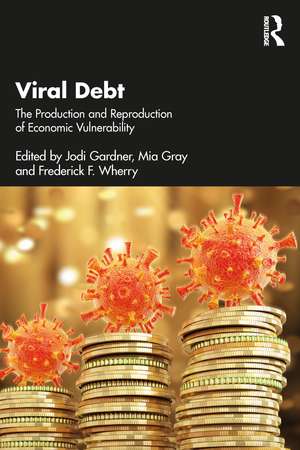
Viral Debt: The Production and Reproduction of Economic Vulnerability
Editat de Jodi Gardner, Mia Gray, Frederick F. Wherryen Limba Engleză Paperback – 3 apr 2026
Debt is not merely a contractual condition, it is also an inherently unequal relationship between creditor and debtor that can exploit pre-existing vulnerabilities while creating new ones. With a roster of leading social science and socio-legal scholars, this book shows how debt – like a contagion – works systematically across economic and social structures and geographies, demonstrating the ways in which policy has exacerbated the problem of debt through policy choices.
This volume offers urgent answers by drawing on quantitative data about household indebtedness, credit and debt policies, and local court actions, together with qualitative research.
The Open Access version of this book, available at www.taylorfrancis.com, has been made available under a Creative Commons Attribution-NonCommercial-NoDerivatives (CC BY-NC-ND) 4.0 International license.
Preț: 380.56 lei
Puncte Express: 571
Carte disponibilă
Livrare economică 07-21 noiembrie
Livrare express 27-31 octombrie pentru 31.54 lei
Livrare prin curier în România Termenul estimat este afișat lângă disponibilitate.
Transport gratuit de la 400.00 lei Plată online sau ramburs, în funcție de opțiunile comenzii.
Retur gratuit în 14 zile Comandă securizată și suport în română.
Specificații
ISBN-13: 9781032758831
ISBN-10: 103275883X
Pagini: 264
Ilustrații: 20
Dimensiuni: 156 x 234 mm
Greutate: 0.37 kg
Ediția:1
Editura: Taylor & Francis
Colecția Routledge
Locul publicării:Oxford, United Kingdom
ISBN-10: 103275883X
Pagini: 264
Ilustrații: 20
Dimensiuni: 156 x 234 mm
Greutate: 0.37 kg
Ediția:1
Editura: Taylor & Francis
Colecția Routledge
Locul publicării:Oxford, United Kingdom
Public țintă
Academic and Undergraduate AdvancedCuprins
1. Viral Debt: Origins, Pathways, and Consequences, Frederick F. Wherry, Mia Gray and Jodi Gardner; Part I: What Makes Households Vulnerable to Viral Debt; 2. How Welfare and Credit Regimes Shape Economic Policies During Times of Crisis: The Case of Covid-19, Marie-Lou Laprise and Andreas Wiedemann; 3. Viral Debts and the Economic Storytelling about Crisis, Johnna Montgomerie; 4. Unpacking Neoliberalism, Financialisation and Housing Class Inequality: Debt Virality, Policy Anomalies, and the Case of Mortgage Prisoners, Matthew Sparkes; Part II: Experience of Viral Spread; 5. How Eviction Protections Created New Debt Problems, Peter Hepburn, Jacob Haas, Emily Lemmerman, and Matthew Desmond; 6. The ABC of Growing Debt and Inequality: Austerity, Brexit and Covid-19, Karen Rowlingson; 7. How Did COVID-19 Feed into Later Life Financial Vulnerability in the UK?, Hilary Cooper; Part III: Responding to the viral debt aftermath; 8. State and personal debt, Covid and tax responses, Andy Lymer; 9. Ripple Effect of Debt and Health, John Ford, Anita Patel, and Anna Starling; 10. Medicine or Poison? Fintech, Racial Inequities, and Bad Debt, Mae Watson-Grote and Frederick F. Wherry; 11. Sunset Clauses, False Dawns: Crises and Possibilities for Debt Cancellation Through Law, Joseph Spooner
Recenzii
“Debt does not accumulate by accident; it ramps up by design, settling unevenly across the social landscape, blighting the lives and futures of all but a wealthy elite. Debt has gone viral; finally, a single book explains how, when, where, and why that happened.”
Susan Smith, Professor of Geography and President of the British Academy
“Situating debt within a conceptual framework of ‘virus’ and ‘contagion’, this book offers a new approach to the study of debt in today’s society. In the wake of the global pandemic, this timely and important work deserves to be read and discussed widely.”
Nicholas Gane, Professor of Sociology, University of Warwick
“This volume offers a novel framing of viral debt and how treating debt as a virus helps us understand ‘bad debts.’ They bring patently to light how indebtedness transcends individual choices and faults. This is an important book for the time we are in!”
Nina Bandelj, Chancellor's Professor of Sociology, University of California, Irvine
Susan Smith, Professor of Geography and President of the British Academy
“Situating debt within a conceptual framework of ‘virus’ and ‘contagion’, this book offers a new approach to the study of debt in today’s society. In the wake of the global pandemic, this timely and important work deserves to be read and discussed widely.”
Nicholas Gane, Professor of Sociology, University of Warwick
“This volume offers a novel framing of viral debt and how treating debt as a virus helps us understand ‘bad debts.’ They bring patently to light how indebtedness transcends individual choices and faults. This is an important book for the time we are in!”
Nina Bandelj, Chancellor's Professor of Sociology, University of California, Irvine
Notă biografică
Jodi Gardner is a Professor and the Brian Coote Chair in Private Law at the University of Auckland. Her research focuses on the relationship between private law and social policy. Jodi was formerly a Fellow at St John’s College, University of Cambridge.
Mia Gray is a Professor of Economic Geography at Cambridge University. She has published extensively on contemporary austerity, debt, and regional economies. She is also one of the editors of the Cambridge Journal of Regions, Economy and Society.
Frederick F. Wherry is the Class of 1917 Professor of Sociology at Princeton University and Founder of the Debt Collection Lab. He is the author, editor, or co-editor of nine books, including Credit Where It’s Due and Money Talks. His forthcoming book is What We Owe: How Debt Came for All of Us and How We Get Free.
Mia Gray is a Professor of Economic Geography at Cambridge University. She has published extensively on contemporary austerity, debt, and regional economies. She is also one of the editors of the Cambridge Journal of Regions, Economy and Society.
Frederick F. Wherry is the Class of 1917 Professor of Sociology at Princeton University and Founder of the Debt Collection Lab. He is the author, editor, or co-editor of nine books, including Credit Where It’s Due and Money Talks. His forthcoming book is What We Owe: How Debt Came for All of Us and How We Get Free.
Descriere
Challenging how social scientists, policymakers, legal scholars, and the public examine household debts and wellbeing, Viral Debt traces how debt moves within and across households to communities and institutions, with devastating effects.