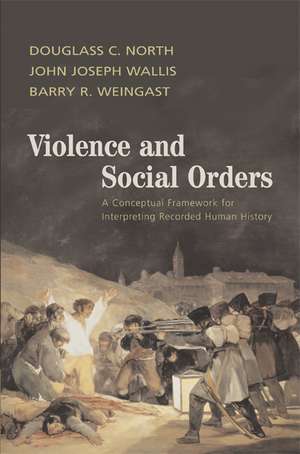
Violence and Social Orders
Autor Douglass C. North, John Joseph Wallis, Barry R. Weingasten Limba Engleză Hardback – apr 2009
În volumul Violence and Social Orders, descoperim un cadru conceptual riguros pentru interpretarea istoriei umane, pornind de la premisa că gestionarea violenței este pilonul central al oricărei organizări sociale. Autorii, printre care se numără laureatul Nobel Douglass C. North, propun o tipologie binară: „statele naturale”, care limitează violența prin crearea de privilegii economice pentru elite, și „ordinele cu acces deschis”, unde competiția politică și economică este liberă. Această lucrare extinde cadrul propus de In the Shadow of Violence cu date fundamentale despre modul în care controlul politic al privilegiilor este utilizat pentru a coordona coalițiile de putere, oferind o perspectivă mai amplă asupra dificultăților de dezvoltare. Suntem de părere că forța acestui volum rezidă în modul în care poziționează violența nu ca un accident, ci ca un factor determinant al structurilor instituționale. Douglass C. North rafinează aici temele explorate în Institutions, Institutional Change and Economic Performance, trecând de la analiza eficienței economice la o sinteză interdisciplinară între politică și istorie socială. Structura cărții urmărește o progresie logică: după stabilirea cadrului teoretic, autorii aplică modelul statului natural asupra legilor funciare engleze, explorează condițiile de prag necesare tranziției și culminează cu propunerea unei noi agende de cercetare pentru științele sociale. Spre deosebire de Order, Conflict, and Violence, care se concentrează pe interdependența dintre sânge și politică, lucrarea de față pune accent pe mecanismele economice de acces care permit unei societăți să devină bogată și stabilă.
Preț: 676.00 lei
Preț vechi: 834.56 lei
-19%
Carte tipărită la comandă
Livrare economică 07-21 decembrie
Specificații
ISBN-10: 0521761735
Pagini: 346
Ilustrații: 9 tables
Dimensiuni: 157 x 235 x 25 mm
Greutate: 0.64 kg
Editura: Cambridge University Press
Locul publicării:New York, United States
V-ar putea interesa
-
 The Oxford Handbook of the New Cultural History of MusicJane F. Fulcher-29%Preț: 389.80 lei546.95 lei
 -
 The Oxford Handbook of the History of ConsumptionFrank Trentmann-18%Preț: 380.96 lei462.34 lei
 -
 Considérations sur les Murs de ce SiecleC. P. DuclosPreț: 268.56 lei
 -
 Institutions, Institutional Change and Economic PerformanceDouglass C. NorthPreț: 205.95 lei
 -
 Towns, Plans and Society in Modern BritainHelen MellerPreț: 248.64 lei
 -
 Sport, Economy and Society in Britain 1750 1914Neil TranterPreț: 228.95 lei
 -
 Education and Economic Decline in Britain, 1870 to the 1990sMichael SandersonPreț: 211.06 lei
 -
 From White Australia to WoomeraJames JuppPreț: 254.67 lei
 -
 The History of the Social Sciences Since 1945Roger E. BackhousePreț: 375.28 lei
 -
 The Industrious RevolutionJan De VriesPreț: 214.62 lei
 -
 The Invention of TraditionEric HobsbawmPreț: 147.64 lei
 -
 In the Shadow of ViolenceDouglass C. NorthPreț: 366.39 lei
 -
 Preț: 70.36 lei
 -
 Noise: A Human History of Sound and ListeningDavid Hendy-19%Preț: 76.10 lei93.65 lei
 -
 Preț: 109.69 lei
 -
 Preț: 287.45 lei
De ce să citești această carte
Recomandăm această carte cercetătorilor și studenților din domeniul științelor politice și economice care doresc să înțeleagă mecanismele profunde ale subdezvoltării. Cititorul câștigă o metodă analitică de a distinge între societățile bazate pe privilegii și cele bazate pe drepturi universale, primind un răspuns fundamentat la întrebarea de ce doar câteva națiuni au reușit tranziția către o democrație stabilă și o economie prosperă.
Despre autor
Douglass C. North a fost co-laureat al Premiului Nobel pentru Științe Economice în 1993, fiind recunoscut pentru reînnoirea cercetării în istoria economică prin aplicarea teoriei economice și a metodelor cantitative. A fost profesor la Washington University în St. Louis și cercetător la Hoover Institution, Stanford. Autor a unsprezece cărți fundamentale, printre care The Rise of the Western World, North s-a concentrat pe rolul instituțiilor în modelarea performanței economice. John Joseph Wallis și Barry R. Weingast, colaboratorii săi, aduc expertiză suplimentară în istorie economică și științe politice, consolidând viziunea interdisciplinară a lucrării.
Descriere scurtă
Cuprins
Recenzii
'If anyone is iconic in the economic history world Doug North certainly qualifies … This time, North is joined by two prominent and strong-minded co-authors, John Wallis and Barry Weingast. Their collaboration has been fruitful … Above all, the notion that one cannot simply 'get rid' of the superficial exterior of natural states and thereby uncover the beating heart of an open access order yearning to be free is the book's most important idea, and profound.' Robert Margo, EH.Net
'A demanding but rewarding work, with intriguing echoes of Marx … Highly recommended.' Choice
'While there is still much more work to be done in understanding how to get from here to there, the authors' insights regarding the control of violence in natural, limited access societies versus modern, open-access societies are nonetheless major contributions … North, Wallis, and Weingast's analysis of violence and its suppression provides a simple, straightforward path to understanding both authoritarianism and transitional violence.' D. Roderick Kiewiet, Journal of Economic History
'… an immodestly titled and immoderately stimulating book …' Jonathan Rauch, The National Journal
'… strong, persuasive … Anyone interested in development, economic history, the analysis of institutions or the idea of a generalized social science would do well to read this book … what is new in the book is the way its authors have connected, systematized and synthesized these previously disparate ideas to produce the limited-/open-access framework with which they propose to interpret human history. Their framework proves strikingly effective at this task … the new social science paradigm it presents is compelling and worthy of wide attention.' Mark Holden, International Affairs
'This much-anticipated, pioneering, sweeping millennial history explains how the evolution of impersonal and standardized treatment, a rule of law for elites, perpetual forms of organization, and consolidated political control of the military combined to produce the 'open access' logic of rent erosion and economic growth often observed in the modern world. Emphatically multi-causal in approach, the book will persuade all those who want to analyze the complex interactions of beliefs, institutions, and organizations that they have to deal with its arguments.' James Alt, Harvard University
'Why do we obey laws, adhere to rules, and conform to norms? Doug North, John Wallis, and Barry Weingast offer a simple, powerful, and compelling answer - disorder and the violence it entails. This book is must-reading for anyone serious about the origins of social order and the reasons for its disintegration.' Stephen Ansolabehere, Harvard University
'A masterful and revealing interpretation of how 'nasty, brutish, and short' became healthy, wealthy, and peaceful and why the transformation occurred in some nations but not in others.' Claudia Goldin, Harvard University
'Violence and Social Orders is a thought-provoking, pioneering, and ambitious study. It should be read by anyone interested in the institutional underpinning of development.' Avner Greif, Stanford University
'This book presents a powerful new theory of the interaction between law, politics, and the structure of power. It is sure to be influential for decades to come.' Daniel Klerman, University of Southern California
'Why are poor countries poor and rich countries rich? North, Wallis, and Weingast explain why - it's the politics stupid! A compelling book for anyone who wants to understand the world.' James A. Robinson, Harvard University