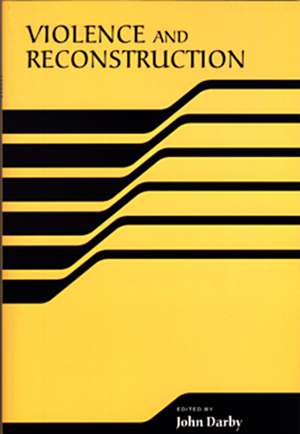
Violence and Reconstruction: RIREC Project on Post-Accord Peacebuilding
Autor John Darbyen Limba Engleză Hardback – 28 dec 2005
| Toate formatele și edițiile | Preț | Express |
|---|---|---|
| Paperback (1) | 200.11 lei 6-8 săpt. | |
| MR – University of Notre Dame Press – 21 dec 2005 | 200.11 lei 6-8 săpt. | |
| Hardback (1) | 554.52 lei 6-8 săpt. | |
| MR – University of Notre Dame Press – 28 dec 2005 | 554.52 lei 6-8 săpt. |


Preț: 554.52 lei
Preț vechi: 652.38 lei
-15%
Puncte Express: 832
Preț estimativ în valută:
98.08€ • 113.83$ • 84.66£
98.08€ • 113.83$ • 84.66£
Carte tipărită la comandă
Livrare economică 24 aprilie-08 mai
Specificații
ISBN-13: 9780268025878
ISBN-10: 0268025878
Pagini: 192
Dimensiuni: 158 x 235 x 18 mm
Greutate: 0.38 kg
Ediția:1
Editura: MR – University of Notre Dame Press
Seria RIREC Project on Post-Accord Peacebuilding
ISBN-10: 0268025878
Pagini: 192
Dimensiuni: 158 x 235 x 18 mm
Greutate: 0.38 kg
Ediția:1
Editura: MR – University of Notre Dame Press
Seria RIREC Project on Post-Accord Peacebuilding
V-ar putea interesa
-
 The International Law of OccupationEyal Benvenisti-22%Preț: 371.23 lei477.22 lei
 -
 -16%Preț: 101.04 lei120.26 lei
 -
 Preț: 323.22 lei
 -
 Understanding Collective Political ViolenceY. Guichaoua-15%Preț: 618.59 lei727.76 lei
 -
 Understanding Peace Research: Methods and ChallengesKristine Hoglund-15%Preț: 410.91 lei483.43 lei
 -
 Peace and Conflict Studies: A ReaderCharles Webel-15%Preț: 465.22 lei547.32 lei
 -
 A Post-Liberal PeaceOliver RichmondPreț: 444.16 lei
 -
 More Bad News From IsraelGreg PhiloPreț: 242.09 lei
 -
 Preț: 205.66 lei
 -
 Preț: 214.23 lei
 -
 New and Old WarsMary KaldorPreț: 160.84 lei
 -
 -18%Preț: 1298.48 lei1583.50 lei
 -
 The Will to ResistDahr JamailPreț: 85.55 lei
 -
 The Case for Withdrawal from AfghanistanNick TursePreț: 133.69 lei
 -
 Conflict and DevelopmentEleanor O' Gorman-18%Preț: 122.53 lei149.02 lei
 -
 The End of WarPaul K. ChappellPreț: 66.58 lei
Recenzii
“Darby has edited a thoughtful book whose eight chapters form a coherent whole. It concerns violence which takes place after the implementation of a peace accord has started. . . . an erudite, coherent, crafted, thoughtful, and informative volume.” —Journal of Peace Research, vol. 44: No 4 (July 2007)
Notă biografică
John Darby is professor of comparative ethnic studies at the Kroc Institute at the University of Notre Dame, where he is Research Director and heads the Research Initiative for the Resolution of Ethnic Conflict (RIREC).
CONTRIBUTORS: John Darby, Kristine Höglund, I. William Zartman, Marie-Jöelle Zahar, Virginia Gamba, Dominic Murray, Roger Mac Ginty, and Timothy D. Sisk.
Descriere
"This well-organized and effective book could not be timelier. It sets out, and achieves, an ambitious program for itself." —Andrew Williams, University of Kent
"This volume makes an original contribution to the field and will be read with great interest by scholars, graduate students, and the policy community. The contributors present an important set of arguments that engage the scholarly and policy-oriented debates about peace implementation and peacebuilding by teasing out the complex and sometimes counterintuitive relationships between violence and peace." —Terrence Lyons, Institute for Conflict Analysis and Resolution, George Mason University
This is the first book to focus on the effects of violence in internal conflicts after peace agreements have been signed. Since the mid-1990s many peace processes, including those in Israel-Palestine, Guatemala, El Salvador, and Northern Ireland, have reverted to violence while seeking to implement formal peace agreements. In all these cases the persistence and forms of violence have been among the main determinants of the success or failure of the peace process. Violence and Reconstruction adopts a four-part analysis, examining in turn violence emanating from the state, from militants, from destabilized societies, and from the challenge of implementing a range of policies including demobilization, disarmament, and policing.
Leading scholars explore in detail each of these aspects of postwar violence. Their findings draw attention to the increased willingness of the state to turn to militias to carry on violence by proxy; to the importance of distinguishing between the aims and actions of different militant groups; to a postwar rise in violent conventional crime; and to the importance of the proper restoration of civil society.