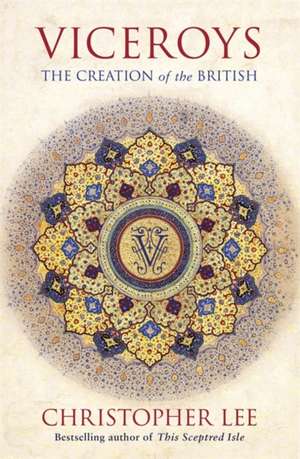
Viceroys: The Creation of the British
Autor Christopher Leeen Limba Engleză Paperback – 30 aug 2018
From 1815, an image of Britain as the first superpower was built that would make do until even the twenty first century. Direct rule in the name of a long-lived queen and the consequential superlatives of style and theatre of conquest had the whole world believing that it knew the secret of that British identity. To be white and British even at the lowest social level was enough to command and to be white, British and aristocratic was enough to rule.
By the end of Victoria's reign a quarter of the world saluted the authority of the British identity. It took until the second half of the twentieth century for even the Americans to question that authority. The token in that identity, the plumed viceroy whose quarterings linked everyone who held that office to the aristocracy that was the guardian of that image, is not just an illusion.
Viceroys is not a chronological biography of each viceroy from Canning to Mountbatten. It is instead, the story of the viceregal caste. It is the supreme view of the British in India, describing the sort of people who went out and the sort of people they were on their return. It is the story of utter power and what men did with it.
Viceroys will come to a conclusion as to what created the international identity of the British that was cherished well into the twentieth century. It was and is an identity that has coloured in the worst pictures of the British character and ambition as seen by modern radicalized people and loyalties around the globe. Ironically, it is in part the answer to how was it that such a small offshore European island people believed themselves to have the right to sit at the highest institutional tables and judge what is right and what is unacceptable in other nations and institutions.
Preț: 92.47 lei
Preț vechi: 123.21 lei
-25%
Puncte Express: 139
Carte disponibilă
Livrare economică 30 octombrie-13 noiembrie
Livrare prin curier în România Termenul estimat este afișat lângă disponibilitate.
Transport gratuit de la 400.00 lei Plată online sau ramburs, în funcție de opțiunile comenzii.
Retur gratuit în 14 zile Comandă securizată și suport în română.
Specificații
ISBN-13: 9781472124746
ISBN-10: 147212474X
Pagini: 384
Ilustrații: 2 x 8pp b/w & colour plate sections
Dimensiuni: 234 x 156 x 33 mm
Greutate: 0.54 kg
Editura: Little Brown
Colecția Constable
Locul publicării:London, United Kingdom
ISBN-10: 147212474X
Pagini: 384
Ilustrații: 2 x 8pp b/w & colour plate sections
Dimensiuni: 234 x 156 x 33 mm
Greutate: 0.54 kg
Editura: Little Brown
Colecția Constable
Locul publicării:London, United Kingdom
V-ar putea interesa
-
 Nelson and NapoleonChristopher LeePreț: 106.12 lei
 -
 A Commentary on the Book of the Acts of the ApostlesWilliam Gilson HumphryPreț: 136.15 lei
 -
 Archaeologia Nova CaesareaCharles C. AbbottPreț: 133.62 lei
 -
 Faber's HymnsFrederick William FaberPreț: 137.52 lei
 -
 The Kaiser as He Is: Or, the Real William II.Henri De NoussannePreț: 139.93 lei
 -
 Synonyms of the New TestamentRichard Chenevix TrenchPreț: 137.11 lei
 -
 Dragon BornChristopher LeePreț: 103.50 lei
 -
 -26%Preț: 79.96 lei108.10 lei
 -
 A Manual of Medical Jurisprudence and ToxicologyHenry C. ChapmanPreț: 143.33 lei
 -
 Preț: 148.93 lei
 -
 Preț: 94.94 lei
 -
 Rape: A History From 1860 To The PresentProfessor Joanna Bourke-26%Preț: 79.53 lei107.08 lei
 -
 -26%Preț: 73.42 lei99.44 lei
 -
 The Handbook of British ArchaeologyLesley Adkins-30%Preț: 135.41 lei193.95 lei
 -
 A Brief History of Slavery: A New Global HistoryJeremy Black-27%Preț: 66.71 lei91.48 lei
 -
 Domestic Soldiers: Six Women's Lives in the Second World WarJennifer Purcell-25%Preț: 49.21 lei65.25 lei
Recenzii
Between 1858 and 1947, twenty British men ruled millions of some of the most remarkable people of the nineteenth and twentieth centuries.
From the Indian Mutiny to the cruel religious partition of India and the newly formed and named Pakistan, the Viceroy had absolute power, more than the monarch who had sent him. Selected from that exclusive class of English, Scottish and Irish breeding, the aristocracy, the Viceroys were plumed, rode elephants, shot tigers. Even their wives stood when they entered the room. Nevertheless, many of them gave everything for India. The first Viceroy, Canning, exhausted by the Mutiny, buried his wife in Calcutta before he left the subcontinent to die shortly afterwards.
The average Viceroy lasted five years and was granted an earldom but rarely a sense of triumph. Did these Viceroys behave as badly as twenty-first century moralists would have us believe? When the Raj was over, the legacy of Empire continued, as the new rulers slipped easily into the offices and styles of the British who had gone. Being 'British' was now a caste.
Viceroys is the tale of the British Raj, the last fling of British aristocracy. It is the supreme view of the British in India, portraying the sort of people who went out and the sort of people they were on their return. It is the story of utter power and what men did with it. Moreover, it is also the story of how modern British identity was established and in part the answer to how it was that such a small offshore European island people believed themselves to have the right to sit at the highest institutional tables and judge what was right and unacceptable in other nations and institutions.
A richly rewarding work of history
From the Indian Mutiny to the cruel religious partition of India and the newly formed and named Pakistan, the Viceroy had absolute power, more than the monarch who had sent him. Selected from that exclusive class of English, Scottish and Irish breeding, the aristocracy, the Viceroys were plumed, rode elephants, shot tigers. Even their wives stood when they entered the room. Nevertheless, many of them gave everything for India. The first Viceroy, Canning, exhausted by the Mutiny, buried his wife in Calcutta before he left the subcontinent to die shortly afterwards.
The average Viceroy lasted five years and was granted an earldom but rarely a sense of triumph. Did these Viceroys behave as badly as twenty-first century moralists would have us believe? When the Raj was over, the legacy of Empire continued, as the new rulers slipped easily into the offices and styles of the British who had gone. Being 'British' was now a caste.
Viceroys is the tale of the British Raj, the last fling of British aristocracy. It is the supreme view of the British in India, portraying the sort of people who went out and the sort of people they were on their return. It is the story of utter power and what men did with it. Moreover, it is also the story of how modern British identity was established and in part the answer to how it was that such a small offshore European island people believed themselves to have the right to sit at the highest institutional tables and judge what was right and unacceptable in other nations and institutions.
A richly rewarding work of history