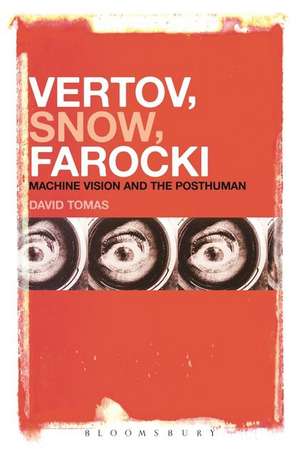
Vertov, Snow, Farocki: Machine Vision and the Posthuman
Autor David Tomasen Limba Engleză Paperback – 23 apr 2015
Preț: 280.18 lei
Preț vechi: 330.71 lei
-15%
Puncte Express: 420
Carte tipărită la comandă
Livrare economică 05-19 decembrie
Livrare prin curier în România Termenul estimat este afișat lângă disponibilitate.
Transport gratuit de la 400.00 lei Plată online sau ramburs, în funcție de opțiunile comenzii.
Retur gratuit în 14 zile Comandă securizată și suport în română.
Specificații
ISBN-13: 9781501307294
ISBN-10: 1501307290
Pagini: 302
Ilustrații: 60 bw illus
Dimensiuni: 152 x 229 x 16 mm
Greutate: 0.45 kg
Editura: Bloomsbury Publishing
Colecția Bloomsbury Academic
Locul publicării:New York, United States
ISBN-10: 1501307290
Pagini: 302
Ilustrații: 60 bw illus
Dimensiuni: 152 x 229 x 16 mm
Greutate: 0.45 kg
Editura: Bloomsbury Publishing
Colecția Bloomsbury Academic
Locul publicării:New York, United States
Cuprins
Introduction
Part I: Threshold: When a Ritual Process Speaks of Machine Vision and Cyborg Prototypes: A Film Document, Circa 1929
Chapter 1. Manufacturing Vision and the Posthuman Circa 1929: Kino-eye, The Man with a Movie Camera, and the Perceptual Reconstruction of Social Identity
Part II: Enigma of the Central Region: A Microhistory of Machine Vision and Posthuman Consciousness, Circa 1969-1972
Chapter 2. La Région Centrale: Basic Cultural, Technical and Formal Filiations
Chapter 3. Toward a Cosmic Rite of Passage: External & Internal Locations and a Play of Authorship
Chapter 4. La Région Centrale: Liminality, Knowledge Production, Pedagogy
Chapter 5. La Région Centrale: From Cosmic to Posthuman Rite of Passage
Chapter 6. De La (1969-71): Authorship, Automation and the Posthuman
Chapter 7. A Comparative Schematic Analysis of the Automated Narrative and its Mechanical Logic in Vertov's The Man with a Movie Camera (1929) and Michael Snow's De La (1969-1972)
Part III: The Public Deployment of Machine Vision and the Programmed Materialization of the Posthuman in Collective Social Space, Two Early Twenty-First Century Video Documents
Chapter 8. A Posthuman Future in the Age of the Algorithm: Farock's Documentation of the Operational Image and its Culture of Surveillance
Bibliography
Index
Part I: Threshold: When a Ritual Process Speaks of Machine Vision and Cyborg Prototypes: A Film Document, Circa 1929
Chapter 1. Manufacturing Vision and the Posthuman Circa 1929: Kino-eye, The Man with a Movie Camera, and the Perceptual Reconstruction of Social Identity
Part II: Enigma of the Central Region: A Microhistory of Machine Vision and Posthuman Consciousness, Circa 1969-1972
Chapter 2. La Région Centrale: Basic Cultural, Technical and Formal Filiations
Chapter 3. Toward a Cosmic Rite of Passage: External & Internal Locations and a Play of Authorship
Chapter 4. La Région Centrale: Liminality, Knowledge Production, Pedagogy
Chapter 5. La Région Centrale: From Cosmic to Posthuman Rite of Passage
Chapter 6. De La (1969-71): Authorship, Automation and the Posthuman
Chapter 7. A Comparative Schematic Analysis of the Automated Narrative and its Mechanical Logic in Vertov's The Man with a Movie Camera (1929) and Michael Snow's De La (1969-1972)
Part III: The Public Deployment of Machine Vision and the Programmed Materialization of the Posthuman in Collective Social Space, Two Early Twenty-First Century Video Documents
Chapter 8. A Posthuman Future in the Age of the Algorithm: Farock's Documentation of the Operational Image and its Culture of Surveillance
Bibliography
Index
Recenzii
Tomas' ideas are fascinating . . . [and his book] presents these ideas in a measured way, precisely and deliberately considering his key examples. The volume is a must for anyone interested in technology or cinema, or for the greater implications of a society who carries in their pocket the capacity to record and represent the world around them.
Tomas, an artist and anthropologist at the Université du Québec, Montréal, continues the work he undertook in Beyond the Image Machine: A History of Visual Technologies, exhorting readers to view visual technologies differently. In this volume, Tomas attempts to shift attention from aesthetic products to ritual practices. Specifically, he argues for understanding the mechanical process of filming as a rite of passage whereby the image is taken, processed, and reincorporated into the socio-symbolic order. This ritual structure becomes the basis for a comparative anthropological study of Dziga Vertov's The Man with a Movie Camera, Michael Snow's La Région Centrale and De La, and Harun Farocki's trilogy Eye/Machine and Counter-Music. The experimental, posthuman processes involved in shooting these unique films is of primary interest, leading to detailed discussions of the filmmaker's intentions and abstract theorization of their specific execution. For this reason, Tomas's esoteric, though intriguing, revisioning of film's history and future is likely of most use to experts. Summing Up: Recommended. Graduate students, researchers, faculty.
Tomas, an artist and anthropologist at the Université du Québec, Montréal, continues the work he undertook in Beyond the Image Machine: A History of Visual Technologies, exhorting readers to view visual technologies differently. In this volume, Tomas attempts to shift attention from aesthetic products to ritual practices. Specifically, he argues for understanding the mechanical process of filming as a rite of passage whereby the image is taken, processed, and reincorporated into the socio-symbolic order. This ritual structure becomes the basis for a comparative anthropological study of Dziga Vertov's The Man with a Movie Camera, Michael Snow's La Région Centrale and De La, and Harun Farocki's trilogy Eye/Machine and Counter-Music. The experimental, posthuman processes involved in shooting these unique films is of primary interest, leading to detailed discussions of the filmmaker's intentions and abstract theorization of their specific execution. For this reason, Tomas's esoteric, though intriguing, revisioning of film's history and future is likely of most use to experts. Summing Up: Recommended. Graduate students, researchers, faculty.
Notă biografică
David Tomas is a Professor at the University of Quebec, Montreal, Canada.