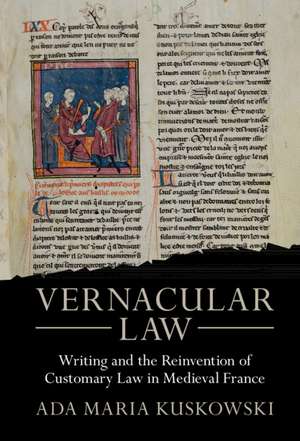
Vernacular Law
Autor Ada Maria Kuskowskien Limba Engleză Hardback – 3 noi 2022
| Toate formatele și edițiile | Preț | Express |
|---|---|---|
| Paperback (1) | 219.05 lei 3-5 săpt. | +26.18 lei 7-11 zile |
| Cambridge University Press – 8 aug 2024 | 219.05 lei 3-5 săpt. | +26.18 lei 7-11 zile |
| Hardback (1) | 719.56 lei 6-8 săpt. | +59.99 lei 7-11 zile |
| Cambridge University Press – 3 noi 2022 | 719.56 lei 6-8 săpt. | +59.99 lei 7-11 zile |
Preț: 719.56 lei
Preț vechi: 836.70 lei
-14%
Puncte Express: 1079
Preț estimativ în valută:
127.25€ • 150.88$ • 110.79£
127.25€ • 150.88$ • 110.79£
Carte tipărită la comandă
Livrare economică 31 martie-14 aprilie
Livrare express 24-28 februarie pentru 69.98 lei
Specificații
ISBN-13: 9781009217897
ISBN-10: 1009217895
Pagini: 432
Dimensiuni: 163 x 230 x 32 mm
Greutate: 0.73 kg
Ediția:Nouă
Editura: Cambridge University Press
Locul publicării:New York, United States
ISBN-10: 1009217895
Pagini: 432
Dimensiuni: 163 x 230 x 32 mm
Greutate: 0.73 kg
Ediția:Nouă
Editura: Cambridge University Press
Locul publicării:New York, United States
Cuprins
Introduction: vernacular writing and the transformation of customary law in Medieval France; Part I. Written Custom and the Formation of Vernacular Law: 1. What is custom? Concept and literary practice; 2. Composing customary law as a vernacular law; 3. Writing a 'ius non scriptum': writtenness, memory and change; Part II. Political and Intellectual Tensions: 4. Uneasy jurisdictions: lay and ecclesiastical law; 5. Roman law, authority and creative citation; Part III. Implications: 6. Custom in lawbooks and records of legal practice; 7. Dynamic text: dialectic, manuscript culture and customary law; 8. Implications of circulating text: crafting a French common law; Conclusion: lasting model and professional community; Bibliography; Index.
Recenzii
'This book is a marvel, mixing erudition and imagination. Describing the cultural upheaval of the writing of custom, Ada Kuskowski opens new doors to the understanding of medieval law.' James Q. Whitman, Yale Law School
'In the first comprehensive study of the earliest Northern French lawbooks known as coutumiers, influential myths about the rules and procedures of lay courts known as customary law are met with challenging scrutiny. Kuskowski compellingly argues that, with no prototype available, the coutumier authors imaginatively shaped a new form of learned and official law for lay jurisdiction and for a new audience of regional secular elites. Coutumiers were the paradigm-shifting achievement of expert legal minds who, in creating an idiom to think with and about custom, profoundly affected medieval legal culture.' Brigitte M. Bedos-Rezak, New York University
'This study is a revelation. Early French customary law emerges from it as the dynamic creation of sophisticated juridical thinkers, who worked not to record local traditions, but to shape and teach a distinct form of legal practice and thinking for secular courts across thirteenth-century France. By studying the first coutumiers as a coherent whole, with a focus on language and manuscripts and an eye toward recent scholarship in legal history generally, Kuskowski defines a subject every bit as complex, interesting, and influential as the medieval Roman and canon laws that overshadow it in the historiography.' Adam Kosto, Columbia University
'In the first comprehensive study of the earliest Northern French lawbooks known as coutumiers, influential myths about the rules and procedures of lay courts known as customary law are met with challenging scrutiny. Kuskowski compellingly argues that, with no prototype available, the coutumier authors imaginatively shaped a new form of learned and official law for lay jurisdiction and for a new audience of regional secular elites. Coutumiers were the paradigm-shifting achievement of expert legal minds who, in creating an idiom to think with and about custom, profoundly affected medieval legal culture.' Brigitte M. Bedos-Rezak, New York University
'This study is a revelation. Early French customary law emerges from it as the dynamic creation of sophisticated juridical thinkers, who worked not to record local traditions, but to shape and teach a distinct form of legal practice and thinking for secular courts across thirteenth-century France. By studying the first coutumiers as a coherent whole, with a focus on language and manuscripts and an eye toward recent scholarship in legal history generally, Kuskowski defines a subject every bit as complex, interesting, and influential as the medieval Roman and canon laws that overshadow it in the historiography.' Adam Kosto, Columbia University
Descriere
A new understanding of the transformative effect of vernacular writing on customary law in medieval France.