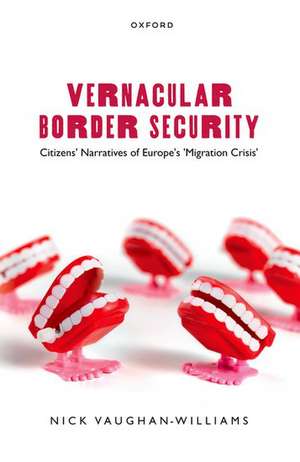
Vernacular Border Security: Citizens' Narratives of Europe's 'Migration Crisis'
Nick Vaughan-Williamsen Limba Engleză Paperback – 29 iun 2023
Preț: 219.77 lei
Preț vechi: 277.57 lei
-21%
Puncte Express: 330
Carte disponibilă
Livrare economică 12-18 noiembrie
Livrare express 28 octombrie-03 noiembrie pentru 84.40 lei
Livrare prin curier în România Termenul estimat este afișat lângă disponibilitate.
Transport gratuit de la 400.00 lei Plată online sau ramburs, în funcție de opțiunile comenzii.
Retur gratuit în 14 zile Comandă securizată și suport în română.
Specificații
ISBN-13: 9780198882695
ISBN-10: 0198882696
Pagini: 256
Dimensiuni: 154 x 234 x 15 mm
Greutate: 0.38 kg
Editura: OUP OXFORD
Colecția OUP Oxford
Locul publicării:Oxford, United Kingdom
ISBN-10: 0198882696
Pagini: 256
Dimensiuni: 154 x 234 x 15 mm
Greutate: 0.38 kg
Editura: OUP OXFORD
Colecția OUP Oxford
Locul publicării:Oxford, United Kingdom
Recenzii
Vernacular Border Security represents a major contribution to the burgeoning field of vernacular security studies and will be of immense interest to scholars looking for alternative conceptualizations to understand the contemporary politics of migration, borders, and security.
Vernacular Border Security is arguably the most conceptually and empirically ambitious contribution to the recent vernacular turn in critical security studies to date. It is not only an accomplished piece of research which should be of immense value to policymakers, but an agenda setting piece for critical border, security, and citizenship studies.
Vaughan-Williams poses the important question, why has the recent frenzy of border fortification—especially but not only in the EU—intensified rather than reduced popular anxieties about borders and migrants? To answer it, Vaughan-Williams listens closely to the people churned by such anxieties. This essential, original, and extraordinarily well-researched contribution to border and migration studies arrives at conclusions that should stop both policy makers and critical theorists in their tracks.
In foregrounding the vernacular, Nick Vaughan-Williams makes a powerful and highly significant interference in contemporary understandings of the politics of security, borders, and migration. Vernacular Border Security takes the extensive literature on the importance of language for securitization and desecuritization in a new direction by foregrounding conversations rather than speech acts, claims, or discourses. In doing so, Vaughan-Williams has given us a rich resource for critically engaging contemporary framings of security, borders, and migration through a democratic analytics that values the reflective and critical engagement of ordinary people in the politics of insecurity.
Vernacular Border Security is a must-read for all political geographers concerned with questions of borderings, wallings, and the contemporary political imaginations of migrations in Europe. Beautifully written and conceptually innovative, this book brilliantly connects the grand narratives of border security promoted by institutions at the most diverse scales with a set of vernacular perspectives on the experience of border security in specific European settings. The rich and original empirical material matched by the sophisticated theoretical analysis proposed here by Nick Vaughan-Williams makes this book a path-breaking intervention in the fields of border and migration studies.
Coming from cultural studies and gender studies, I found Nick Vaughan-Williams' vernacular approach to be an illustrative perspective on security. Besides deconstructing the 'migration crisis' narrative, Vaughan-Williams explains theories of populism and ontological (in)security in a reader-friendly manner. I particularly enjoyed the author's take on affect and processes of gendering and racializing the figure of 'the migrant'. Reading this eloquent and important book gave me tools to analyze critically the perpetual debate about migration, borders, and securitization.
European governments adopted inhuman, unlawful, and ineffective border security measures in the name of citizens allegedly frightened by migrants. Yet the empirical evidence offered by Nick Vaughan-Williams suggests that anti-migrant narratives originated at the top rather than at the bottom of societal ladders, aggravating anxieties among European citizens. The book points to counter-narratives embracing cultures of hospitality, rebuffing fantasies of walls and wired borders. These findings are not likely to deter populist politicians, but they should offer food for thought to moderate ones and to mass-media gurus eager to talk on behalf of 'ordinary people' without engaging in genuine conversation with them. I strongly recommend this book to all concerned citizens.
Vernacular Border Security is arguably the most conceptually and empirically ambitious contribution to the recent vernacular turn in critical security studies to date. It is not only an accomplished piece of research which should be of immense value to policymakers, but an agenda setting piece for critical border, security, and citizenship studies.
Vaughan-Williams poses the important question, why has the recent frenzy of border fortification—especially but not only in the EU—intensified rather than reduced popular anxieties about borders and migrants? To answer it, Vaughan-Williams listens closely to the people churned by such anxieties. This essential, original, and extraordinarily well-researched contribution to border and migration studies arrives at conclusions that should stop both policy makers and critical theorists in their tracks.
In foregrounding the vernacular, Nick Vaughan-Williams makes a powerful and highly significant interference in contemporary understandings of the politics of security, borders, and migration. Vernacular Border Security takes the extensive literature on the importance of language for securitization and desecuritization in a new direction by foregrounding conversations rather than speech acts, claims, or discourses. In doing so, Vaughan-Williams has given us a rich resource for critically engaging contemporary framings of security, borders, and migration through a democratic analytics that values the reflective and critical engagement of ordinary people in the politics of insecurity.
Vernacular Border Security is a must-read for all political geographers concerned with questions of borderings, wallings, and the contemporary political imaginations of migrations in Europe. Beautifully written and conceptually innovative, this book brilliantly connects the grand narratives of border security promoted by institutions at the most diverse scales with a set of vernacular perspectives on the experience of border security in specific European settings. The rich and original empirical material matched by the sophisticated theoretical analysis proposed here by Nick Vaughan-Williams makes this book a path-breaking intervention in the fields of border and migration studies.
Coming from cultural studies and gender studies, I found Nick Vaughan-Williams' vernacular approach to be an illustrative perspective on security. Besides deconstructing the 'migration crisis' narrative, Vaughan-Williams explains theories of populism and ontological (in)security in a reader-friendly manner. I particularly enjoyed the author's take on affect and processes of gendering and racializing the figure of 'the migrant'. Reading this eloquent and important book gave me tools to analyze critically the perpetual debate about migration, borders, and securitization.
European governments adopted inhuman, unlawful, and ineffective border security measures in the name of citizens allegedly frightened by migrants. Yet the empirical evidence offered by Nick Vaughan-Williams suggests that anti-migrant narratives originated at the top rather than at the bottom of societal ladders, aggravating anxieties among European citizens. The book points to counter-narratives embracing cultures of hospitality, rebuffing fantasies of walls and wired borders. These findings are not likely to deter populist politicians, but they should offer food for thought to moderate ones and to mass-media gurus eager to talk on behalf of 'ordinary people' without engaging in genuine conversation with them. I strongly recommend this book to all concerned citizens.
Notă biografică
Nick Vaughan-Williams, Professor of International Security, University of WarwickNick Vaughan-Williams is Professor of International Security at the University of Warwick, UK. He is a recipient of the Philip Leverhulme Prize for outstanding research in Politics and International Studies and the Association for Borderlands Studies Past Presidents' Gold Award. His research on the international politics of borders, security, and migration has been funded by the British Academy, UK Economic and Social Research Council, and Leverhulme Trust. His publications include Europe's Border Crisis (OUP, 2015) and Border Politics (Edinburgh University Press, 2009).
Cuprins
- 1: Towards a Vernacular Study of Border Security
- 2: Exceptional Times, Emergency Borders: (De)Constructing Europe's 'Migration Crisis'
- 3: Populist and 'Post-Truth' Border Politics: The Securitization of Public Opinion on Migration
- 4: Dangerous Aliens, Crisis Constellations, and Information Gaps: Vernacular Narratives of Migration
- 5: Border Anxieties: Vernacular Narratives of Ontological (In)Security
- 6: Desecuritizing Strangeness: Vernacular Counter-Narratives of Border Security
- Appendix 1: Moderators' Discussion Guide
- Appendix 2: List of Focus Groups