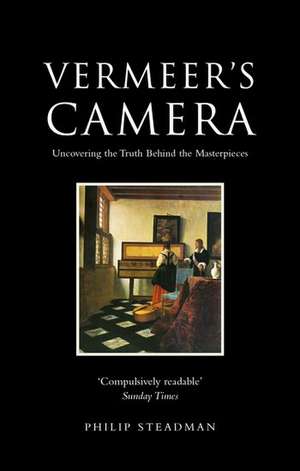
Vermeer's Camera: Uncovering the Truth Behind the Masterpieces
Autor Philip Steadmanen Limba Engleză Paperback – 4 apr 2002
Preț: 103.31 lei
Preț vechi: 127.52 lei
-19%
Puncte Express: 155
Carte disponibilă
Livrare economică 19-25 noiembrie
Livrare express 31 octombrie-06 noiembrie pentru 51.68 lei
Livrare prin curier în România Termenul estimat este afișat lângă disponibilitate.
Transport gratuit de la 400.00 lei Plată online sau ramburs, în funcție de opțiunile comenzii.
Retur gratuit în 14 zile Comandă securizată și suport în română.
Specificații
ISBN-13: 9780192803023
ISBN-10: 0192803026
Pagini: 222
Ilustrații: numerous halftones and line drawings; 8pp colour plates
Dimensiuni: 156 x 233 x 15 mm
Greutate: 0.38 kg
Editura: OUP OXFORD
Colecția OUP Oxford
Locul publicării:Oxford, United Kingdom
ISBN-10: 0192803026
Pagini: 222
Ilustrații: numerous halftones and line drawings; 8pp colour plates
Dimensiuni: 156 x 233 x 15 mm
Greutate: 0.38 kg
Editura: OUP OXFORD
Colecția OUP Oxford
Locul publicării:Oxford, United Kingdom
V-ar putea interesa
-
 Secret Knowledge (New and Expanded Edition)David HockneyPreț: 412.10 lei
 -
 Secret KnowledgeDavid HockneyPreț: 248.21 lei
 -
 VermeerWayne Franits-16%Preț: 118.00 lei140.74 lei
 -
 VermeerArthur K Wheelock-9%Preț: 126.37 lei139.40 lei
 -
 The Portrait ArtistDani Heywood-Lonsdale-25%Preț: 82.35 lei109.50 lei
 -
 -24%Preț: 84.37 lei110.63 lei
 -
 The Louvre: All The PaintingsAnja Grebe-18%Preț: 476.13 lei579.60 lei
 -
 Vermeer's MapsRozemarijn LandsmanPreț: 244.85 lei
 -
 Preț: 144.32 lei
 -
 -23%Preț: 181.33 lei236.40 lei
 -
 VermeerAndrew Graham-DixonPreț: 232.23 lei
 -
 Everything You Know about Art Is WrongMatt Brown-9%Preț: 67.13 lei73.48 lei
 -
 Vermeer's Mistress and MaidJames Ivory-17%Preț: 124.99 lei151.44 lei
 -
 Hockney's EyeJane MunroPreț: 353.44 lei
 -
 Frans Hals or not Frans HalsAnna TummersPreț: 403.76 lei
 -
 VermeerAlexander AdamsPreț: 86.80 lei
 -
 VermeerNorbert SchneiderPreț: 132.26 lei
 -
 Vermeer. The Complete WorksKarl Schütz-8%Preț: 619.31 lei673.17 lei
 -
 VermeerKarl SchützPreț: 204.31 lei
Notă biografică
Philip Steadman is Professor of Urban and Built Form Studies at University College London. He trained as an architect, and has taught at Cambridge University and the Open University. He has published several books on geometry in architecture, and on computer-aided design. In the 1960s he edited and published Form, a quarterly magazine of the arts, and co-authored a book on kinetic art. He helped to produce four computer-animated films on the work of Leonardo da Vinci for an exhibition in London in 1989. He has also contributed to other exhibitions, films, and books on perspective geometry and the history of art. Vermeer's Camera is the product of twenty years' fascination with the Dutch painter.
Cuprins
- Introduction
- 1: The camera obscura
- 2: The discovery of Vermeer's use of the camera
- 3: Who taught Vermeer about optics?
- 4: A room in Vermeer's house?
- 5: Reconstructing the spaces in Vermeer's paintings
- 6: The riddle of the Sphinx of Delft
- 7: More evidence, from rebuilding Vermeer's studio
- 8: Arguments against Vermeer's use of the camera
- 9: The influence of the camera on Vermeer's painting style
- Appendices
- Further Reading
- A. Architectural features appearing in Vermeer's interiors
- B. Measurements of Vermeer's room and furniture