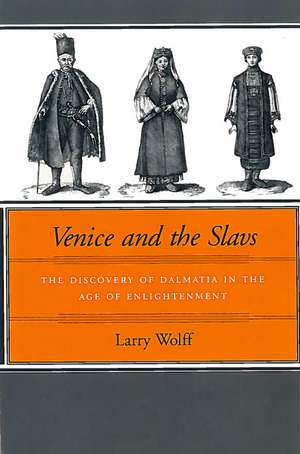
Venice and the Slavs: The Discovery of Dalmatia in the Age of Enlightenment
Autor Larry Wolffen Limba Engleză Paperback – 12 noi 2002
Bazându-ne pe analiza detaliată a arhivelor administrative și a literaturii iluministe, Venice and the Slavs oferă o perspectivă riguroasă asupra modului în care Republica Venețiană și-a definit autoritatea în Dalmația prin construcția unei identități de „misiune civilizatoare”. Larry Wolff demonstrează că procesul de descoperire a slavilor nu a fost doar o chestiune geografică, ci una profund ideologică, în care Iluminismul adriatic a jucat un rol central în inventarea conceptului de „înapoiere” a Europei de Est.
Putem afirma că volumul excelează în decodarea mecanismelor prin care elitele venețiene, de la dramaturgi ca Carlo Goldoni la administratori de carieră, au transformat populația Morlacchi în simbolul „sălbaticului nobil” sau al primitivismului rural. Structura cărții urmărește trecerea de la reprezentările literare la discursul administrativ, culminând cu impactul acestor perspective asupra identității slave de sud în secolele XIX și XX. Comparabil cu Venice and the Dalmatian Hinterland de Lena Sadovski în rigurozitatea utilizării surselor primare, volumul lui Wolff se distinge prin actualizarea tematicii pentru contextul istoriei ideilor, mutând accentul de la microistoria economică spre construcția mentală a frontierelor culturale europene.
Această lucrare reprezintă o evoluție firească în opera autorului, fiind strâns legată de temele explorate în Inventing Eastern Europe. Dacă în lucrarea precedentă Wolff analiza harta civilizației creată de filosofii parizieni, în Venice and the Slavs el aplică aceeași metodologie critică asupra unui studiu de caz specific: laboratorul adriatic, unde periferia slavă a servit drept oglindă pentru definirea modernității occidentale.
Preț: 234.74 lei
Carte disponibilă
Livrare economică 10-24 noiembrie
Specificații
ISBN-10: 0804739463
Pagini: 424
Dimensiuni: 152 x 229 x 23 mm
Greutate: 0.57 kg
Ediția:Adnotată
Editura: Stanford University Press
Colecția Stanford University Press
V-ar putea interesa
-
 Preț: 289.99 lei
 -
 The Boys and Their BabyLarry WolffPreț: 126.36 lei
 -
 The Bronx Nobody KnowsWilliam B HelmreichPreț: 170.14 lei
 -
 -23%Preț: 513.81 lei667.28 lei
 -
 Preț: 310.94 lei
 -
 Making a Mindful NationJoanna CookPreț: 173.24 lei
 -
 Preț: 238.47 lei
 -
 The Anthropology of the EnlightenmentLarry Wolff-23%Preț: 839.18 lei1089.85 lei
 -
 -23%Preț: 779.84 lei1012.78 lei
 -
 -23%Preț: 738.56 lei959.17 lei
 -
 Child Abuse in Freud's ViennaLarry WolffPreț: 276.57 lei
 -
 Violence of Democracy – Interparty Conflict in South IndiaRuchi ChaturvediPreț: 194.79 lei
 -
 The City after PropertySara SafranskyPreț: 188.20 lei
 -
 The Other Side of EmpathyJade E. DavisPreț: 168.39 lei
 -
 Together, SomehowLuis Manuel Garcia-MispiretaPreț: 188.78 lei
 -
 The Pulse of the EarthAdam BobbettePreț: 194.87 lei
 -
 Brown Saviors and Their OthersArjun ShankarPreț: 228.25 lei
 -
 The Singing TurkOutmaskPreț: 243.83 lei
 -
 Preț: 220.06 lei
De ce să citești această carte
Această carte este esențială pentru cercetătorii istoriei europene și ai studiilor slave, oferind o explicație documentată a modului în care prejudecățile culturale de acum trei secole încă influențează percepția asupra Balcanilor. Cititorul câștigă o înțelegere profundă a rădăcinilor intelectuale ale diviziunii Est-Vest, analizată prin prisma unei puteri maritime aflate în amurg, Veneția, care și-a căutat legitimitatea prin reformarea „celuilalt” slav.
Despre autor
Larry Wolff este profesor de istorie europeană la Boston College și un specialist recunoscut în istoria intelectuală a Iluminismului. Cariera sa este marcată de explorarea modului în care geografia mentală a Europei a fost construită în secolul al XVIII-lea, temă centrală în lucrări precum Inventing Eastern Europe. Dincolo de cercetările istorice, Wolff a publicat și proză scurtă, precum Eight Stories – Tales of War and Loss, și studii culturale inedite, cum este The Singing Turk, demonstrând o capacitate remarcabilă de a analiza intersecția dintre politică, artă și identitate în spațiul european și mediteranean.
Descriere scurtă
The book begins by discussing Venetian literary perspectives on Dalmatia, notably the drama of Carlo Goldoni and the memoirs of Carlo Gozzi. It then studies the work that brought the subject of Dalmatia to the attention of the European Enlightenment: the travel account of the Paduan philosopher Alberto Fortis, which was translated from Italian into English, French, and German. The next two chapters focus on the Dalmatian inland mountain people called the Morlacchi, famous as “savages” throughout Europe in the eighteenth century. The Morlacchi are considered first as a concern of Venetian administration and then in relation to the problem of the “noble savage,” anthropologically studied and poetically celebrated. The book then describes the meeting of these administrative and philosophical discourses concerning Dalmatia during the final decades of the Venetian Republic. It concludes by assessing the legacy of the Venetian Enlightenment for later perspectives on Dalmatia and the South Slavs from Napoleonic Illyria to twentieth-century Yugoslavia.
Recenzii
Notă biografică
Textul de pe ultima copertă
“A fine imaginative historian who makes a persuasive case for the origin of the concept “eastern Europe,” [Wolff] has a tendency to base his assertions not only on the findings of his meticulous research but on theories he discovered in the work of the late Michel Foucault, who sought to disclose how knowledge, in the guise of various scientific “discourses,” exercised a disciplinary power.”—Slavic Review