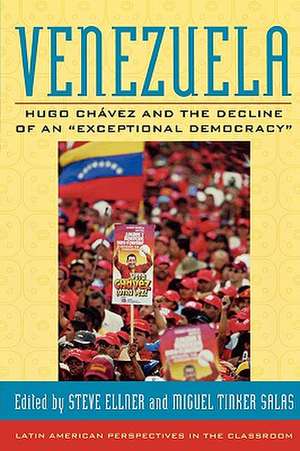
Venezuela: Hugo Chavez and the Decline of an "Exceptional Democracy": Latin American Perspectives in the Classroom
Editat de Steve Ellner, Miguel Tinker Salasen Limba Engleză Paperback – 7 dec 2006
Contributions by: Christopher I. Clement, Steve Ellner, Maria Pilar García Guadilla, Daniel Hellinger, Jesús María Herrera Salas, Edgardo Lander, Dick Parker, Miguel Tinker Salas, and Cristóbal Valencia Ramírez












Preț: 278.25 lei
Preț vechi: 362.10 lei
-23%
Puncte Express: 417
Carte tipărită la comandă
Livrare economică 28 noiembrie-12 decembrie
Livrare prin curier în România Termenul estimat este afișat lângă disponibilitate.
Transport gratuit de la 400.00 lei Plată online sau ramburs, în funcție de opțiunile comenzii.
Retur gratuit în 14 zile Comandă securizată și suport în română.
Specificații
ISBN-13: 9780742554566
ISBN-10: 0742554562
Pagini: 236
Dimensiuni: 148 x 226 x 18 mm
Greutate: 0.36 kg
Ediția:Adnotată
Editura: Bloomsbury Publishing
Colecția Rowman & Littlefield
Seria Latin American Perspectives in the Classroom
Locul publicării:New York, United States
ISBN-10: 0742554562
Pagini: 236
Dimensiuni: 148 x 226 x 18 mm
Greutate: 0.36 kg
Ediția:Adnotată
Editura: Bloomsbury Publishing
Colecția Rowman & Littlefield
Seria Latin American Perspectives in the Classroom
Locul publicării:New York, United States
V-ar putea interesa
-
 Colours Of The MountainDa ChenPreț: 114.17 lei
 -
 Dogs and DemonsAlex KerrPreț: 117.86 lei
 -
 -28%Preț: 392.40 lei547.56 lei
 -
 Friday Night LightsH G Bissinger-19%Preț: 76.22 lei93.82 lei
 -
 Das ReichJames LucasPreț: 151.83 lei
 -
 The Great EscapePaul BrickhillPreț: 93.16 lei
 -
 The White RabbitBruce Marshall-27%Preț: 68.25 lei93.07 lei
 -
 The Balkans Since the Second World WarR. J. Crampton-15%Preț: 433.67 lei510.19 lei
 -
 Pol Pot: The History of a NightmarePhilip Short-25%Preț: 81.63 lei109.29 lei
 -
 -7%Preț: 73.77 lei79.55 lei
 -
 -25%Preț: 81.66 lei109.12 lei
 -
 In the Footsteps of Mr KurtzMichela WrongPreț: 93.44 lei
 -
 Defying Hitler: A MemoirSebastian Haffner-26%Preț: 59.13 lei79.55 lei
 -
 The Monuments MenRobert M. Edsel-16%Preț: 67.97 lei81.26 lei
Cuprins
Introduction: New Perspectives and the Chávez Phenomenon
Part I: Theoretical, Historical, and International Background
Chapter 1: The Venezuelan Exceptionalism Thesis: Separating Myth from Reality
Chapter 2: Venezuelan Social Conflict in a Global Context
Part II: Oil and Economic Policy
Chapter 3: U.S. Oil Companies in Venezuela: The Forging of an Enduring Alliance
Chapter 4: Chávez and the Search for an Alternative to Neoliberalism
Part III: Labor and Race
Chapter 5: Trade Autonomy and the Emergence of a New Labor Movement in Venezuela
Chapter 6: Ethnicity and Revolution: The Political Economy of Racism in Venezuela
Part IV: Social Movements
Chapter 7: Venezuela's Bolivarian Revolution: Who Are the Chavistas?
Chapter 8: Social Movements in a Polarized Setting: Myths of Venezuelan Civil Society
Part V: Electoral Politics, Social Change, and U.S. Reaction
Chapter 9: When "No" Means "Yes to Revolution": Electoral Politics in Bolivarian Venezuela
Chapter 10: Confronting Hugo Chávez: United States "Democracy Promotion" in Latin America
Part I: Theoretical, Historical, and International Background
Chapter 1: The Venezuelan Exceptionalism Thesis: Separating Myth from Reality
Chapter 2: Venezuelan Social Conflict in a Global Context
Part II: Oil and Economic Policy
Chapter 3: U.S. Oil Companies in Venezuela: The Forging of an Enduring Alliance
Chapter 4: Chávez and the Search for an Alternative to Neoliberalism
Part III: Labor and Race
Chapter 5: Trade Autonomy and the Emergence of a New Labor Movement in Venezuela
Chapter 6: Ethnicity and Revolution: The Political Economy of Racism in Venezuela
Part IV: Social Movements
Chapter 7: Venezuela's Bolivarian Revolution: Who Are the Chavistas?
Chapter 8: Social Movements in a Polarized Setting: Myths of Venezuelan Civil Society
Part V: Electoral Politics, Social Change, and U.S. Reaction
Chapter 9: When "No" Means "Yes to Revolution": Electoral Politics in Bolivarian Venezuela
Chapter 10: Confronting Hugo Chávez: United States "Democracy Promotion" in Latin America
Recenzii
The authors of this edited volume provide a generally positive portrayal of Venezuelan president Hugo Chávez and the reforms he has introduced since he was first elected in 1998. Recommended.
The sociology and history in the book are . . . illuminating.
This collection of articles . . . is probably the best English-language introduction to the profound changes taking place in Venezuela in the past 10 years.
Steve Ellner and Miguel Tinker Salas meet the need for a measured and accessible synthesis of the arguments around the decline of Venezuelan 'exceptional' democracy and the concomitant rise and presidency of Hugo Chávez. . . . The contributions are all of high quality. . . . Achieves its goal of introducing contemporary Venezuela to a student audience. . . . The volume successfully stimulates discussion and covers relevant topics at an accessible level for today's universities, colleges, and schools, while it is also more widely valuable to the inquiring general public.
With the rise and presidency of Hugo Chavez, Ellner finds himself uniquely positioned to commentate on and explain the drivers of contemporary change and political evolution in Venezuela, where he has lived for over 30 years. Unlike many of those currently writing on the country and its president, he brings an objective and informed perspective, one that transcends subjective accounts and the current polarization of assessments. More importantly, his writing and explanatory frameworks are accessible and engaging, making his latest book both an excellent introduction for those bewildered and new to the Chavez phenomenon and also an invaluable read for long-term observers of Venezuela and the South American region more broadly.
An excellent overview of the collapse of Venezuelan democracy, the rise of Hugo Chávez, and what Venezuela looks like under Chávez.
The sociology and history in the book are . . . illuminating.
This collection of articles . . . is probably the best English-language introduction to the profound changes taking place in Venezuela in the past 10 years.
Steve Ellner and Miguel Tinker Salas meet the need for a measured and accessible synthesis of the arguments around the decline of Venezuelan 'exceptional' democracy and the concomitant rise and presidency of Hugo Chávez. . . . The contributions are all of high quality. . . . Achieves its goal of introducing contemporary Venezuela to a student audience. . . . The volume successfully stimulates discussion and covers relevant topics at an accessible level for today's universities, colleges, and schools, while it is also more widely valuable to the inquiring general public.
With the rise and presidency of Hugo Chavez, Ellner finds himself uniquely positioned to commentate on and explain the drivers of contemporary change and political evolution in Venezuela, where he has lived for over 30 years. Unlike many of those currently writing on the country and its president, he brings an objective and informed perspective, one that transcends subjective accounts and the current polarization of assessments. More importantly, his writing and explanatory frameworks are accessible and engaging, making his latest book both an excellent introduction for those bewildered and new to the Chavez phenomenon and also an invaluable read for long-term observers of Venezuela and the South American region more broadly.
An excellent overview of the collapse of Venezuelan democracy, the rise of Hugo Chávez, and what Venezuela looks like under Chávez.