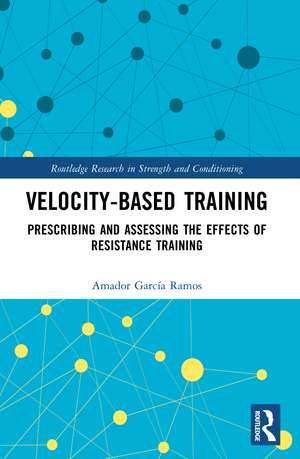
Velocity-Based Training: Prescribing and Assessing the Effects of Resistance Training: Routledge Research in Strength and Conditioning
Autor Amador Garcia Ramosen Limba Engleză Paperback – 19 iul 2026
Preț: 364.98 lei
Preț vechi: 384.19 lei
-5% Nou
Puncte Express: 547
Carte tipărită la comandă
Livrare economică 04-10 noiembrie
Livrare prin curier în România Termenul estimat este afișat lângă disponibilitate.
Transport gratuit de la 400.00 lei Plată online sau ramburs, în funcție de opțiunile comenzii.
Retur gratuit în 14 zile Comandă securizată și suport în română.
Specificații
ISBN-13: 9780367756918
ISBN-10: 0367756919
Pagini: 280
Ilustrații: 72
Dimensiuni: 156 x 234 mm
Greutate: 0.44 kg
Ediția:1
Editura: Taylor & Francis
Colecția Routledge
Seria Routledge Research in Strength and Conditioning
Locul publicării:Oxford, United Kingdom
ISBN-10: 0367756919
Pagini: 280
Ilustrații: 72
Dimensiuni: 156 x 234 mm
Greutate: 0.44 kg
Ediția:1
Editura: Taylor & Francis
Colecția Routledge
Seria Routledge Research in Strength and Conditioning
Locul publicării:Oxford, United Kingdom
Public țintă
Postgraduate and UndergraduateCuprins
List of Tables and Figures Foreword Preface Table of ContentsSection I: Introduction to velocity-based trainingChapter 1: Methods of prescribing resistance trainingChapter 2: What is VBT? Chapter 3: Types of velocity variablesSection II: Prescribing resistance training from velocityChapter 4: Prescription of the intensity Chapter 5: Prescription of the volumeChapter 6: Programming with VBTSection III: Assessing neuromuscular performance from velocityChapter 7: Maximal mechanical capacitiesChapter 8: Maximum velocity maintenance capacityChapter 9: Interpreting individual changes in velocity performanceChapter 10: How are coaches implementing VBT?Section IV: Strategies to increase velocity performance during trainingChapter 11: Using velocity to provide feedbackChapter 12: Manipulation of intra- and inter-set rest periodsChapter 13: Warm-up protocols and ergogenic aidsSection V: Commercially available velocity monitoring devicesChapter 14: Factors to consider when purchasing a velocity monitoring deviceChapter 15: Reliability and validity of commercially available velocity monitoring devicesReferences Index
Notă biografică
Amador García Ramos is a professor of strength & conditioning in the department of education at the University of Granada, Spain
Descriere
Velocity Based Training looks to describe how movement velocity can be used as a supplement to or replacement for more traditional methods commonly used to prescribe RT and assess its effects on neuromuscular function This new volume thoroughly examines the scientific literature related to VBT.