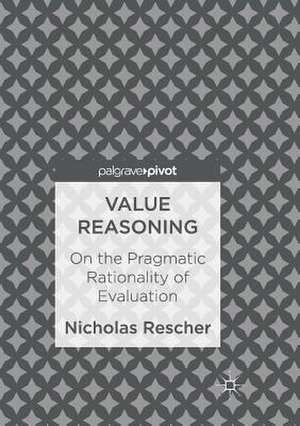
Value Reasoning
Autor Nicholas Rescheren Limba Engleză Paperback – 13 mai 2018
This book is a survey of key issues in the theory of evaluation aimed at exhibiting and clarifying the rational nature of the thought-procedures involved. By means of theoretical analysis and explanatory case studies, this volume shows how evaluation is—or should be—a rational procedure directed at appropriate objectives. Above all, it maintains the objectivity of rational evaluation.
Preț: 447.52 lei
Puncte Express: 671
Carte tipărită la comandă
Livrare economică 26 noiembrie-10 decembrie
Livrare prin curier în România Termenul estimat este afișat lângă disponibilitate.
Transport gratuit pentru acest produs Plată online sau ramburs, în funcție de opțiunile comenzii.
Retur gratuit în 14 zile Comandă securizată și suport în română.
Specificații
ISBN-13: 9783319853291
ISBN-10: 3319853295
Pagini: 160
Ilustrații: X, 147 p. 17 illus.
Dimensiuni: 148 x 210 x 9 mm
Greutate: 0.2 kg
Ediția:Softcover reprint of the original 1st edition 2017
Editura: Springer
Locul publicării:Cham, Switzerland
ISBN-10: 3319853295
Pagini: 160
Ilustrații: X, 147 p. 17 illus.
Dimensiuni: 148 x 210 x 9 mm
Greutate: 0.2 kg
Ediția:Softcover reprint of the original 1st edition 2017
Editura: Springer
Locul publicării:Cham, Switzerland
V-ar putea interesa
-
 Pluralism: Against the Demand for ConsensusNicholas Rescher-29%Preț: 461.62 lei647.84 lei
 -
 An Essay on Belief and AcceptanceL. Jonathan Cohen-29%Preț: 395.98 lei555.08 lei
 -
 A Parliament of Souls: Limits and Renewals 2Stephen R. L. Clark-21%Preț: 374.47 lei474.33 lei
 -
 Sound Sentiments: Integrity in the EmotionsDavid Pugmire-21%Preț: 378.44 lei481.37 lei
 -
 Nature and Understanding: The Metaphysics and Method of ScienceNicholas Rescher-20%Preț: 363.44 lei452.81 lei
 -
 Self-Knowing AgentsLucy O'Brien-12%Preț: 335.93 lei379.71 lei
 -
 Objectivity and the ParochialCharles Travis-31%Preț: 792.52 lei1148.52 lei
 -
 Decision Theory and RationalityJosé Luis Bermúdez-13%Preț: 299.10 lei345.05 lei
 -
 Self-ExpressionMitchell S. Green-12%Preț: 373.75 lei422.38 lei
 -
 Disjunctivism: Perception, Action, KnowledgeAdrian Haddock-11%Preț: 371.72 lei416.74 lei
 -
 Selves: An Essay in Revisionary MetaphysicsGalen Strawson-12%Preț: 294.75 lei335.59 lei
 -
 Philosophy BitesDavid Edmonds-19%Preț: 58.33 lei71.97 lei
 -
 Collected Papers, Volume 1: Mind and Language, 1972-2010Stephen Stich-28%Preț: 521.66 lei726.47 lei
 -
 -11%Preț: 383.89 lei432.72 lei
 -
 Artificial Intelligence: The BasicsKevin WarwickPreț: 212.80 lei
 -
 Phenomenology for TherapistsLinda FinlayPreț: 381.04 lei
 -
 Anti-IndividualismGoldberg Sanford C.Preț: 317.89 lei
 -
 The Ego TrickJulian BagginiPreț: 70.87 lei
Cuprins
1. Value Basics.- 2. Value Attribution.- 3. Rational Choice and Value Complementarity.- 4. Integration Problems.- 5. Rationality Issues.- 6. Rational Choice and Merit Complementarity.- 7. Circularity Issues.- 8. Evaluating Cognitive Significance.- 9. Epistemic Evaluation.- 10. Allocating Scientific Credit.- 11. Evaluating Contention Tenacity.
Notă biografică
Nicholas Rescher is Distinguished University Professor of Philosophy at be University of Pittsburgh where he has also served as Chairman of the Philosophy Department and a Director of the Center for Philosophy of Science.
Textul de pe ultima copertă
This book is a survey of key issues in the theory of evaluation aimed at exhibiting and clarifying the rational nature of the thought-procedures involved. By means of theoretical analysis and explanatory case studies, this volume shows how evaluation is—or should be—a rational procedure directed at appropriate objectives. Above all, it maintains the objectivity of rational evaluation.
Caracteristici
Book represents a new topic explained by a prominent philosopher Outlines basic principles for evaluating excellence Illustrates the principles with four examples, called “cognitive importance, allocating scientific credit, actions, and contention tenacity”