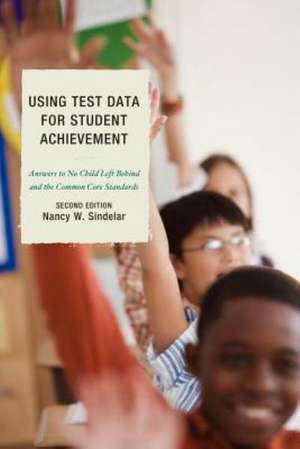
Using Test Data for Student Achievement: Answers to No Child Left Behind
Autor Nancy W. Sindelaren Limba Engleză Paperback – 4 noi 2011
Now, more than ever, teachers and administrators need to embrace testing as a valuable classroom tool to guide instruction, use efficient technological resources available for test scoring and analysis, and profit from the benefits of test analysis to increase learning and achievement.
Using Test Data for Student Achievement shows educators, step by step, how to use test data to facilitate student learning. The book combines research, technology and Sindelar's experience as a teacher and administrator to provide practical and efficient ways to use test data to increase learning, close achievement gaps and even raise test scores.
Preț: 221.62 lei
Preț vechi: 293.60 lei
-25%
Puncte Express: 332
Carte tipărită la comandă
Livrare economică 25 noiembrie-09 decembrie
Livrare prin curier în România Termenul estimat este afișat lângă disponibilitate.
Transport gratuit de la 400.00 lei Plată online sau ramburs, în funcție de opțiunile comenzii.
Retur gratuit în 14 zile Comandă securizată și suport în română.
Specificații
ISBN-13: 9781607099611
ISBN-10: 1607099616
Pagini: 171
Dimensiuni: 155 x 232 x 11 mm
Greutate: 0.38 kg
Ediția:2
Editura: Bloomsbury Publishing
Colecția R&L Education
Locul publicării:New York, United States
ISBN-10: 1607099616
Pagini: 171
Dimensiuni: 155 x 232 x 11 mm
Greutate: 0.38 kg
Ediția:2
Editura: Bloomsbury Publishing
Colecția R&L Education
Locul publicării:New York, United States
V-ar putea interesa
-
 Assessment for LearningPaul Black-27%Preț: 198.12 lei272.55 lei
 -
 Preț: 340.45 lei
 -
 Effective Grading 2eBarbara E WalvoordPreț: 349.03 lei
 -
 AssessmentMargaret Sangster-45%Preț: 99.97 lei182.10 lei
 -
 AssessmentHoward Tanner-45%Preț: 79.72 lei145.00 lei
 -
 101 Essential Lists on AssessmentTabatha Rayment-41%Preț: 71.62 lei121.73 lei
 -
 Preț: 60.95 lei
 -
 Preț: 146.46 lei
Cuprins
Chapter 1: Why Schools Need to Use Test Data
Chapter 2: Building a Data-Driven Instructional System at the School or District Level
Chapter 3: Aligning Curriculum and Assessments with Standards
Chapter 4: Types of Assessments and Their Purpose
Chapter 5: Gathering and Analyzing Meaningful Test Data
Chapter 6: Using Assessment Data to Increase Student Achievement
Chapter 7: Nurturing a Culture of Accountability and Achievement
Chapter 8: Helping Parents Understand and Embrace the Benefits of Test Results
Chapter 2: Building a Data-Driven Instructional System at the School or District Level
Chapter 3: Aligning Curriculum and Assessments with Standards
Chapter 4: Types of Assessments and Their Purpose
Chapter 5: Gathering and Analyzing Meaningful Test Data
Chapter 6: Using Assessment Data to Increase Student Achievement
Chapter 7: Nurturing a Culture of Accountability and Achievement
Chapter 8: Helping Parents Understand and Embrace the Benefits of Test Results
Recenzii
In Leadership and Sustainability Michael Fullan contends that a key to sustaining improvement in any organization is the development of 'system thinkers in action'-leaders who build professional learning communities by creating structures and cultures in which people engage in the daily habit of working together to deepen the learning of their craft. Nancy Sindelar is a wonderful example of Fullan's systems thinker in action. In Using Data for Student Achievement, she combines her knowledge of research and practice to offer wonderful examples of what schools can do to meet the challenge of learning for all students.
One the best teaching tools introduced to my school was the provision of data to teachers which identified the percentage of students selecting each option in a forced choice test. Back in 1993, as a new advanced placement teacher, I began using that information to direct the reteaching and review efforts in my economics classroom. The result was stunning-consistently high scores on the AP test resulted year after year due to the diagnostic benefits of using item analysis. I could not have been as effective a teacher without it!
Sindelar's book, Using Test Data for Student Achievement, is a lucid and useful guide to understanding the essential importance of data, standards and curriculum alignment. It will help educators at all levels to promote better instruction and hence, higher levels of learning.
Using Test Data for Student Achievement is a practical, hands-on resource to help educators understand and implement the total process of assessment to help their students achieve. Its value transcends all levels of an educator's career and is especially valuable for college and university professors and staff developers to use as a resource to train the uninitiated in how to collect data and then how to utilize that data to assure that students are achieving at their highest potential. The clarity with which the data collection and analysis is explained, coupled with the practical experience of the author, makes this text a valuable addition to the professional library of all educators and administrators from the pre-service level to the halls of higher education.
One the best teaching tools introduced to my school was the provision of data to teachers which identified the percentage of students selecting each option in a forced choice test. Back in 1993, as a new advanced placement teacher, I began using that information to direct the reteaching and review efforts in my economics classroom. The result was stunning-consistently high scores on the AP test resulted year after year due to the diagnostic benefits of using item analysis. I could not have been as effective a teacher without it!
Sindelar's book, Using Test Data for Student Achievement, is a lucid and useful guide to understanding the essential importance of data, standards and curriculum alignment. It will help educators at all levels to promote better instruction and hence, higher levels of learning.
Using Test Data for Student Achievement is a practical, hands-on resource to help educators understand and implement the total process of assessment to help their students achieve. Its value transcends all levels of an educator's career and is especially valuable for college and university professors and staff developers to use as a resource to train the uninitiated in how to collect data and then how to utilize that data to assure that students are achieving at their highest potential. The clarity with which the data collection and analysis is explained, coupled with the practical experience of the author, makes this text a valuable addition to the professional library of all educators and administrators from the pre-service level to the halls of higher education.