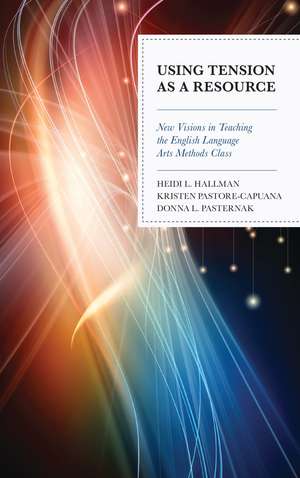
Using Tension as a Resource: New Visions in Teaching the English Language Arts Methods Class
Editat de Heidi L. Hallman, Kristen Pastore-Capuana, Donna L. Pasternaken Limba Engleză Paperback – 16 apr 2019
Preț: 255.81 lei
Preț vechi: 334.38 lei
-23%
Puncte Express: 384
Carte tipărită la comandă
Livrare economică 23 noiembrie-07 decembrie
Livrare prin curier în România Termenul estimat este afișat lângă disponibilitate.
Transport gratuit de la 400.00 lei Plată online sau ramburs, în funcție de opțiunile comenzii.
Retur gratuit în 14 zile Comandă securizată și suport în română.
Specificații
ISBN-13: 9781475845488
ISBN-10: 1475845480
Pagini: 184
Ilustrații: 4 Tables
Dimensiuni: 150 x 225 x 15 mm
Greutate: 0.31 kg
Editura: Bloomsbury Publishing
Colecția Rowman & Littlefield
Locul publicării:New York, United States
ISBN-10: 1475845480
Pagini: 184
Ilustrații: 4 Tables
Dimensiuni: 150 x 225 x 15 mm
Greutate: 0.31 kg
Editura: Bloomsbury Publishing
Colecția Rowman & Littlefield
Locul publicării:New York, United States
Cuprins
Acknowledgments
Editors' Introduction
Heidi L. Hallman, Kristen Pastore-Capuana, and Donna L. Pasternak
Section I: Frameworks for English Education
Chapter 1: Educating Teachers for Critical Pragmatism: Methods as a "Conceptual Home Base"
Lauren Gatti, Sarah Thomas, Jessica Masterson, Robert Brooke, and Rachael Wendler-Shah
A Response to Chapter 1
Melissa Schieble
Chapter 2: Enduring Assignments in the Methods Course: Lesson Planning and Micro-Teaching as Trigger Points for Stimulating Social Justice Teaching
Terri L. Rodriguez
A Response to Chapter 2
Allison Wynhoff Olsen
Chapter 3: Exploring Tensions During Critical Conversations about Race in English Education
Amy Vetter and Melissa Schieble
A Response to Chapter 3
Lauren Gatti
Section II: Practices in English Education
Chapter 4: Writing in and for the 21st Century: Crossing Digital and Multimodal Thresholds in ELA Methods Courses
Amber Jensen
A Response to Chapter 4
Mike Metz
Chapter 5: Moving Pre-service English Majors from Egocentric to Sociocentric Readings
Crag Hill
A Response to Chapter 5
Christopher M. Parsons
Chapter 6: Powerful Influence and Absurd Neglect: The Legacy of Louise M. Rosenblatt
Sue Ringler Pet
A Response to Chapter 6
Crag Hill
Chapter 7: Teacher Candidates' Perspectives on Tensions within the Methods-Based Field Experience
Christopher M. Parsons
A Response to Chapter 7
Laura A. Renzi
Section III: Communities of English Education
Chapter 8: English Education Methods Courses as Sites of Induction into English Teacher Communities of Practice
James Cercone and Kristen Pastore-Capuana
A Response to Chapter 8
Amber Jensen
Chapter 9: Tensions in ELA Field Experiences: Service-learning Initiatives in Rural Contexts
Allison Wynhoff Olsen
A Response to Chapter 9
Jamie M. Collins
Chapter 10: A Teaching Mythology: Disrupting the Tutor/Teacher Dichotomy
Heidi L. Hallman and Melanie N. Burdick
A Response to Chapter 10
Terri L. Rodriguez
About the Editors
About the Contributors
Index
Editors' Introduction
Heidi L. Hallman, Kristen Pastore-Capuana, and Donna L. Pasternak
Section I: Frameworks for English Education
Chapter 1: Educating Teachers for Critical Pragmatism: Methods as a "Conceptual Home Base"
Lauren Gatti, Sarah Thomas, Jessica Masterson, Robert Brooke, and Rachael Wendler-Shah
A Response to Chapter 1
Melissa Schieble
Chapter 2: Enduring Assignments in the Methods Course: Lesson Planning and Micro-Teaching as Trigger Points for Stimulating Social Justice Teaching
Terri L. Rodriguez
A Response to Chapter 2
Allison Wynhoff Olsen
Chapter 3: Exploring Tensions During Critical Conversations about Race in English Education
Amy Vetter and Melissa Schieble
A Response to Chapter 3
Lauren Gatti
Section II: Practices in English Education
Chapter 4: Writing in and for the 21st Century: Crossing Digital and Multimodal Thresholds in ELA Methods Courses
Amber Jensen
A Response to Chapter 4
Mike Metz
Chapter 5: Moving Pre-service English Majors from Egocentric to Sociocentric Readings
Crag Hill
A Response to Chapter 5
Christopher M. Parsons
Chapter 6: Powerful Influence and Absurd Neglect: The Legacy of Louise M. Rosenblatt
Sue Ringler Pet
A Response to Chapter 6
Crag Hill
Chapter 7: Teacher Candidates' Perspectives on Tensions within the Methods-Based Field Experience
Christopher M. Parsons
A Response to Chapter 7
Laura A. Renzi
Section III: Communities of English Education
Chapter 8: English Education Methods Courses as Sites of Induction into English Teacher Communities of Practice
James Cercone and Kristen Pastore-Capuana
A Response to Chapter 8
Amber Jensen
Chapter 9: Tensions in ELA Field Experiences: Service-learning Initiatives in Rural Contexts
Allison Wynhoff Olsen
A Response to Chapter 9
Jamie M. Collins
Chapter 10: A Teaching Mythology: Disrupting the Tutor/Teacher Dichotomy
Heidi L. Hallman and Melanie N. Burdick
A Response to Chapter 10
Terri L. Rodriguez
About the Editors
About the Contributors
Index
Recenzii
English teacher educators struggle to resolve tensions between teacher preparation and classroom experience; they help preservice English teachers move toward resolution on those issues as well. This book provides a thoughtful, inspired, and analytical discussion of some of these tensions, and is particularly well situated to assist both new and experienced English teacher educators with this puzzling and difficult work. The book is both a mirror and a ladder: the discussion between chapter authors and respondents mirrors the values placed in our field on discussion and collaboration, while the content of the chapters and responses will provide a helpful assist to English teacher educators. The tensions addressed in our work and in this book are many - the chapters here will provide new direction and ideas for any English teacher educator who takes it up.
This is a clear-eyed and thoughtful examination of critical problems identified by English teacher educators who wish to prepare teachers for classrooms as they are, not as we wish they were. The list of teacher educators and the experience and wide-reading they bring to the tensions explored validates our entire profession: we seek to negotiate messy and complicated truths to educate young people for the future. This book is an important tool for that quest.
Amidst the changing field of English education, Using Tension as a Resource offers a variety of enlightening and informative perspectives that recognize the complexity of our work in the field. The chapters provide invaluable ideas for extending the learning of our pre-service teachers beyond the university and into the communities of the students with whom they will work.
This is a clear-eyed and thoughtful examination of critical problems identified by English teacher educators who wish to prepare teachers for classrooms as they are, not as we wish they were. The list of teacher educators and the experience and wide-reading they bring to the tensions explored validates our entire profession: we seek to negotiate messy and complicated truths to educate young people for the future. This book is an important tool for that quest.
Amidst the changing field of English education, Using Tension as a Resource offers a variety of enlightening and informative perspectives that recognize the complexity of our work in the field. The chapters provide invaluable ideas for extending the learning of our pre-service teachers beyond the university and into the communities of the students with whom they will work.