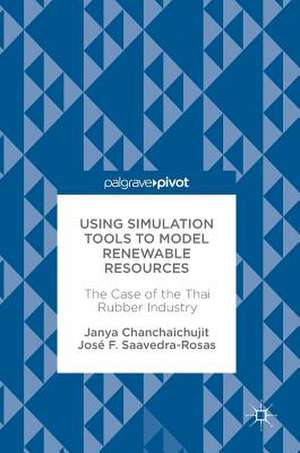
Using Simulation Tools to Model Renewable Resources
Autor Janya Chanchaichujit, José F. Saavedra-Rosasen Limba Engleză Hardback – 10 iul 2017
Preț: 398.13 lei
Puncte Express: 597
Carte tipărită la comandă
Livrare economică 07-21 decembrie
Livrare prin curier în România Termenul estimat este afișat lângă disponibilitate.
Transport gratuit de la 400.00 lei Plată online sau ramburs, în funcție de opțiunile comenzii.
Retur gratuit în 14 zile Comandă securizată și suport în română.
Specificații
ISBN-13: 9783319558158
ISBN-10: 3319558153
Pagini: 180
Ilustrații: XIX, 158 p. 109 illus.
Dimensiuni: 153 x 216 x 15 mm
Greutate: 0.31 kg
Ediția:1st edition 2018
Editura: Springer International Publishing
Locul publicării:Cham, Switzerland
ISBN-10: 3319558153
Pagini: 180
Ilustrații: XIX, 158 p. 109 illus.
Dimensiuni: 153 x 216 x 15 mm
Greutate: 0.31 kg
Ediția:1st edition 2018
Editura: Springer International Publishing
Locul publicării:Cham, Switzerland
V-ar putea interesa
-
 Supply Chain Management Best PracticesDavid BlanchardPreț: 443.93 lei
 -
 Green Supply ChainsEmmett-8%Preț: 603.72 lei656.22 lei
 -
 Strategic ProcurementCaroline BoothPreț: 309.73 lei
 -
 Pricing Done RightTim J SmithPreț: 442.30 lei
 -
 Managing Project Supply ChainsRon BasuPreț: 458.47 lei
 -
 -18%Preț: 684.20 lei834.40 lei
 -
 -15%Preț: 618.64 lei727.80 lei
 -
 Managing the Global Supply ChainJuliana H Mikkola-24%Preț: 396.20 lei523.54 lei
Cuprins
1. Introduction.- 2. The Elements of the Natural Rubber Industry Supply Chain.- 3. Discrete Event Simulation Concepts.- 4. DES Model Development.- 5. Model Implementation and Validation.- 6. Conclusions and Future Research Avenues.
Notă biografică
Janya Chanchaichujit is Lecturer in Logistics and Supply Chain Management at Walailak University, Thailand.
José F. Saavedra-Rosas is Adjunct Professor in the Faculty of Physical and Mathematical Sciences at the University of Chile.
José F. Saavedra-Rosas is Adjunct Professor in the Faculty of Physical and Mathematical Sciences at the University of Chile.
Textul de pe ultima copertă
This book provides a detailed study of the Thai rubber industry and its utilisation of renewable resources, focussing on the use of open source software in building supply chain models. By describing elements that the supply chain is composed of and relating this to Thailand’s rubber industry, the authors then outline the construction of a Discrete Event Simulation (DES) model and use open source software to model renewable resources in this particular supply chain. Emphasis is placed on the way that modelling can aid the important decision-making required in the exploitation of natural resources. By taking a hands-on approach and offering a valuable guide for readers, this book not only appeals to academics in the fields of industrial engineering, operations, logistics and supply chain management, but also to practitioners, policy-makers and associations involved in the rubber industry.
Caracteristici
Provides a hands-on approach to creating a model for assessing the performance of the supply chain Provision of a decision support model for non-technical readers, such as manager, entrepreneurs and policy makers in the Thai Rubber industry, through easily-understood instructions Guides how to re-apply a similar decision problems in other renewable resources including the palm oil industry, farming and livestock management Offers detailed case study examples of how the model can applied to calculate transportation costs in the supply chain and how to restructure the supply chain Includes supplementary material: sn.pub/extras