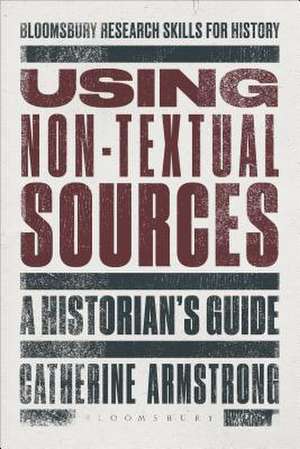
Using Non-Textual Sources: A Historian's Guide: Bloomsbury Research Skills for History
Autor Dr Catherine Armstrongen Limba Engleză Hardback – 17 dec 2015
There is coverage of the creation, production and distribution of non-textual sources; the acquisition of skills to 'read' these sources analytically; and the meaning, significance and reliability of these forms of evidence. Using Non-Textual Sources includes a section on interdisciplinary non-textual source work, outlining what historians borrow from disciplines such as art history, archaeology, geography and media studies, as well as a discussion of how to locate these resources online and elsewhere in order to use them in essays and dissertations.
Case studies, such as William Hogarth's print Gin Lane (1751), the 1939 John Ford Western Stagecoach and the Hereford Mappa Mundi, are employed throughout to illustrate the functions of main source types. Photographs, cartoons, maps, artwork, audio clips, film, places and artifacts are all explored in a text that provides students with a comprehensive, cohesive and practical guide to using non-textual sources.
Preț: 644.11 lei
Preț vechi: 852.78 lei
-24%
Puncte Express: 966
Carte tipărită la comandă
Livrare economică 09-23 noiembrie
Livrare prin curier în România Termenul estimat este afișat lângă disponibilitate.
Transport gratuit pentru acest produs Plată online sau ramburs, în funcție de opțiunile comenzii.
Retur gratuit în 14 zile Comandă securizată și suport în română.
Specificații
ISBN-13: 9781472505835
ISBN-10: 1472505832
Pagini: 160
Ilustrații: 20 bw illus
Dimensiuni: 156 x 234 x 11 mm
Greutate: 0.4 kg
Editura: Bloomsbury Publishing
Colecția Bloomsbury Academic
Seria Bloomsbury Research Skills for History
Locul publicării:London, United Kingdom
ISBN-10: 1472505832
Pagini: 160
Ilustrații: 20 bw illus
Dimensiuni: 156 x 234 x 11 mm
Greutate: 0.4 kg
Editura: Bloomsbury Publishing
Colecția Bloomsbury Academic
Seria Bloomsbury Research Skills for History
Locul publicării:London, United Kingdom
V-ar putea interesa
-
 Letter To An Unknown SoldierKate PullingerPreț: 111.94 lei
 -
 An Ordinary Man: The True Story Behind Hotel RwandaPaul Rusesabagina-28%Preț: 74.44 lei102.92 lei
 -
 Red AzaleaAnchee Min-27%Preț: 52.10 lei70.96 lei
 -
 Gringo LessonsBill WhaleyPreț: 207.58 lei
 -
 Titanic on TrialNic ComptonPreț: 71.64 lei
 -
 Exorcising Hitler: The Occupation and Denazification of GermanyFrederick Taylor-40%Preț: 88.42 lei148.09 lei
 -
 -18%Preț: 47.55 lei57.74 lei
 -
 The Vanishing Map: A Journey from LA to Tokyo to the Heart of EuropeDr Stephen Barber-38%Preț: 265.97 lei429.71 lei
Cuprins
Introduction \ 1. Borrowing from Other Disciplines \ 2. Reading Images \ 3. Audio/Film Sources \ 4. Material Culture and Historic Places \ 5. Practical Applications \ Postscript \ Glossary \ Further Reading \ Index
Recenzii
Armstrong's work is an excellent point of entry into material for the analysis of non-textual sources. Written by an enthusiastic historian, it will be of great use to students, but can also serve as an inspiration to other researchers.
Students eager to find a fresh way to study history should read this book. Written in a clear, accessible style, it applies essential cultural theory to a dazzling array of examples from many continents and periods, from pottery and portraits to films and interviews. One of Catherine Armstrong's outstanding qualities as a historian is that far from talking down to her readers she encourages them to join her on an exciting and surprising voyage of historical discovery. As such, this is both a useful handbook and an extended essay, fizzing with interest and enthusiasm, that one can read with pleasure from start to finish.
Armstrong's Using Non-Texual Sources is an ambitious, concise, clearly structured and lucidly written introduction to the use of visual, aural, and material sources for the writing of history. Based upon a broad and deep knowledge of the relevant interdisciplinary literatures, there is no comparable textbook available for undergraduate historical methods courses. Its intended audience will find a persuasive argument for why they should look beyond textual sources as well as a detailed guide to best-practices in their analysis of film, paintings, cartoons, music, film, and artefacts.
Students eager to find a fresh way to study history should read this book. Written in a clear, accessible style, it applies essential cultural theory to a dazzling array of examples from many continents and periods, from pottery and portraits to films and interviews. One of Catherine Armstrong's outstanding qualities as a historian is that far from talking down to her readers she encourages them to join her on an exciting and surprising voyage of historical discovery. As such, this is both a useful handbook and an extended essay, fizzing with interest and enthusiasm, that one can read with pleasure from start to finish.
Armstrong's Using Non-Texual Sources is an ambitious, concise, clearly structured and lucidly written introduction to the use of visual, aural, and material sources for the writing of history. Based upon a broad and deep knowledge of the relevant interdisciplinary literatures, there is no comparable textbook available for undergraduate historical methods courses. Its intended audience will find a persuasive argument for why they should look beyond textual sources as well as a detailed guide to best-practices in their analysis of film, paintings, cartoons, music, film, and artefacts.