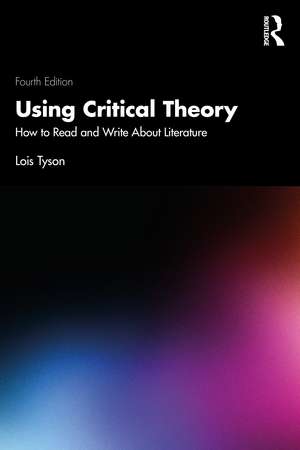
Using Critical Theory: How to Read and Write About Literature
Autor Lois Tysonen Limba Engleză Paperback – 25 mar 2026
Key features include:
• coverage of major theories including reader-response theory, New Criticism (formalism), psychoanalysis, Marxism, feminism, lesbian/gay/queer theories, African American theory, and postcolonial theory;
• practical demonstrations of how to use these theories to interpret short literary works selected from canonical authors including William Faulkner and Alice Walker;
• a chapter on reader-response theory that shows students how to use their personal responses to literature while avoiding typical pitfalls;
• sections on cultural criticism in each chapter that use our selected theories to interpret productions of popular culture; and
• sections on environmental issues (ecocriticism) in the introductory and closing chapters as well as in the chapters on psychoanalysis, Marxism, feminism, lesbian/gay/queer theories, African American theory, and postcolonial theory.
This new edition also includes updated and expanded theoretical vocabulary, basic concepts, and suggestions for further study as well as an expanded next-steps appendix that suggests additional literary works for extra practice. Comprehensive, easy to use, and fully updated throughout, Using Critical Theory is the ideal starting point for students beginning degrees in literature, composition, and cultural studies.
Preț: 395.05 lei
Puncte Express: 593
Carte disponibilă
Livrare economică 09-23 noiembrie
Livrare express 23-29 octombrie pentru 61.43 lei
Livrare prin curier în România Termenul estimat este afișat lângă disponibilitate.
Transport gratuit de la 400.00 lei Plată online sau ramburs, în funcție de opțiunile comenzii.
Retur gratuit în 14 zile Comandă securizată și suport în română.
Specificații
ISBN-13: 9781041122180
ISBN-10: 1041122187
Pagini: 570
Dimensiuni: 152 x 229 mm
Greutate: 1.05 kg
Ediția:4. Auflage
Editura: Taylor & Francis
Colecția Routledge
Locul publicării:Oxford, United Kingdom
ISBN-10: 1041122187
Pagini: 570
Dimensiuni: 152 x 229 mm
Greutate: 1.05 kg
Ediția:4. Auflage
Editura: Taylor & Francis
Colecția Routledge
Locul publicării:Oxford, United Kingdom
V-ar putea interesa
-
 The Orlando Furioso and Its PredecessorE. W. EdwardsPreț: 270.10 lei
 -
 La TouraineHenri GuerlinPreț: 260.98 lei
 -
 Dionysius SolomosRomilly JenkinsPreț: 330.91 lei
 -
 The Fowre HymnsEdmund SpenserPreț: 268.73 lei
 -
 The Traveller and the Deserted VillageOliver GoldsmithPreț: 266.78 lei
 -
 Stories from SpenserEdmund SpenserPreț: 285.88 lei
 -
 White Knights LibraryRobert Harding EvansPreț: 326.66 lei
 -
 The Works of Anna Laetitia Barbauld 2 Volume SetAnna Laetitia Barbauld-19%Preț: 677.99 lei837.03 lei
 -
 Preț: 177.17 lei
 -
 Madame EugenioChampfleuryPreț: 176.80 lei
 -
 Polyeucte, martyr, tragédie, annotée par M. GéruzezPierre CorneillePreț: 101.63 lei
 -
 Marie Stuart (Éd.1861)Friedrich von SchillerPreț: 145.45 lei
 -
 PulchériePierre CorneillePreț: 93.97 lei
 -
 Preț: 223.41 lei
 -
 Consuelo.Tome 3George SandPreț: 200.54 lei
 -
 Romans de Schiller.Volume 2Friedrich von SchillerPreț: 176.62 lei
 -
 Romans de Schiller.Volume 1Friedrich von SchillerPreț: 177.30 lei
 -
 La Comtesse de Monrion. 1epartie, La Lionne.Partie 2Frédéric SouliéPreț: 169.14 lei
 -
 Preț: 86.49 lei
 -
 Preț: 137.92 lei
 -
 Théâtres français. Oeuvres de Molière. Tome 1. Vie de Molière, par VoltaireJean-Baptiste Molière (Poquelin Dit)Preț: 161.94 lei
 -
 Oeuvres complètes de Jacques-Henri-Bernardin de Saint-Pierre. T. 1 Etudes de la natureHenri Bernardin De Saint-PierrePreț: 239.24 lei
 -
 Preț: 207.95 lei
 -
 Nouveau Tableau de Paris Au XIXe Siècle. Tome 6Sans AuteurPreț: 201.61 lei
 -
 Les buttes de Baville. Tome 1Georgette DucrestPreț: 162.43 lei
 -
 Les Buttes de Baville. Tome 2Georgette DucrestPreț: 169.73 lei
 -
 Preț: 79.99 lei
 -
 Critique Littéraire d'Un Poète Français, Par Un AnglaisArthur PonroyPreț: 82.11 lei
 -
 Preț: 199.70 lei
Public țintă
Undergraduate Advanced and Undergraduate CoreNotă biografică
Cuprins
1 Critical theory, cultural criticism, and the environment
What is critical theory, and what does it have to do with me?
Critical theory and cultural criticism
Critical theory and the environment
The basic principles of ecocriticism
An ecocritical reading of “I started Early—Took my Dog”
An ecocritical reading of “A White Heron”
An ecocritical reading of “Some keep the Sabbath going to Church”
Three questions about interpretation most students ask
My interpretation is my opinion, so how can it be wrong?
Do authos deliberately use concepts from critical theories when they write literary works?
How can we interpret a literary work without knowing what the author intended the work to mean?
Why feeling confused can be a good sign
Suggestions for further study
2 Using concepts from reader-response theory to understand our own literary interpretations
Why should we learn about reader-response theory?
Response vehicles
Identification-with-a-character
The familiar character
The familiar plot event
The familiar setting
Response exercise
Identification-with-a-character exercise
Familiar-character exercise
Familiar-plot-event exercise
How our personal responses can help or hinder interpretation
The "symbolic leap"
The difference between representing and endorsing human behavior
Using our personal responses to generate paper topics
Food for further thought
Thinking it over
Reader-response theory and cultural criticism
Taking the next step
Questions for further practice
Suggestions for further study
3 Using concepts from New Critical theory to understand literature
Why should we learn about New Critical theory?
Basic concepts
Theme
Formal elements
Unity
Close reading and textual evidence
Interpretation exercises
Appreciating the importance of tradition: Interpreting “Everyday Use”
Recognizing the presence of death: Interpreting “A Rose for Emily”
Understanding the power of alienation: Interpreting “The Battle Royal”
Respecting the importance of nonconformity: Interpreting “Don’t Explain”
Responding to the challenge of the unknown: Interpreting “I started Early—Took my Dog”
Food for further thought
Thinking it over
The limitations of New Critical theory for cultural criticism
Taking the next step
Questions for further practice
Suggestions for further study
4 Using concepts from psychoanalytic theory to understand literature
Why should we learn about psychoanalytic theory?
Basic concepts
The family
Repression and the unconscious
The defenses
Core issues
The meaning of death
The meaning of sexuality
Superego, id, ego
Dream symbolism
Interpretation exercises
Analyzing characters’ dysfunctional behavior: Interpreting “Everyday Use”
Exploring a character’s insanity: Interpreting “A Rose for Emily”
Understanding dream images in literature: Interpreting “I started Early—Took my Dog”
Recognizing a character’s self-healing: Interpreting “Don’t Explain”
Using psychoanalytic concepts in service of other theories: Interpreting “The Battle Royal”
Food for further thought
Thinking it over
Psychoanalytic theory and cultural criticism
A cultural analysis of Pretty Woman from a psychoanalytic perspective
Taking the next step
Questions for further practice
Suggestions for further study
5 Using concepts from Marxist theory to understand literature
Why should we learn about Marxist theory?
Basic concepts
Classism
Capitalism
Competition
Commodification
The American Dream
Rugged individualism
Consumerism
The role of religion
Interpretation exercises
Understanding the operations of capitalism: Interpreting “Everyday Use”
Recognizing the operations of the American Dream: Interpreting “The Battle Royal”
Analyzing the operations of classism: Interpreting“A Rose for Emily”
Resisting classism: Interpreting “Don’t Explain”
Learning when not to use Marxist concepts: Resisting the temptation to interpret “I started Early—Took my Dog”
Food for further thought
Thinking it over
Marxist theory and cultural criticism
Taking the next step
Questions for further practice
Suggestions for further study
6 Using concepts from feminist theory to understand literature
Why should we learn about feminist theory?
Basic concepts
Patriarchy
Traditional gender roles
The cult of “true womanhood”
The objectification of women: “good girls” and “bad girls”
Sexism
Everyday sexism
Phallocentrism and phallogocentrism
Intersectionality
White feminism
Multicultural feminism
The four waves of feminism
Interpretation exercises
Rejecting the objectification of women: Interpreting “The Battle Royal”
Resisting patriarchal ideology: Interpreting “Don’t Explain”
Recognizing a conflicted attitude toward patriarchy: Interpreting “Everyday Use”
Analyzing a sexist text: Interpreting “A Rose for Emily”
Understanding patriarchy’s psychological oppression of women: Interpreting “I started Early—Took my Dog”
Food for further thought
Thinking it over
Feminist theory and cultural criticism
Feminist theory and the environment
Taking the next step
Questions for further practice
Suggestions for further study
7 Using concepts from lesbian, gay, and queer theories to understand literature
Why should we learn about lesbian, gay, and queer theories?
Basic concepts
Heteronormativity
Heterosexism and heteropatriarchy
Homophobia and lesbophobia
Bisexual people, monosexism, and biphobia
Nonbinary people
Transgender people and the prefix cis
Transphobia
Queerphobia
Homosocial bonding
The woman-identified woman
Homoerotic imagery
Queer theory
Interpretation exercises
Rejecting lesbian stereotypes: Interpreting “Don’t Explain”
Analyzing homophobia: Interpreting “The Battle Royal”
Recognizing the woman-identified woman in a heterosexual text: Interpreting “Everyday Use”
Using queer theory: Interpreting “A Rose for Emily”
Drawing upon context: Interpreting “I started Early—Took my Dog”
Food for further thought
Thinking it over
Lesbian, gay, and queer theories and cultural criticism
Queer theory and the environment
Taking the next step
Questions for further practice
Suggestions for further study
8 Using concepts from African American theory to understand literature
Why should we learn about African American theory?
Basic concepts
African American culture and the African American literary tradition
Racism
Institutionalized racism (systemic racism)
Environmental racism
Everyday racism (casual racism)
Internalized racism
Intraracial racism (colorism)
White privilege
Double consciousness
Interpretation exercises
Analyzing the overt operations of institutionalized racism: Interpreting “The Battle Royal”
Recognizing the “less visible” operations of institutionalized racism: Interpreting “Don’t Explain”
Understanding the operations of internalized racism: Interpreting “Everyday Use”
Exploring the function of black characters in white literature: Interpreting “A Rose for Emily”
Learning when not to use African American concepts: Resisting the temptation to interpret “I started Early—Took my Dog”
Food for further thought
Thinking it over
African American theory and cultural criticism
African American theory and the environment
Taking the next step
Questions for further practice
Suggestions for further study
9 Using concepts from postcolonial theory to understand literature
Why should we learn about postcolonial theory?
Basic concepts
Colonialist ideology
Othering
Subalterns
The dominant culture
The colonial subject
Mimicry
Unhomeliness
Hybridity
Anticolonialist resistance
Interpretation exercises
Understanding colonialist ideology: Interpreting “The Battle Royal”
Analyzing the colonial subject: Interpreting “Everyday Use”
Exploring the influence of cultural stereotypes: Interpreting “A Rose for Emily”
Appreciating anticolonialist resistance: Interpreting “Don’t Explain”
Recognizing the othering of nature: Interpreting “I started Early—Took my Dog”
Food for further thought
Thinking it over
Postcolonial theory and cultural criticism
Postcolonial theory and the environment
Taking the next step
Questions for further practice
Suggestions for further study
10 Holding on to what you’ve learned
A shorthand overview of our critical theories
A shorthand overview of our literary interpretation exercises
“Everyday Use”
“The Battle Royal”
“A Rose for Emily”
“Don’t Explain”
“I started Early—Took my Dog”
A shorthand overview of our sample readings
Pretty Woman
Waiting to Exhale
Philadelphia
“Opie’s Girlfriend”
“The Brother of the Bride”
“A White Heron”
“Some keep the Sabbath going to Church”
“I started Early—Took my Dog”
“Queer Earth”
“Greeting from the Moon, the Sacrificial Side”
“Map”
A shorthand overview of the range of perspectives offered by each theory
Reader-response concepts
New Critical concepts
Psychoanalytic concepts
Marxist concepts
Feminist concepts
Lesbian, gay, and queer concepts
African American concepts
Postcolonial concepts
Critical theory and cultural criticism revisited
Television game shows
A situation comedy
Critical theory and the environment revisited
Critical theory and an ethics for a diverse world
Appendix A: “I started Early—Took my Dog” (Emily Dickinson, c. 1862)
Appendix B: “A White Heron” (Sarah Orne Jewett, 1886)
Appendix C: “A Rose for Emily” (William Faulkner, 1931)
Appendix D: “The Battle Royal” (Ralph Ellison, 1952)
Appendix E: “Everyday Use” (Alice Walker, 1973)
Appendix F: “Don’t Explain” (Jewelle Gomez, 1987)
Appendix G: Additional literary works for further practice
Index
What is critical theory, and what does it have to do with me?
Critical theory and cultural criticism
Critical theory and the environment
The basic principles of ecocriticism
An ecocritical reading of “I started Early—Took my Dog”
An ecocritical reading of “A White Heron”
An ecocritical reading of “Some keep the Sabbath going to Church”
Three questions about interpretation most students ask
My interpretation is my opinion, so how can it be wrong?
Do authos deliberately use concepts from critical theories when they write literary works?
How can we interpret a literary work without knowing what the author intended the work to mean?
Why feeling confused can be a good sign
Suggestions for further study
2 Using concepts from reader-response theory to understand our own literary interpretations
Why should we learn about reader-response theory?
Response vehicles
Identification-with-a-character
The familiar character
The familiar plot event
The familiar setting
Response exercise
Identification-with-a-character exercise
Familiar-character exercise
Familiar-plot-event exercise
How our personal responses can help or hinder interpretation
The "symbolic leap"
The difference between representing and endorsing human behavior
Using our personal responses to generate paper topics
Food for further thought
Thinking it over
Reader-response theory and cultural criticism
Taking the next step
Questions for further practice
Suggestions for further study
3 Using concepts from New Critical theory to understand literature
Why should we learn about New Critical theory?
Basic concepts
Theme
Formal elements
Unity
Close reading and textual evidence
Interpretation exercises
Appreciating the importance of tradition: Interpreting “Everyday Use”
Recognizing the presence of death: Interpreting “A Rose for Emily”
Understanding the power of alienation: Interpreting “The Battle Royal”
Respecting the importance of nonconformity: Interpreting “Don’t Explain”
Responding to the challenge of the unknown: Interpreting “I started Early—Took my Dog”
Food for further thought
Thinking it over
The limitations of New Critical theory for cultural criticism
Taking the next step
Questions for further practice
Suggestions for further study
4 Using concepts from psychoanalytic theory to understand literature
Why should we learn about psychoanalytic theory?
Basic concepts
The family
Repression and the unconscious
The defenses
Core issues
The meaning of death
The meaning of sexuality
Superego, id, ego
Dream symbolism
Interpretation exercises
Analyzing characters’ dysfunctional behavior: Interpreting “Everyday Use”
Exploring a character’s insanity: Interpreting “A Rose for Emily”
Understanding dream images in literature: Interpreting “I started Early—Took my Dog”
Recognizing a character’s self-healing: Interpreting “Don’t Explain”
Using psychoanalytic concepts in service of other theories: Interpreting “The Battle Royal”
Food for further thought
Thinking it over
Psychoanalytic theory and cultural criticism
A cultural analysis of Pretty Woman from a psychoanalytic perspective
Taking the next step
Questions for further practice
Suggestions for further study
5 Using concepts from Marxist theory to understand literature
Why should we learn about Marxist theory?
Basic concepts
Classism
Capitalism
Competition
Commodification
The American Dream
Rugged individualism
Consumerism
The role of religion
Interpretation exercises
Understanding the operations of capitalism: Interpreting “Everyday Use”
Recognizing the operations of the American Dream: Interpreting “The Battle Royal”
Analyzing the operations of classism: Interpreting“A Rose for Emily”
Resisting classism: Interpreting “Don’t Explain”
Learning when not to use Marxist concepts: Resisting the temptation to interpret “I started Early—Took my Dog”
Food for further thought
Thinking it over
Marxist theory and cultural criticism
Taking the next step
Questions for further practice
Suggestions for further study
6 Using concepts from feminist theory to understand literature
Why should we learn about feminist theory?
Basic concepts
Patriarchy
Traditional gender roles
The cult of “true womanhood”
The objectification of women: “good girls” and “bad girls”
Sexism
Everyday sexism
Phallocentrism and phallogocentrism
Intersectionality
White feminism
Multicultural feminism
The four waves of feminism
Interpretation exercises
Rejecting the objectification of women: Interpreting “The Battle Royal”
Resisting patriarchal ideology: Interpreting “Don’t Explain”
Recognizing a conflicted attitude toward patriarchy: Interpreting “Everyday Use”
Analyzing a sexist text: Interpreting “A Rose for Emily”
Understanding patriarchy’s psychological oppression of women: Interpreting “I started Early—Took my Dog”
Food for further thought
Thinking it over
Feminist theory and cultural criticism
Feminist theory and the environment
Taking the next step
Questions for further practice
Suggestions for further study
7 Using concepts from lesbian, gay, and queer theories to understand literature
Why should we learn about lesbian, gay, and queer theories?
Basic concepts
Heteronormativity
Heterosexism and heteropatriarchy
Homophobia and lesbophobia
Bisexual people, monosexism, and biphobia
Nonbinary people
Transgender people and the prefix cis
Transphobia
Queerphobia
Homosocial bonding
The woman-identified woman
Homoerotic imagery
Queer theory
Interpretation exercises
Rejecting lesbian stereotypes: Interpreting “Don’t Explain”
Analyzing homophobia: Interpreting “The Battle Royal”
Recognizing the woman-identified woman in a heterosexual text: Interpreting “Everyday Use”
Using queer theory: Interpreting “A Rose for Emily”
Drawing upon context: Interpreting “I started Early—Took my Dog”
Food for further thought
Thinking it over
Lesbian, gay, and queer theories and cultural criticism
Queer theory and the environment
Taking the next step
Questions for further practice
Suggestions for further study
8 Using concepts from African American theory to understand literature
Why should we learn about African American theory?
Basic concepts
African American culture and the African American literary tradition
Racism
Institutionalized racism (systemic racism)
Environmental racism
Everyday racism (casual racism)
Internalized racism
Intraracial racism (colorism)
White privilege
Double consciousness
Interpretation exercises
Analyzing the overt operations of institutionalized racism: Interpreting “The Battle Royal”
Recognizing the “less visible” operations of institutionalized racism: Interpreting “Don’t Explain”
Understanding the operations of internalized racism: Interpreting “Everyday Use”
Exploring the function of black characters in white literature: Interpreting “A Rose for Emily”
Learning when not to use African American concepts: Resisting the temptation to interpret “I started Early—Took my Dog”
Food for further thought
Thinking it over
African American theory and cultural criticism
African American theory and the environment
Taking the next step
Questions for further practice
Suggestions for further study
9 Using concepts from postcolonial theory to understand literature
Why should we learn about postcolonial theory?
Basic concepts
Colonialist ideology
Othering
Subalterns
The dominant culture
The colonial subject
Mimicry
Unhomeliness
Hybridity
Anticolonialist resistance
Interpretation exercises
Understanding colonialist ideology: Interpreting “The Battle Royal”
Analyzing the colonial subject: Interpreting “Everyday Use”
Exploring the influence of cultural stereotypes: Interpreting “A Rose for Emily”
Appreciating anticolonialist resistance: Interpreting “Don’t Explain”
Recognizing the othering of nature: Interpreting “I started Early—Took my Dog”
Food for further thought
Thinking it over
Postcolonial theory and cultural criticism
Postcolonial theory and the environment
Taking the next step
Questions for further practice
Suggestions for further study
10 Holding on to what you’ve learned
A shorthand overview of our critical theories
A shorthand overview of our literary interpretation exercises
“Everyday Use”
“The Battle Royal”
“A Rose for Emily”
“Don’t Explain”
“I started Early—Took my Dog”
A shorthand overview of our sample readings
Pretty Woman
Waiting to Exhale
Philadelphia
“Opie’s Girlfriend”
“The Brother of the Bride”
“A White Heron”
“Some keep the Sabbath going to Church”
“I started Early—Took my Dog”
“Queer Earth”
“Greeting from the Moon, the Sacrificial Side”
“Map”
A shorthand overview of the range of perspectives offered by each theory
Reader-response concepts
New Critical concepts
Psychoanalytic concepts
Marxist concepts
Feminist concepts
Lesbian, gay, and queer concepts
African American concepts
Postcolonial concepts
Critical theory and cultural criticism revisited
Television game shows
A situation comedy
Critical theory and the environment revisited
Critical theory and an ethics for a diverse world
Appendix A: “I started Early—Took my Dog” (Emily Dickinson, c. 1862)
Appendix B: “A White Heron” (Sarah Orne Jewett, 1886)
Appendix C: “A Rose for Emily” (William Faulkner, 1931)
Appendix D: “The Battle Royal” (Ralph Ellison, 1952)
Appendix E: “Everyday Use” (Alice Walker, 1973)
Appendix F: “Don’t Explain” (Jewelle Gomez, 1987)
Appendix G: Additional literary works for further practice
Index