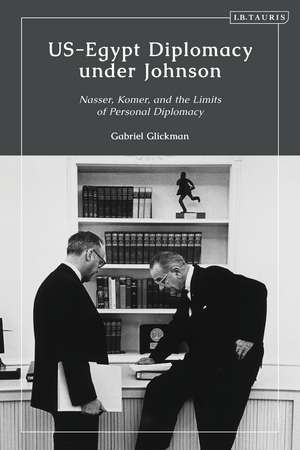
US-Egypt Diplomacy under Johnson: Nasser, Komer, and the Limits of Personal Diplomacy
Autor Gabriel Glickmanen Limba Engleză Paperback – 25 aug 2022
Among these officials was a driven National Security Council staffer named Robert Komer, who had made it his personal mission to have the United States form better relations with Egypt's Gamal Abdel Nasser after diplomatic relations were nearly severed during the Eisenhower years. While Kennedy saw the benefit of having good, personal relations with the most influential leader in the Middle East-believing that it was the key to preventing a new front in the global Cold War-Johnson did not share his predecessor's enthusiasm for influencing Nasser with aid.
In US-Egypt Diplomacy under Johnson, Glickman brings to light the diplomatic efforts of Komer, a masterful strategist at navigating the bureaucratic process. Appealing to scholars of Middle Eastern history and US foreign policy, the book reveals a new perspective on the path to a war that was to change the face of the Middle East, and provides an important "applied history" case study for policymakers on the limits of personal diplomacy.
Preț: 219.30 lei
Preț vechi: 293.91 lei
-25%
Puncte Express: 329
Carte tipărită la comandă
Livrare economică 23 noiembrie-07 decembrie
Livrare prin curier în România Termenul estimat este afișat lângă disponibilitate.
Transport gratuit de la 400.00 lei Plată online sau ramburs, în funcție de opțiunile comenzii.
Retur gratuit în 14 zile Comandă securizată și suport în română.
Specificații
ISBN-13: 9780755639946
ISBN-10: 0755639944
Pagini: 296
Dimensiuni: 156 x 234 x 26 mm
Greutate: 0.44 kg
Editura: Bloomsbury Publishing
Colecția I.B.Tauris
Locul publicării:London, United Kingdom
ISBN-10: 0755639944
Pagini: 296
Dimensiuni: 156 x 234 x 26 mm
Greutate: 0.44 kg
Editura: Bloomsbury Publishing
Colecția I.B.Tauris
Locul publicării:London, United Kingdom
Cuprins
PART 1: AFTER KENNEDY (NOVEMBER 1963-JUNE 1964)
1. Prologue: Kennedy's Men
2. Komer's War
3. Nasser's New Frontier
4. Weapons and Bases
5. Enter Britain
6. Badeau's Final Mission
PART II: AFTER BADEAU (JUNE 1964-MARCH 1966)
7. Starting Over With/In Cairo
8. Two Summits
9. Communication Breakdown
10. Congress Reacts
11. Komer's Gamble
12. Johnson's Reluctance
13. Rusk Takes Over
14. The $37 Million
15. Another Long Summer
16. Komer's Final Campaign
17. Sadat's Visit
PART III: AFTER KOMER (MARCH 1966-MAY 1967)
18. Johnson's Men
19. A New Policy
20. Nasser's Last Stand
21. Cold Shoulders
22. U.S.-Egyptian Relations Unbound
23. Epilogue: Applied History
1. Prologue: Kennedy's Men
2. Komer's War
3. Nasser's New Frontier
4. Weapons and Bases
5. Enter Britain
6. Badeau's Final Mission
PART II: AFTER BADEAU (JUNE 1964-MARCH 1966)
7. Starting Over With/In Cairo
8. Two Summits
9. Communication Breakdown
10. Congress Reacts
11. Komer's Gamble
12. Johnson's Reluctance
13. Rusk Takes Over
14. The $37 Million
15. Another Long Summer
16. Komer's Final Campaign
17. Sadat's Visit
PART III: AFTER KOMER (MARCH 1966-MAY 1967)
18. Johnson's Men
19. A New Policy
20. Nasser's Last Stand
21. Cold Shoulders
22. U.S.-Egyptian Relations Unbound
23. Epilogue: Applied History
Recenzii
"US-Egypt Diplomacy under Johnson is a well-researched and significant book which chronicles and analyzes how one government official, Robert Komer, shaped American-Egyptian diplomatic relations. For Komer, a grand strategy meant working with Nasser - in spite of ideological differences - to contain Soviet influence in the Middle East. This book is a must read for anyone wishing to understand how one individual greatly influenced diplomacy between Washington and Cairo from the Kennedy Administration to the Johnson Administration."
Gabriel Glickman has written an illuminating history of U.S.-Egyptian diplomacy in the LBJ era. It's an account of world affairs, grand strategy, strong personalities, bureaucratic fancy footwork, idealism, calculation, lies and naiveté. Especially fascinating is the story of how Egypt's Nasser condemned the United States in justifying his actions that brought on the 1967 Six Days War with Israel. Were Nasser's complaints about U.S. policy a substantial factor in Egypt's war policy, or mostly a pretext? Could the United States have averted the war by giving more aid to Egypt? These are worthy questions, and Professor Glickman's book contributes importantly to the debate.
Gabriel Glickman has written an illuminating history of U.S.-Egyptian diplomacy in the LBJ era. It's an account of world affairs, grand strategy, strong personalities, bureaucratic fancy footwork, idealism, calculation, lies and naiveté. Especially fascinating is the story of how Egypt's Nasser condemned the United States in justifying his actions that brought on the 1967 Six Days War with Israel. Were Nasser's complaints about U.S. policy a substantial factor in Egypt's war policy, or mostly a pretext? Could the United States have averted the war by giving more aid to Egypt? These are worthy questions, and Professor Glickman's book contributes importantly to the debate.
Notă biografică
Gabriel Glickman is an Associate Fellow at Bar-Ilan University's Begin-Sadat Center for Strategic Studies. His research is focused on history and international relations. His writing has appeared in publications such as The Washington Post, The National Interest, The Jerusalem Post, and The Hill.