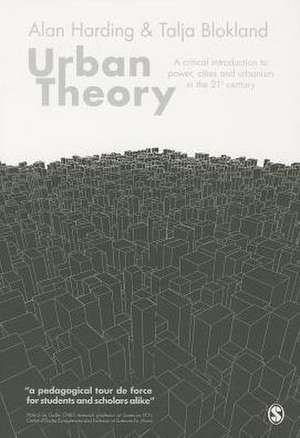
Urban Theory
Autor Alan Harding, Talja Bloklanden Limba Engleză Hardback – 16 mai 2014
- Relations between urban theory and modernity in key ideas of the Chicago School, spatial analysis, humanistic urban geography, and ‘radical' approaches like Marxism
- Cities and the transition to informational economies, globalization, urban growth machine and urban regime theory, the city as an “actor”
- Spatial expressions of inequality and key ideas like segregation, ghettoization, suburbanization, gentrification
- Socio-cultural spatial expressions of difference and key concepts like gender, sexuality, race, ethnicity and “culturalist” perspectives on identity, lifestyle, subculture
- How cities should be understood as intersections of horizontal and vertical – of coinciding resources, positions, locations, influencing how we make and understand urban experiences.
Preț: 1120.40 lei
Preț vechi: 1366.34 lei
-18%
Puncte Express: 1681
Carte tipărită la comandă
Livrare economică 23 noiembrie-07 decembrie
Livrare prin curier în România Termenul estimat este afișat lângă disponibilitate.
Transport gratuit pentru acest produs Plată online sau ramburs, în funcție de opțiunile comenzii.
Retur gratuit în 14 zile Comandă securizată și suport în română.
Specificații
ISBN-13: 9781446294512
ISBN-10: 144629451X
Pagini: 314
Ilustrații: black & white halftones
Dimensiuni: 175 x 250 x 21 mm
Greutate: 0.68 kg
Ediția:1
Editura: SAGE Publications Ltd
Locul publicării:London, United Kingdom
ISBN-10: 144629451X
Pagini: 314
Ilustrații: black & white halftones
Dimensiuni: 175 x 250 x 21 mm
Greutate: 0.68 kg
Ediția:1
Editura: SAGE Publications Ltd
Locul publicării:London, United Kingdom
V-ar putea interesa
-
 AerotropolisJohn KasardaPreț: 125.06 lei
 -
 Preț: 403.80 lei
 -
 Shoes Were For SundayMolly Weir-21%Preț: 60.77 lei77.13 lei
 -
 Preț: 303.45 lei
 -
 Urban EcologyKevin J. GastonPreț: 448.44 lei
 -
 Urban Political GeographiesUgo Rossi-15%Preț: 628.52 lei739.43 lei
 -
 Urban ResidenceChristien Klaufus-23%Preț: 764.35 lei992.66 lei
 -
 Cities in American Political HistoryRichard Dilworth-27%Preț: 1175.39 lei1610.12 lei
 -
 The SAGE Companion to the CityTim Hall-18%Preț: 796.11 lei970.87 lei
 -
 Spaces for ConsumptionSteven Miles-15%Preț: 617.02 lei725.91 lei
 -
 Cultures and GlobalizationHelmut K. Anheier-18%Preț: 941.88 lei1148.64 lei
 -
 Community as Urban PracticeTalja BloklandPreț: 147.70 lei
 -
 -44%Preț: 109.61 lei196.21 lei
 -
 Prayer in the City: The Making of Muslim Sacred Places and Urban LifePatrick A. Desplat-23%Preț: 252.88 lei329.14 lei
Recenzii
Just when we need it most, urban theory seems to be failing us. This book explains why we need it.
Harding and Blokland address the vaunted “crisis” in urban theory with a thoughtful assessment of extant theories in terms of performance, commensurability, and critical engagement. In a conversational and lively tone, they view theories of inequality, public space, identity, power, agency, and culture through the lens of “relaxed urban theory.” Excellent overview for scholars and engaging classroom material.
Inspired by Peter Saunders’s non-spatial urban thinking, Harding and Blokland’s book provides a provocative, wide-ranging and comprehensive treatment of concepts geared to understand cities, and is a compulsory addition to any urban student’s intellectual arsenal in a period of renewed interest in urban theory.
Urban theory is said to be in a mess. Proceeding with great analytical clarity, this book introduces a relaxed definition of urban theory that enables the reader to make sense of the non-linear, variegated world of urban theory as it has developed over time and through the application of different disciplines, methods and epistemologies. In reviewing all the major conceptualisations of urban theory, Harding and Blokland provide clear insights into recent developments and the controversies and critiques they have provoked. The book is a pedagogical tour de force for students and scholars alike.
Harding and Blokland address the vaunted “crisis” in urban theory with a thoughtful assessment of extant theories in terms of performance, commensurability, and critical engagement. In a conversational and lively tone, they view theories of inequality, public space, identity, power, agency, and culture through the lens of “relaxed urban theory.” Excellent overview for scholars and engaging classroom material.
Inspired by Peter Saunders’s non-spatial urban thinking, Harding and Blokland’s book provides a provocative, wide-ranging and comprehensive treatment of concepts geared to understand cities, and is a compulsory addition to any urban student’s intellectual arsenal in a period of renewed interest in urban theory.
Urban theory is said to be in a mess. Proceeding with great analytical clarity, this book introduces a relaxed definition of urban theory that enables the reader to make sense of the non-linear, variegated world of urban theory as it has developed over time and through the application of different disciplines, methods and epistemologies. In reviewing all the major conceptualisations of urban theory, Harding and Blokland provide clear insights into recent developments and the controversies and critiques they have provoked. The book is a pedagogical tour de force for students and scholars alike.
Cuprins
1. WHAT IS URBAN THEORY?
Urban Studies and Urban Theory
What is Urban?
What is Theory?
And So What on Earth is Urban Theory?
2. URBAN THEORIES UNDER CONDITIONS OF MODERNITY
The Chicago School and Urban Ecology
Urban Geography and Spatial Analysis
The Community Power Debate
Humanistic (Urban) Geography
‘Radical' Approaches
The Legacy of Previous Theories and Their Challenges
3. FROM THE URBAN CRISIS TO THE ‘TRIUMPH OF THE CITY’
Cities as Actors in a Globalising Economy
Urban Decline and Obsolescence
Urban Economic Renaissance
Discussion
4. CAN CITIES ACT? URBAN POLITICAL ECONOMY AND THE QUESTION OF AGENCY
The Rediscovery of Agency Within Urban Theory
Introducing American Urban Political Economy
Urban Regimes and Growth Machines
The Normative Dimension
Critiques and Applications
5. SPATIAL EXPRESSIONS OF INTRA-URBAN INEQUALITIES
Inequalities Versus Differentiations: Vertical and Horizontal Paradigms
Cities as Sites of Resources: Space and Inequalities
Segregation
Suburbanization
Gentrification
Ghettoization as a Spatial Process of Marginalization
Neighbourhood Effects: Spatial Profit and Disadvantage
6. SPATIAL EXPRESSION OF DIFFERENTIATION
The Cultural Turn
The City as a Realm of Community and Lifestyle
The Subcultural Thesis
The Representational City: Public Space
Cultural Diversity: Identities in Public Space
Conclusion: Cities as Matrix of Resources
7. URBAN THEORY RECONSIDERED
The 'Crisis' in Urban Theory Revisited
The Performance of Theories
The Commensurability of Theories
Theory, Politics and Practice
A New Urban Agenda?
Urban Studies and Urban Theory
What is Urban?
What is Theory?
And So What on Earth is Urban Theory?
2. URBAN THEORIES UNDER CONDITIONS OF MODERNITY
The Chicago School and Urban Ecology
Urban Geography and Spatial Analysis
The Community Power Debate
Humanistic (Urban) Geography
‘Radical' Approaches
The Legacy of Previous Theories and Their Challenges
3. FROM THE URBAN CRISIS TO THE ‘TRIUMPH OF THE CITY’
Cities as Actors in a Globalising Economy
Urban Decline and Obsolescence
Urban Economic Renaissance
Discussion
4. CAN CITIES ACT? URBAN POLITICAL ECONOMY AND THE QUESTION OF AGENCY
The Rediscovery of Agency Within Urban Theory
Introducing American Urban Political Economy
Urban Regimes and Growth Machines
The Normative Dimension
Critiques and Applications
5. SPATIAL EXPRESSIONS OF INTRA-URBAN INEQUALITIES
Inequalities Versus Differentiations: Vertical and Horizontal Paradigms
Cities as Sites of Resources: Space and Inequalities
Segregation
Suburbanization
Gentrification
Ghettoization as a Spatial Process of Marginalization
Neighbourhood Effects: Spatial Profit and Disadvantage
6. SPATIAL EXPRESSION OF DIFFERENTIATION
The Cultural Turn
The City as a Realm of Community and Lifestyle
The Subcultural Thesis
The Representational City: Public Space
Cultural Diversity: Identities in Public Space
Conclusion: Cities as Matrix of Resources
7. URBAN THEORY RECONSIDERED
The 'Crisis' in Urban Theory Revisited
The Performance of Theories
The Commensurability of Theories
Theory, Politics and Practice
A New Urban Agenda?
Descriere
This interdisciplinary introduction to urban theory explains how the concepts that help us understand the contemporary urban experience have developed and been applied. It discusses a wide range of work - within political science, economics, geography and sociology. Reviewing the core issues in urban theory, the authors demonstrate different ways of understanding urban inequalities and social justice for all students and researchers of the city.
Notă biografică
Alan Harding is Professor of Public Policy and Director of the Heseltine Institute for Public Policy and Practice at the University of Liverpool Management School in the UK. Previously, he held posts at Manchester, Salford and Liverpool John Moores universities. His research interests are in urban and regional development, governance and policy and he has acted as an advisor on these issues for a wide range of leading agencies with interests in this field.