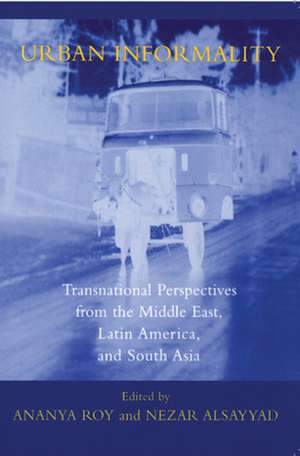
Urban Informality: Transnational Perspectives from the Middle East, Latin America, and South Asia: Transnational Perspectives on Space and Place
Editat de Ananya Roy, Nezar Alsayyad Contribuţii de Asef Bayat, Ray Bromley, Alan Gilbert, Arif Hasan, Janice E. Perlman, Ahmed M. Soliman, Peter M. Ward, Haim Yakobi, Oren Yiftachelen Limba Engleză Paperback – 19 noi 2003
Analiza proceselor de liberalizare și globalizare din capitolul „Liberalization, Globalization, and Urban Informality” stabilește premisa centrală a acestui volum: informalitatea nu este o anomalie a dezvoltării, ci un sistem complex de norme care guvernează utilizarea spațiului urban modern. Credem că relevanța acestei lucrări rezidă în capacitatea sa de a demonstra cum locuințele informale au încetat să fie exclusiv domeniul săracilor, devenind active strategice pentru elitele transnaționale și clasa medie. Această perspectivă transformă radical înțelegerea planificării urbane contemporane.
Reținem structura ambițioasă a cărții, care facilitează un dialog rar între regiuni geografice disparate — Orientul Mijlociu, America Latină și Asia de Sud. De la studiile de caz despre transformarea favelas-urilor din Rio între 1969 și 2002, până la analiza „orașului domnilor” în Calcutta sub noul comunism, volumul oferă o rigoare empirică remarcabilă. Urban Informality este comparabil cu Informality and the City în rigurozitate, dar este actualizat pentru dinamica puterii politice și sociale care redefinește granițele dintre formal și informal în secolul XXI.
În contextul operei editorului Ananya Roy, volumul se aliniază preocupărilor din Territories of Poverty, provocând geografiile convenționale Nord-Sud. Dacă în Encountering Poverty – Thinking and Acting in an Unequal World accentul cădea pe privilegiul care susține pauperizarea, aici accentul este pus pe modul în care informalitatea devine un instrument de control și rezistență. Recomandăm această lectură pentru modul în care reușește să „interogheze transnațional” interfața urban-rural și mecanismele de excludere specifice etnocrației urbane.

Preț: 338.89 lei
Preț vechi: 436.97 lei
-22%
Carte tipărită la comandă
Livrare economică 08-22 decembrie
Specificații
ISBN-10: 0739107410
Pagini: 346
Dimensiuni: 148 x 228 x 24 mm
Greutate: 0.45 kg
Ediția:New.
Editura: Bloomsbury Publishing
Colecția Lexington Books
Seria Transnational Perspectives on Space and Place
Locul publicării:New York, United States
V-ar putea interesa
-
 Preț: 370.66 lei
 -
 Global Urban PoliticsJulie-Anne BoudreauPreț: 162.60 lei
 -
 Preț: 420.20 lei
 -
 -8%Preț: 450.18 lei489.33 lei
 -
 Preț: 387.50 lei
 -
 Comparative Urbanism - Tactics for Global Urban StudiesJennifer RobinsonPreț: 178.51 lei
 -
 -22%Preț: 196.01 lei250.39 lei
 -
 -33%Preț: 550.78 lei816.08 lei
 -
 Urban GeographyAndrew E. G. JonasPreț: 264.91 lei
 -
 Messy CitiesZahra EbrahimPreț: 129.40 lei
 -
 Planet of SlumsMike DavisPreț: 77.86 lei
 -
 Preț: 127.04 lei
 -
 The Homegrown CityMatias EchanovePreț: 152.63 lei
 -
 Urban InformalityAhmed M. SolimanPreț: 387.03 lei
 -
 Informal Market Worlds: ReaderPeter MörtenböeckPreț: 268.51 lei
 -
 The Spatial Logic of Informal UrbanismKim DoveyPreț: 336.97 lei
De ce să citești această carte
Recomandăm această carte profesioniștilor din urbanism și cercetătorilor care doresc să depășească viziunea simplistă asupra așezărilor informale ca fiind simple „probleme” sociale. Cititorul câștigă o înțelegere profundă a modului în care globalizarea restructurează orașele din Sudul Global, transformând informalitatea într-o nouă formă de exercitare a puterii politice. Este un instrument esențial pentru a înțelege dinamica actuală a marilor metropole precum Cairo, Karachi sau Rio de Janeiro.
Despre autor
Ananya Roy este profesor de planificare urbană și bunăstare socială la UCLA și director al Institutului pentru Inegalitate și Democrație. Expertiza sa se concentrează pe analize critice ale sărăciei și urbanismului în context global. Nezar Alsayyad, profesor de arhitectură și planificare la UC Berkeley, completează această viziune prin vasta sa experiență în studiile Orientului Mijlociu. Împreună, cei doi editori au curatoriat o lucrare fundamentală care reflectă intersecția dintre politică, cultură și spațiu construit, integrând contribuții ale unor cercetători de prestigiu internațional.
Descriere
Cuprins
Recenzii
The spread of urban informality is the most significant trend shaping the space and time of our 21st century world. This book is the finest collection of scholarly essays I know on this phenomenon. It should be mandatory reading for courses on urbanization and on development studies.
The book presents a rich view of 'urban informality' as a system of regulation and norms that governs the use of space and makes possible new forms of social and political power. The editors are well experienced in teaching town planning and the book will be found very useful reading by the town planners, developers, and other government and local self-government officials.