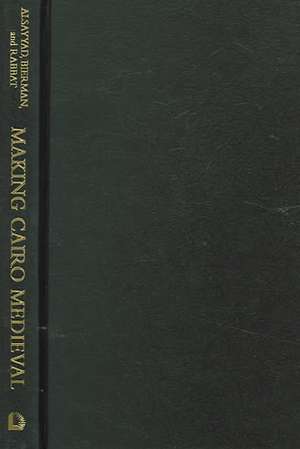
Making Cairo Medieval: Transnational Perspectives on Space and Place
Editat de Nezar Alsayyad, Irene A. Bierman, Nasser Rabbat Contribuţii de Heba Farouk Ahmed, Khaled Fahmy, Derek Gregory, Nairy Hampikian, May al-Ibrashy, Donald Preziosi, Caroline Williamsen Limba Engleză Hardback – 25 mar 2005
Preț: 505.84 lei
Preț vechi: 722.12 lei
-30%
Puncte Express: 759
Carte tipărită la comandă
Livrare economică 08-22 decembrie
Livrare prin curier în România Termenul estimat este afișat lângă disponibilitate.
Transport gratuit pentru acest produs Plată online sau ramburs, în funcție de opțiunile comenzii.
Retur gratuit în 14 zile Comandă securizată și suport în română.
Specificații
ISBN-13: 9780739109151
ISBN-10: 0739109154
Pagini: 272
Dimensiuni: 158 x 236 x 22 mm
Greutate: 0.54 kg
Ediția:New.
Editura: Bloomsbury Publishing
Colecția Lexington Books
Seria Transnational Perspectives on Space and Place
Locul publicării:New York, United States
ISBN-10: 0739109154
Pagini: 272
Dimensiuni: 158 x 236 x 22 mm
Greutate: 0.54 kg
Ediția:New.
Editura: Bloomsbury Publishing
Colecția Lexington Books
Seria Transnational Perspectives on Space and Place
Locul publicării:New York, United States
V-ar putea interesa
-
 Cleopatra: A BiographyDuane W. Roller-17%Preț: 90.69 lei109.32 lei
 -
 Libya since 1969D. VandewallePreț: 290.55 lei
 -
 The Making of Modern South AfricaNigel WordenPreț: 288.73 lei
 -
 Warfare in African HistoryRichard J. ReidPreț: 211.81 lei
 -
 Explorers of the NileTim JealPreț: 109.43 lei
 -
 CleopatraStacy Schiff-18%Preț: 99.53 lei121.72 lei
 -
 Summoned from the MarginLamin SannehPreț: 200.04 lei
 -
 K. O. MbadiweHollis R LynchPreț: 390.09 lei
 -
 The Lion Sleeps at NightRian Malan-19%Preț: 102.74 lei126.15 lei
 -
 -26%Preț: 68.68 lei92.66 lei
 -
 -20%Preț: 95.48 lei119.96 lei
Cuprins
Chapter 1 Prologue: The Project of Making Cairo Medieval
Part 2 A Medieval City for a Modern World
Chapter 3 Disciplining the Eye: Perceiving Medieval Cairo
Chapter 4 The Medieval Link: Maqrizi's Khitat and Modern Narratives of Cairo
Chapter 5 'Ali Mubarark's Egypt: Between the Testimony of 'Alamuddin and the Imaginary of the Khitat
Part 6 Representing and Narrating
Chapter 7 Performing Cairo: Orientalism and the City of the Arabian Nights
Chapter 8 Nineteenth-Century Images of Cairo: From the Real to the Interpretive
Chapter 9 The Museum of What You Shall Have Been
Part 10 Disciplining and Making
Chapter 11 Nineteenth-Century Cairo: A Dual City?
Chapter 12 Modernizing Cairo: A Revisionist Narrative
Chapter 13 Medievalization of the Old City as an Ingredient of Cairo's Modernization: Case Study of Bab Zuwayla
Chapter 14 The Cemeteries of Cairo and the Comité de Conservation
Part 2 A Medieval City for a Modern World
Chapter 3 Disciplining the Eye: Perceiving Medieval Cairo
Chapter 4 The Medieval Link: Maqrizi's Khitat and Modern Narratives of Cairo
Chapter 5 'Ali Mubarark's Egypt: Between the Testimony of 'Alamuddin and the Imaginary of the Khitat
Part 6 Representing and Narrating
Chapter 7 Performing Cairo: Orientalism and the City of the Arabian Nights
Chapter 8 Nineteenth-Century Images of Cairo: From the Real to the Interpretive
Chapter 9 The Museum of What You Shall Have Been
Part 10 Disciplining and Making
Chapter 11 Nineteenth-Century Cairo: A Dual City?
Chapter 12 Modernizing Cairo: A Revisionist Narrative
Chapter 13 Medievalization of the Old City as an Ingredient of Cairo's Modernization: Case Study of Bab Zuwayla
Chapter 14 The Cemeteries of Cairo and the Comité de Conservation
Recenzii
Making Cairo Medieval will fascinate any scholar who cares about cities, their histories, their transformations, and efforts to control them. It was French specialists and amateurs at the 1867 Paris Exposition who first designated a specific area as 'Islamic Cairo,' though Cairenes soon became active agents. While historic preservation was the ostensible goal, artistic classifications, historical knowledge, cultural hierarchies, urban design, property ownership, tourism, and colonial power all played a role, giving a distinct orientalist tone to the enterprise. The essays offer an illuminating variety of perspectives on the cultural, architectural, political, economic, and intellectual intentions and effects of this immense, ongoing urban project.
Typically, scholarship of the urban development of Cairo has emphasized the dichotomy between its 'medieval' and it's 'modern' quarters, with little critical analysis about how this notion of a dual city came about, and the impacts of this treatment on both perceptions of Cairo and on its subsequent development. Through the work of ten scholars, Making Cairo Medieval examines the idea of a 'medieval Cairo'-a concept developed in the nineteenth century by people who were essentially outsiders to the historic quarters of the city, yet whose ideas of refashioning such neighborhoods to create a 'medievalized' Cairo continue to affect the policies governing these quarters of the city today.. To readers with more than a passing interest in the urban history of the city, Making Cairo Medieval is a good re-assessment of frameworks too often taken for granted.. The book is valuable in pointing out how deceptive an orchestrated (though seemingly natural) process of urban change can be.
The Egyptian, American, and European-based contributors to Making Cairo Medieval offer a fresh perspective on an early instance of what has come to be known as the heritage industry. The book balances textual analyses with on-the-ground case studies to shed light on various aspects of this complex transformation.
Making Cairo Medieval offers an exciting reappraisal of how and why the city was refashioned in the modern era. Exploring the ways this urban transformation was engineered, portrayed, fought over, and experienced, the book brilliantly illuminates the recent past of the Arab world's great metropolis.
Typically, scholarship of the urban development of Cairo has emphasized the dichotomy between its 'medieval' and it's 'modern' quarters, with little critical analysis about how this notion of a dual city came about, and the impacts of this treatment on both perceptions of Cairo and on its subsequent development. Through the work of ten scholars, Making Cairo Medieval examines the idea of a 'medieval Cairo'-a concept developed in the nineteenth century by people who were essentially outsiders to the historic quarters of the city, yet whose ideas of refashioning such neighborhoods to create a 'medievalized' Cairo continue to affect the policies governing these quarters of the city today.. To readers with more than a passing interest in the urban history of the city, Making Cairo Medieval is a good re-assessment of frameworks too often taken for granted.. The book is valuable in pointing out how deceptive an orchestrated (though seemingly natural) process of urban change can be.
The Egyptian, American, and European-based contributors to Making Cairo Medieval offer a fresh perspective on an early instance of what has come to be known as the heritage industry. The book balances textual analyses with on-the-ground case studies to shed light on various aspects of this complex transformation.
Making Cairo Medieval offers an exciting reappraisal of how and why the city was refashioned in the modern era. Exploring the ways this urban transformation was engineered, portrayed, fought over, and experienced, the book brilliantly illuminates the recent past of the Arab world's great metropolis.