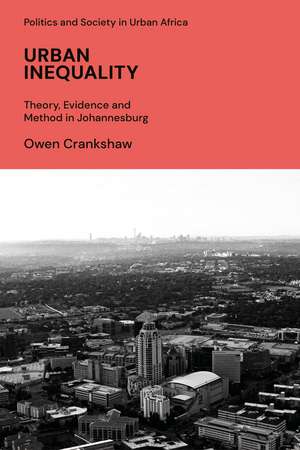
Urban Inequality: Theory, Evidence and Method in Johannesburg: Politics and Society in Urban Africa
Autor Owen Crankshawen Limba Engleză Paperback – 24 aug 2023
Central to this examination is that the social polarisation hypothesis, which is accepted by many, is simply wrong in the case of Johannesburg. Ultimately, Crankshaw posits that the post-Fordist, post-apartheid period is characterised by a completely new division of labour that has caused new forms of racial inequality. That racial inequality in the post-apartheid period is not the result of the persistence of apartheid-era causes, but is the result of new causes that have interacted with the historical effects of apartheid to produce new patterns of racial inequality.

Preț: 197.36 lei
Preț vechi: 270.16 lei
-27%
Puncte Express: 296
Carte tipărită la comandă
Livrare economică 08-22 iunie
Specificații
ISBN-13: 9781786998958
ISBN-10: 1786998955
Pagini: 232
Dimensiuni: 154 x 232 x 16 mm
Greutate: 0.36 kg
Editura: Bloomsbury Publishing
Colecția Zed Books
Seria Politics and Society in Urban Africa
Locul publicării:London, United Kingdom
ISBN-10: 1786998955
Pagini: 232
Dimensiuni: 154 x 232 x 16 mm
Greutate: 0.36 kg
Editura: Bloomsbury Publishing
Colecția Zed Books
Seria Politics and Society in Urban Africa
Locul publicării:London, United Kingdom
Cuprins
Acknowledgements
List of Figures
List of Tables
Introduction:
1.Theories of Urban Inequality
Part One: De-Industrialisation and the Labour Market
2.The Changing Occupational Structure: Social Polarisation or Professionalisation?
3.Professionalisation, Unemployment and Racial Inequality
Part Two: From a Fordist to a Post-Fordist Spatial Order
4.Johannesburg's Fordist Spatial Order
5.The Edge City of Sandton
6.From Racial Ghetto to Excluded Ghetto: Soweto, Eldorado Park and Lenasia
7.Racial Residential Desegregation in White Neighbourhoods
Conclusion
8.Urban Inequality
References
List of Figures
List of Tables
Introduction:
1.Theories of Urban Inequality
Part One: De-Industrialisation and the Labour Market
2.The Changing Occupational Structure: Social Polarisation or Professionalisation?
3.Professionalisation, Unemployment and Racial Inequality
Part Two: From a Fordist to a Post-Fordist Spatial Order
4.Johannesburg's Fordist Spatial Order
5.The Edge City of Sandton
6.From Racial Ghetto to Excluded Ghetto: Soweto, Eldorado Park and Lenasia
7.Racial Residential Desegregation in White Neighbourhoods
Conclusion
8.Urban Inequality
References
Recenzii
This detailed study of urban inequality in Johannesburg provides a rigorous examination of the links between de-industrialisation, occupational change, residential segregation and the housing market. It highlights the way in which race and the legacy of the South African apartheid state intersect with changes in the structure of the labour market over a 40 year period from 1970-2011 to change the structure of urban inequality. It is an invaluable source which links to wider international debates about urban social polarisation, professionalization and the post-Fordist city. A 'must read' for all students of African cities.