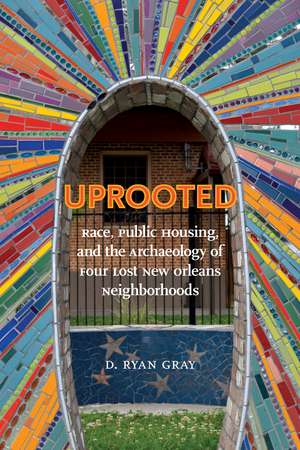
Uprooted: Race, Public Housing, and the Archaeology of Four Lost New Orleans Neighborhoods: Archaeology of the American South: New Directions and Perspectives
Autor D. Ryan Grayen Limba Engleză Hardback – 11 feb 2020
Observăm în lucrarea Uprooted o schimbare de paradigmă în arheologia urbană americană, autorul D. Ryan Gray propunând o investigație asupra a patru cartiere din New Orleans care au fost șterse de pe hartă pentru a face loc proiectelor de locuințe sociale în timpul celui de-al Doilea Război Mondial. Găsim în această carte o documentare metodică a modului în care eticheta de „mahala” a fost folosită ca instrument politic pentru a justifica demolările, în timp ce dovezile arheologice scot la iveală comunități vibrante și strategii complexe de supraviețuire. Analiza lui Gray demonstrează că selecția acestor zone nu a fost întâmplătoare, ci a vizat spații unde interacțiunile dintre rasă, clasă și gen sfidau normele rigide ale segregării Jim Crow.
Structura narativă a cărții, publicată în seria Archaeology of the American South: New Directions and Perspectives, integrează date materiale cu surse documentare inedite, precum celebrele „Blue Books” din Storyville, oferind o perspectivă micro-istorică asupra gospodăriilor afectate. Descoperim aici că segregarea nu a fost un proces pasiv, ci unul activ de control urban prin arhitectură și politici publice. Această lucrare acoperă o arie tematică similară cu Segregation Made Them Neighbors de William A. White, III, dar cu o abordare mult mai ancorată în politicile specifice ale sudului american și în impactul pe care aceste decizii istorice îl au asupra orașului New Orleans post-Katrina. Tonul este unul academic și analitic, evitând generalizările și concentrându-se pe modul în care arheologia poate recupera demnitatea unor populații marginalizate, oferind în același timp un cadru critic pentru dezbaterile contemporane despre urbanism și echitate socială.






Preț: 399.53 lei
Carte disponibilă
Livrare economică 06-20 noiembrie
Livrare express 22-28 octombrie pentru 37.61 lei
Specificații
ISBN-10: 0817320474
Pagini: 256
Ilustrații: 34 B&W figures - 4 tables
Dimensiuni: 152 x 229 x 30 mm
Greutate: 0.51 kg
Ediția:First Edition
Editura: University Of Alabama Press
Colecția University Alabama Press
Seria Archaeology of the American South: New Directions and Perspectives
De ce să citești această carte
Recomandăm această carte specialiștilor în arheologie istorică și sociologie urbană care doresc să înțeleagă rădăcinile segregării în orașele americane. Cititorul câștigă o perspectivă documentată despre cum politicile locative pot fi folosite ca instrumente de control rasial și social. Este o lectură esențială pentru a înțelege contextul istoric al New Orleans-ului contemporan, oferind dovezi concrete despre reziliența comunităților care au refuzat să fie reduse la simplul statut de „locuitori ai mahalalei”.
Despre autor
D. Ryan Gray este un cercetător și autor specializat în arheologia istorică a mediului urban, cu un interes marcat pentru dinamica socială a orașului New Orleans. Lucrările sale se concentrează pe intersecția dintre cultura materială, documentele istorice și politicile de clasă și rasă în sudul Statelor Unite. Prin cercetările sale, Gray aduce la lumină istoriile ascunse ale comunităților marginalizate, contribuind semnificativ la seria Archaeology of the American South: New Directions and Perspectives publicată de University Of Alabama Press. Expertiza sa îmbină rigoarea analizei arheologice cu o înțelegere profundă a contextului sociopolitic american.
Descriere scurtă
Uprooted: Race, Public Housing, and the Archaeology of Four Lost New Orleans Neighborhoods uses archaeological research on four neighborhoods that were razed during the construction of public housing in World War II–era New Orleans. Although each of these neighborhoods was identified as a “slum” historically, the material record challenges the simplicity of this designation. D. Ryan Gray provides evidence of the inventiveness of former residents who were marginalized by class, color, or gender and whose everyday strategies of survival, subsistence, and spirituality challenged the city’s developing racial and social hierarchies.
These neighborhoods initially appear to have been quite distinct, ranging from the working-class Irish Channel, to the relatively affluent Creole of Color–dominated Lafitte area, to the former location of Storyville, the city’s experiment in semilegal prostitution. Archaeological and historical investigations suggest that race was the crucial factor in the areas’ selection for clearance. Each neighborhood manifested a particular perceived racial disorder, where race intersected with ethnicity, class, or gender in ways that defied the norms of Jim Crow segregation.
Gray’s research makes use of both primary documents—including census records, city directories, and even the brothel advertising guides called “Blue Books”—and archaeological data to examine what this entailed at a variety of scales, reconstructing narratives of the households and communities affected by clearance. Public housing, both in New Orleans and elsewhere, imposed a new kind of control on urban life that had the effect of making cities both more segregated and less equal. The story of the neighborhoods that were destroyed provides a reminder that their erasure was not an inevitable outcome, and that a more equitable and just city is still possible today. A critical examination of the rise of public housing helps inform the ongoing debates over its demise, especially in light of the changing face of post-Katrina New Orleans.
Notă biografică
Recenzii
— Paul R. Mullins, author of The Archaeology of Consumer Culture
“This is a good book and readers with specific interest in New Orleans history will find much to intrigue them. Readers with wider interests in the realities of urban renewal, the insertion of racial preconceptions in urban design, and the intricate relationships between heritage, history, and ‘progress’ will also be rewarded.”
—Heritage and Society
“This book would be a great read for those interested in the histories and narratives of marginalized communities. Gray’s book successfully connects the past and present, calling to question the real intentions
of public housing redevelopment.”
—Southeastern Archaeology