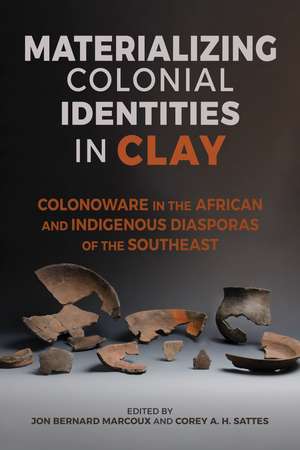
Materializing Colonial Identities in Clay: Colonoware in the African and Indigenous Diasporas of the Southeast: Archaeology of the American South: New Directions and Perspectives
Editat de Jon Bernard Marcoux, Corey A. H. Sattes Contribuţii de Andrew Agha, Ronald W. Anthony, Jodi A. Barnes, David J. Cranford, Katherine P. Gill, J. W. Joseph, Julia A. King, Sarah E. Platt, Craig T. Sheldon, Jr., Scott M. Strickland, Martha A. Zierdenen Limba Engleză Paperback – 30 apr 2024
In Materializing Colonial Identities in Clay, Jon Bernard Marcoux, Corey A. H. Sattes, and contributors examine colonoware to explore the active roles that African Americans and Indigenous people played in constructing southern colonial culture and part of their shared history with Europeans.
Colonoware was most likely produced by African and Indigenous potters and used by all colonial groups for cooking, serving, and storing food. It formed the foundation of colonial foodways in many settlements across the southeastern United States. Even so, compared with other ceramics from this period, less has been understood about its production and use because of the lack of documentation. This collection of essays fills this gap with valuable, recent archaeological data from which much may be surmised about the interaction among Europeans, Indigenous, and Africans, especially within the contexts of the African and Indigenous slave trade and plantation systems.
The chapters represent the full range of colonoware research: from the beginning to the end of its production, from urban to rural contexts, and from its intraregional variation in the Lowcountry to the broad patterns of colonialism across the early American Southeast. The book summarizes current approaches in colonoware research and how these may bridge the gaps between broader colonial American studies, Indigenous studies, and African Diaspora studies.
A concluding discussion contextualizes the chapters through the perspectives of intersectionality and Black feminist theory, drawing attention to the gendered and racialized meanings embodied in colonoware, and considering how colonialism and slavery have shaped these cultural dimensions and archaeologists’ study of them.







Preț: 266.29 lei
Puncte Express: 399
Carte disponibilă
Livrare economică 09-23 noiembrie
Livrare express 23-29 octombrie pentru 29.48 lei
Livrare prin curier în România Termenul estimat este afișat lângă disponibilitate.
Transport gratuit de la 400.00 lei Plată online sau ramburs, în funcție de opțiunile comenzii.
Retur gratuit în 14 zile Comandă securizată și suport în română.
Specificații
ISBN-13: 9780817361464
ISBN-10: 0817361464
Pagini: 296
Ilustrații: 33 B&W figures - 9 maps
Dimensiuni: 152 x 229 x 25 mm
Greutate: 0.45 kg
Editura: University Of Alabama Press
Colecția University Alabama Press
Seria Archaeology of the American South: New Directions and Perspectives
ISBN-10: 0817361464
Pagini: 296
Ilustrații: 33 B&W figures - 9 maps
Dimensiuni: 152 x 229 x 25 mm
Greutate: 0.45 kg
Editura: University Of Alabama Press
Colecția University Alabama Press
Seria Archaeology of the American South: New Directions and Perspectives
Notă biografică
Jon Bernard Marcoux is the director of the joint Graduate Program in Historic Preservation at Clemson University. He is author of Pox, Empire, Shackles, and Hides: The Townsend Site, 1670–1715, and The Cherokees of Tuckaleechee Cove.
Corey A. H. Sattes is an adjunct professor of anthropology at the College of Charleston.
Corey A. H. Sattes is an adjunct professor of anthropology at the College of Charleston.
Cuprins
Illustrations
Acknowledgments
A Note on Terminology
Introduction
Corey A. H. Sattes and Jon Bernard Marcoux
Part I: Colonoware as a Materialization of Social Relationships
Chapter 1. Using Indigenous Colonoware to Trace Social Coalescence across the Early Colonial Landscape of the Southeastern United States
Jon Bernard Marcoux and Corey A. H. Sattes
Chapter 2. Colonoware among the Upper Creeks of Alabama
Craig T. Sheldon Jr.
Chapter 3. Colonoware in the Rappahannock River Valley of Virginia, ca. 1665–17800
Julia A. King, Katherine P. Gill, and Scott M. Strickland
Chapter 4. Pottery and Property: Redefining Colonoware through Seventeenth-Century Social Relations
Andrew Agha
Part II. Colonoware as a Materialization of Economic Relationships in the Lowcountry
Chapter 5. Colonoware in the City: Archaeological Assemblages from Charleston, South Carolina
Martha A. Zierden, Ronald W. Anthony, and Sarah E. Platt
Chapter 6. Colonoware, Craftwork, and the Rise of Black Artisan Potters
J. W. Joseph
Chapter 7. Catawba Contributions to South Carolina Colonoware
David J. Cranford
Chapter 8. Colonoware Variation, Exchange, and Use from Drayton Hall’s South Flanker Well
Corey A. H. Sattes
Commentary: Situating Colonoware at the Intersections
Jodi A. Barnes
Appendix: Colonoware Vessels and Sherds and Major Associations among the Upper Creeks of Alabama
References Cited
Contributors
Index
Acknowledgments
A Note on Terminology
Introduction
Corey A. H. Sattes and Jon Bernard Marcoux
Part I: Colonoware as a Materialization of Social Relationships
Chapter 1. Using Indigenous Colonoware to Trace Social Coalescence across the Early Colonial Landscape of the Southeastern United States
Jon Bernard Marcoux and Corey A. H. Sattes
Chapter 2. Colonoware among the Upper Creeks of Alabama
Craig T. Sheldon Jr.
Chapter 3. Colonoware in the Rappahannock River Valley of Virginia, ca. 1665–17800
Julia A. King, Katherine P. Gill, and Scott M. Strickland
Chapter 4. Pottery and Property: Redefining Colonoware through Seventeenth-Century Social Relations
Andrew Agha
Part II. Colonoware as a Materialization of Economic Relationships in the Lowcountry
Chapter 5. Colonoware in the City: Archaeological Assemblages from Charleston, South Carolina
Martha A. Zierden, Ronald W. Anthony, and Sarah E. Platt
Chapter 6. Colonoware, Craftwork, and the Rise of Black Artisan Potters
J. W. Joseph
Chapter 7. Catawba Contributions to South Carolina Colonoware
David J. Cranford
Chapter 8. Colonoware Variation, Exchange, and Use from Drayton Hall’s South Flanker Well
Corey A. H. Sattes
Commentary: Situating Colonoware at the Intersections
Jodi A. Barnes
Appendix: Colonoware Vessels and Sherds and Major Associations among the Upper Creeks of Alabama
References Cited
Contributors
Index
Recenzii
“Materializing Colonial Identities in Clay speaks to the diverse historical contexts and material forms of colonoware and highlights the ways in which colonoware was used by all peoples of the Southeast in ongoing cultural negotiations. The multisited approach taken by many authors is absolutely essential in moving forward our understanding of colonoware, colonialism, and its legacies.” —Barbara Heath, author of Hidden Lives: The Archaeology of Slave Life at Thomas Jefferson’s Poplar Forest
“Much more than a book about pottery, this volume employs colonoware as a tool for exploring the complex cultural negotiations taking place in the historic Southeast. This volume deftly weaves together the many threads of colonoware research to date, offering new models for material culture analyses in such contexts. An insightful work of this kind has been long overdue.”—Lindsay Bloch, editor of Southeastern Archaeology
“This volume is a significant contribution to the growing field of colonoware studies.”—American Antiquity
“Much more than a book about pottery, this volume employs colonoware as a tool for exploring the complex cultural negotiations taking place in the historic Southeast. This volume deftly weaves together the many threads of colonoware research to date, offering new models for material culture analyses in such contexts. An insightful work of this kind has been long overdue.”—Lindsay Bloch, editor of Southeastern Archaeology
“This volume is a significant contribution to the growing field of colonoware studies.”—American Antiquity
Descriere
Materializing Colonial Identities in Clay is a groundbreaking interdisciplinary volume that uncovers how colonoware—hand‑built pottery created primarily by African and Indigenous potters—actively shaped the cultural landscape of the early American Southeast. Drawing on new archaeological evidence, Jon Bernard Marcoux, Corey A. H. Sattes, and contributors illuminate the ways African Americans, Indigenous communities, and Europeans interacted through craft, foodways, and daily practice. The essays trace colonoware across urban and rural contexts, plantation systems, and trade networks, revealing how this humble ceramic tradition both reflected and transformed relationships amid enslavement, colonization, and cultural exchange. With perspectives informed by Indigenous studies, African Diaspora studies, and Black feminist theory, this volume reframes colonoware as a rich archive of identity, endurance, and resistance.