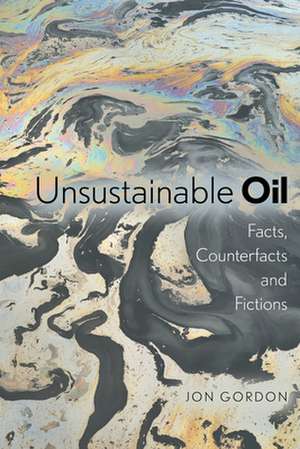
Unsustainable Oil: Facts, Counterfacts and Fictions
Autor Jon Gordonen Limba Engleză Paperback – 8 dec 2015
Observăm în Unsustainable Oil o abordare riguroasă a modului în care industria energetică modelează nu doar economia, ci și imaginarul colectiv. Autorul Jon Gordon, deși cunoscut în spațiul nord-american pentru lucrările sale despre leadership și dinamica echipelor, își extinde aici expertiza didactică și de analiză a culturii organizaționale către o critică interdisciplinară a „petroculturii”. Lucrarea fundamentează o teză curajoasă: literatura și ficțiunea nu sunt simple evadări, ci instrumente esențiale pentru a înțelege criza ecologică și pentru a genera alternative creative în afara status quo-ului creșterii economice cu orice preț.
Remarcăm o structură progresivă, organizată în șase capitole dense, care pornesc de la „retorica nesustenabilă” și ajung la analiza „dorințelor petroliere”. Cartea acoperă aceeași arie tematică precum Oil Culture de Ross Barrett, însă Jon Gordon se distanțează printr-o focalizare specifică pe nisipurile bituminoase din Alberta și pe conceptul de „fapte poetice contrafactuale”. În timp ce alte lucrări din domeniu rămân în sfera analizei socio-politice, această ediție apărută la University of Alberta Press investighează modul în care metafora și auto-amăgirea devin componente structurale ale unei națiuni dependente de bitum.
În contextul operei sale anterioare, unde titluri precum The Coffee Bean sau The Sale se concentrau pe transformarea individuală și succesul profesional, Unsustainable Oil reprezintă o ramificație academică surprinzătoare. Autorul aplică rigoarea cercetării literare pentru a demonta mecanismele prin care critica este transformată în consimțământ, oferind o lectură esențială pentru cei interesați de intersecția dintre ecologie, etică și studii culturale.
Preț: 274.78 lei
Preț vechi: 329.47 lei
-17%
Carte disponibilă
Livrare economică 18 mai-01 iunie
Specificații
ISBN-10: 1772120367
Pagini: 288
Ilustrații: 12
Dimensiuni: 152 x 229 x 19 mm
Greutate: 0.44 kg
Editura: University of Alberta Press
Colecția University of Alberta Press
Locul publicării:Edmonton, Canada
V-ar putea interesa
-
 Nancy CunardLois GordonPreț: 209.38 lei
 -
 Preț: 125.97 lei
 -
 The No Complaining RuleJon GordonPreț: 127.39 lei
 -
 Edmund Wilson: Centennial ReflectionsLewis M. DabneyPreț: 388.33 lei
 -
 F.W. Harvey: Soldier, PoetAnthony BodenPreț: 126.42 lei
 -
 Empire of Language – Toward a Critique of (Post)colonial ExpressionLaurent Dubreuil-23%Preț: 447.79 lei581.54 lei
 -
 Solzhenitsyn's Traditional ImaginationJames M CurtisPreț: 186.52 lei
 -
 The Achievement of William StyronRobert K. MorrisPreț: 246.83 lei
 -
 The Aesthetics of PowerClaire KeyesPreț: 225.16 lei
 -
 Literary SymbiosisDavid CowartPreț: 198.20 lei
 -
 Life WordJon GordonPreț: 107.97 lei
 -
 The Power of a Positive TeamJon GordonPreț: 138.37 lei
 -
 How to Be a Coffee BeanJon GordonPreț: 113.59 lei
 -
 William Trevor (Routledge Revivals): A Study of His FictionGregory A Schirmer-18%Preț: 1194.14 lei1456.26 lei
 -
 James Merrill: Knowing InnocenceReena Sastri-15%Preț: 401.99 lei472.93 lei
 -
 -35%Preț: 362.49 lei561.39 lei
 -
 -19%Preț: 675.58 lei834.04 lei
 -
 Born Under AuschwitzMary Cosgrove-19%Preț: 678.80 lei838.02 lei
 -
 -19%Preț: 675.58 lei834.04 lei
 -
 Conversations with Maxine Hong KingstonPaul SkenazyPreț: 230.49 lei
 -
 A Companion to Mario Vargas LlosaSabine Köllmann-23%Preț: 700.03 lei909.13 lei
 -
 Marie NDiayeShirley Jordan-8%Preț: 538.04 lei584.83 lei
De ce să citești această carte
Această carte este indispensabilă cercetătorilor din domeniul științelor umaniste și mediului, oferind o perspectivă critică asupra dependenței noastre culturale de combustibilii fosili. Cititorul câștigă o înțelegere profundă a modului în care literatura poate servi drept contra-discurs la retorica industrială, deschizând calea către un viitor sustenabil. Este o resursă valoroasă pentru cursuri de etică, studii canadiene și critică literară ecologică.
Despre autor
Jon O. Gordon este un autor și orator american, recunoscut la nivel internațional pentru expertiza sa în leadership, cultură organizațională și performanță. Licențiat în ecologie umană la Cornell University și deținător al unui Master în pedagogie de la Emory University, Gordon a colaborat cu organizații de prestigiu precum Los Angeles Dodgers și universități americane de top. Deși este celebru pentru volume motivaționale precum „The Energy Bus”, în Unsustainable Oil își folosește fundalul academic pentru a analiza critic relația dintre cultură și extracția resurselor naturale, aducând o perspectivă pedagogică unică asupra crizei ecologice contemporane.
Descriere
Comentariile autorului
Cuprins
Recenzii
"[Gordon] proposes that we turn to works of literature (plays, poetry, short stories) as a means of re-imagining the narratives that we tell ourselves about our embeddedness in petroculture.... [He demonstrates] that literature performs not only a necessary diagnostic function (namely, to articulate the environmental and social costs of our dependence on bitumen), but also a vital prognostic function, through which we can begin to restore our understanding of the intimate relations between humans and their environment, and our hope for a post-bitumen future". Canadian Literature, Spring/Summer 2016. [Full review at https://canlit.ca/article/creativecollective-resistance]
Gordon’s agenda is to short-circuit the extremely polarized debate between team oil and team environment by bringing into play not facts and counterfacts alone but the power of narrative, storytelling, theatre, theory, even poetry.... The book is theoretically astute, Gordon’s writing throughout is crystal clear and elegant, and his analysis of texts insightful: this book is an exhilarating and beautiful read. The Goose 2017: Vol. 16 : Iss. 1, Article 4. [Full review at: http://scholars.wlu.ca/thegoose/vol16/iss1/4]
"Unsustainable Oil deserves to be read alongside other excoriations of Alberta's great speculative game, such as Tar Sands: Dirty Oil and the Future of a Continent (2008) by Canadian journalist Andrew Nikiforuk, and studies in the emergent field of petrocriticism, such as Stephanie LeMenager's Living Oil: Petroleum Culture in the American Century (2014). Oil, with its climate consequences, is a defining environmental concern of our age: it has found an impassioned critic in Jon Gordon." , Western American Literature 52.2, 2017
"At the heart of Gordon’s analysis is the argument that literature performs a ‘downward counterfactual function’—that is to say, that it exposes the grim realities of bitumen extraction—but that in doing so, it also reaffirms the possibilities for other types of futures…. Environmental work is difficult work. It is difficult because of the ways it often conflicts with and runs up against corporate and/or academic interests, and difficult because it must engage with a crisis whose effects are both currently unfolding and as of yet unforetold. Both Unsustainable Oil: Facts, Counterfacts, and Fictions and Sustaining the West: Cultural Responses to Canadian Environments take on this challenging work, and in doing so, demonstrate that a rich critical and creative network of humanities-based artists and critics is integral to both eco-critical conversation and ecological action.” Lucia Lorenzi, Canadian Literature, March 2017