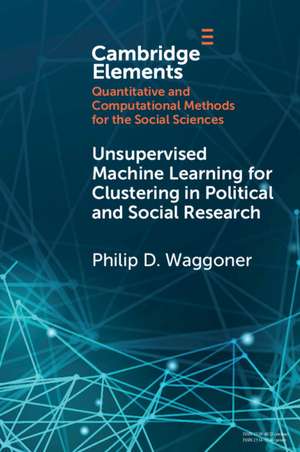
Unsupervised Machine Learning for Clustering in Political and Social Research: Elements in Quantitative and Computational Methods for the Social Sciences
Autor Philip D. Waggoneren Limba Engleză Paperback – 27 ian 2021





Preț: 129.09 lei
Nou
Puncte Express: 194
Preț estimativ în valută:
22.84€ • 26.82$ • 20.05£
22.84€ • 26.82$ • 20.05£
Carte disponibilă
Livrare economică 06-20 ianuarie 26
Livrare express 23-27 decembrie pentru 14.63 lei
Preluare comenzi: 021 569.72.76
Specificații
ISBN-13: 9781108793384
ISBN-10: 110879338X
Pagini: 75
Dimensiuni: 230 x 150 x 5 mm
Greutate: 0.1 kg
Editura: Cambridge University Press
Colecția Cambridge University Press
Seria Elements in Quantitative and Computational Methods for the Social Sciences
Locul publicării:New York, United States
ISBN-10: 110879338X
Pagini: 75
Dimensiuni: 230 x 150 x 5 mm
Greutate: 0.1 kg
Editura: Cambridge University Press
Colecția Cambridge University Press
Seria Elements in Quantitative and Computational Methods for the Social Sciences
Locul publicării:New York, United States
Cuprins
1. Introduction; 2. Setting the stage for clustering; 3. Agglomerative hierarchical clustering; 4. k-means clustering; 5. Gaussian mixture models; 6. Advanced methods; 7. Conclusion.
Descriere
Offers researchers and teachers an introduction to clustering, with R code and real data to facilitate interaction with the concepts.